| 25th November | |
| Ofcom rejects complaints about EastEnders stabbing
| From broadcastnow.co.uk
|
An EastEnders episode that featured a violent stabbing was acceptable for a pre-watershed audience, Ofcom has ruled.
The TV censor has rejected 45 complaints that an episode of the BBC1 soap broadcast on 28 August was too violent.
The episode featured the death of ex-football hooligan Jase Dyer, who was stabbed in the chest by his former gang leader Terry Bates.
The BBC itself received 134 complaints from viewers but defended the scenes on the grounds that the violence was implied rather than explicit.
|
| 26th June | |
| David Currie steps down at Ofcom
| From Ofcom
|
Ofcom have announced that David Currie will step down as Chairman of the Ofcom Board after Easter 2009. David was named in July 2002 as the inaugural Chairman of the then new regulator for the communications sector and has been instrumental, during two
terms as Chairman, in guiding Ofcom through its formative years and establishing the strong censorial reputation that Ofcom has built within the sector. The process to appoint his successor, which is an appointment by the Department for Culture,
Media and Sport and the Department for Business, Enterprise and Regulatory Reform, has begun and the intention is to advertise for the role of Chairman in September 2008.
|
| 24th June | | |
Ofcom whinge at the burial alive in EastEnders
| Based on article from the
BBC
|
An EastEnders storyline which involved a live burial has been ruled "offensive" by Ofcom.
The TV censor received 116 complaints from viewers who thought the scenes, featuring character Max Branning, were "unsuitable" for the
time of broadcast.
The BBC said the storyline, aired in March, was crafted in a "responsible manner" and took into account any pre-watershed audience "sensitivity". But Ofcom has ruled that the BBC was in breach of its rules.
'The BBC noted that the two episodes involved "no explicit violence" and the lead up to the burial scenes were "carefully paced with several indications of the direction of the storyline offered". However, the Corporation
admitted more than 600 complaints had been made following two pre-watershed episodes which saw Branning drugged, put into a coffin and buried alive by his wife, Tanya.
Ofcom said the scenes of the burial alive had a seriously disturbing
element to them. Overall the storyline and its treatment had more in common with a dark psychological thriller than a pre-watershed drama. Further, in our view, the information supplied at the start of the programmes did not adequately prepare viewers
for the extent of the distressing scenes that followed. For the reasons already stated the scenes of Max being buried alive were offensive and not justified by the context.
|
| 13th June | | |
Channel 4 regularly cut the Simpsons
| Thanks to Andrew
|
In regards to the complaints about the use of "wankers" x2 on the Simpsons, not sure how this slipped through, as Channel 4 regularly cut this show. On quite a few occasions "GAY" comments have been removed, (homer drives by
Lenny and Carl shouting about something incomprehensible, Lenny asks Carl what Homer said, Carl replies with I dont know, something about being gay , in the channel 4 version the pair just look confused and are cut away from before the line). This
happens on quite a few episodes. Yet the now infamous John waters/gay steel mill episode is shown in its entirety, yet it contains some of the bluntest stereotyping of the gay community could ever wish to see. Strange.
Plus several
episodes seem to have been cut for advertising space/time. The Halloween specials seem to suffer from this the most, but they did on Sky one for a vast portion of the 90's. Not as bad as the U.S. though, great chunks of footage are constantly cut for
syndicated airings. Most famously Treehouse of Horror 3 which at one point was due to have an entire story removed for advertising time, as the show reached its peak of popularity.
|
| 12th June | |
| Government sides with Ofcon against pan-Europe TV regulator
| Based on article from
PC Pro
|
The Government has sided with Ofcom against EU plans for a pan-European telecoms regulator.
The Government have never been convinced of the case for a new pan-EU regulator, notes Baroness Vadera, parliamentary under-secretary of state for
business and competitiveness in a ministerial statement: You will be reassured to know that none of my opposite numbers in other member states, or indeed the views from the European Parliament, support the Commission's original proposals.
She goes on to confirm that Britain, together with Germany and France, intend on laying out their objections during a meeting with telecoms Commissioner, Viviane Reding in Luxembourg.
Vadera says that rather than a pan-EU authority the Government is in favour of a much smaller entity comprising the chairs of all 27 National Regulatory Authorities complemented by a small permanent secretariat appropriate only to undertake
the revised remit.
Ofcom will undoubtedly take heart from the Government's stance, following a spat with the EU when the proposals were first announced. At the time Ofcom chief executive Ed Richards questioned whether such a body would
undermine the watchdog's authority.
|
| 10th June | | |
Complaints about The Simpsons
| See full article from
Digital Spy
|
Channel 4 has issued an apology after airing an episode of The Simpsons in which Mr. Burns calls U2 "wankers".
Earlier in the show, U2 member Larry Mullen is seen using the insult - which is not considered offensive in the US -
on his bandmates. Mr. Burns imitates him during the closing credits.
Usually such language would be cut out for British television but the offending instances slipped past Channel 4 staff preparing the April 15 episode.
Ofcom received 31
complaints about the show.
Channel 4 apologised for this offensive language and acknowledged that it was unsuitable for broadcast at 6pm. The broadcaster explained that it has robust compliance procedures for The Simpsons . Channel
4 blamed human error and said it was the first time in over ten years such a mistake had occurred.
The word was clearly offensive language, Ofcom said. However, taking into account Channel 4's otherwise "robust" compliance
performance, the regulator did not record a breach of its Broadcasting Code.
|
| 5th June | |
| Protecting kids lest they grow up as dickheads like Ofcom
| Based on article from the
BBC
|
MTV has been fined £255,000 by Ofcom for broadcasting strong language before the watershed.
The broadcaster was censured for "persistent" breaches on some of its European channels on programmes that were likely to appeal to
children.
Reality shows repeated during the day contained swearing and music videos not suitable for children were shown before 2100, the media regulator said.
MTV blamed the mistakes on human error and technical problems. A spokesman for
the broadcaster said: We take this sanction and fine very seriously. He added that the network had taken a series of steps to minimise as much as possible any breaches in the future.
Totally Jodie Marsh - a reality programme
shown on the TMF channel in the UK - prompted a number of complaints because of the model's use of bad language.
Ofcom said in a statement: Pop video and entertainment channels like those controlled by MTV Networks attract large numbers of
viewers under 15. They have a responsibility to these children and their parents to ensure their compliance arrangements are robust and effective.
TMF was also criticised for playing the video to Windowlicker , a track by dance
producer Aphex Twin, which contained repeated swearing and also attracted complaints.
And the network's viewer-based text message show Mr Know It All came under fire for screening sexually explicit content. Ofcom concluded that the
material contained in the text messages was grotesque, unpleasant and offensive.
MTV France's text programme Belge Chat fell foul of broadcasting regulations by showing a series of racist and homophobic comments, the regulator
added.
The continental station was fined £35,000 of the total fine while MTV UK and TMF were hit the hardest with penalties of £80,000 each. MTV Hits was handed a fine of £60,000 to make a total of £255,000 across the
network.
|
| 31st May | | |
| Ofcom whinge at UKTV Gold
| From Ofcom
|
The American President
UKTV Gold, 13 January 2008, 14:55
The American President is a film about the difficulties of an emerging romance for a fictional president of the United States in the midst of a re-election campaign. It
was transmitted in UKTV Gold'
s regular Sunday afternoon movie slot. Ofcom received complaints that this film contained highly offensive language (“fuck”), which was inappropriate for a pre-watershed transmission when children could be
watching. Decision
Rule 1.14 of the Code states that the most offensive language must not be broadcast before the watershed or when children are particularly likely to be listening. The
broadcast of the word “fuck” three times within this film in an afternoon slot when children were particularly likely to be viewing was clearly unacceptable. We welcome UKTV'
s broadcast apology as soon as it was alerted to the issue, and its review
of scheduling processes. However, it is the licensee'
s clear responsibility to ensure that material originally intended for post watershed transmission is scheduled correctly and in accordance with the requirements of the Code, to ensure that
viewers under eighteen are protected from broadcast of harmful or offensive material.
In this instance the most offensive language was broadcast before the watershed. UKTV have encountered similar problems before in that technical and human
errors have resulted in inappropriate material being broadcast before the watershed. We treated the issues as resolved on those occasions, given UKTV's assurances that it had reviewed its compliance processes. However, as there have been repeated lapses
in compliance procedures of this nature at UKTV, on this occasion we have recorded a breach of the Code.
|
| 30th May | | |
Ofcom continue to whinge at babe channels
| From Ofcom |
Early Bird
Turn On TV, 28 October 2007, 07:15 – 09:00
Turn On TV (now broadcasting as Tease Me) is a free-to-air unencrypted channel shown in the “adult section” of the Sky Electronic Programme Guide (“EPG”). It broadcasts programmes based on
interactive chat services: viewers are invited to contact on-screen female presenters via premium rate telephony services (“PRS”). A viewer complained that the presenter on the channel'
s Early Bird programme broadcast in the early morning was
shown rubbing her crotch over a pair of skimpy knickers and tweaking and blowing on her nipples to make them erect. The complainant objected that the presenter'
s behaviour was unsuitable for the time of broadcast.
Ofcom Decision
Ofcom has repeatedly made clear its concerns about inappropriate, sexually explicit content being shown on “babe” channels whose programmes are based on interactive “adult” chat. Turn On TV has itself previously been found in breach of the Code for the inappropriate scheduling of sexual content (Ofcom Broadcast Bulletin issue number 85).
In this case, Ofcom considers that the actions of the presenter were not explicit. However, they were clearly sexual in nature and unsuitable for the time of broadcast. We note the broadcaster has taken certain remedial steps as a result of the
complaint, but are concerned that at the time of these breaches it did not have sufficient procedures in place to satisfy itself that the material it transmitted was fully compliant with the Code.
Breach of Rules 1.3, 1.17 and 2.1
|
| 28th May | | |
Ofcom whinge at Blackpool Medics for muffled 'cunt'
| From Ofcom
|
Blackpool Medics
BBC1, 28 January 2008, 19:30
Blackpool Medics is a fly-on-the-wall three-part documentary series about the difficulties faced by NHS staff in Blackpool. Ofcom received a complaint that this episode
contained the words “ Oi, you fat cunt ”, which they found unacceptable for broadcast at this time of the evening when children could be watching. The BBC agreed that the inclusion of this language was inappropriate in a programme broadcast
at that time of the evening when there was a strong likelihood that a significant number of children may have been watching. It apologised unreservedly for its error.
The offending word was contained in a sequence illustrating night life in
Blackpool and was in one of a series of shots edited to music and commentary. The spoken words which were distant and muffled. In particular the expletive complained of was not spotted during the later stages of production, including the technical review
stage which was the final viewing for both technical quality and editorial content. Ofcom Decision Rule 1.14 of the Code states that the most offensive language must not be broadcast before the
watershed or when children are particularly likely to be listening. The inclusion of the words Oi you fat cunt within this programme, albeit slightly muffled but still audible, was clearly offensive and inappropriate before the watershed.
We note the BBC'
s apology. However, the BBC'
s broadcast of this language before the 21:00 watershed was a breach of Rule 1.14 of the Code.
|
| 14th May | | |
MPs discuss 9pm watershed for the internet
| Thanks to Nick
See full
article from the Guardian
|
Ofcom has dismissed claims by a group of MPs that the 9pm watershed is failing to protect young children because they can now access television online.
Giving evidence at a culture, media and sport committee hearing today, the Ofcom chief
executive, Ed Richards, denied the regulator had put itself in an "impossible and absurd position" by not doing more to regulate objectionable content on the web.
Richards was responding to claims made by Nigel Evans a conservative
MP who argued that Ofcom's powers over broadcasting should be more rigorously applied to internet content.
It's important to remember that the watershed isn't dead, Richards said: Despite the internet, television remains remarkably
resilient as a medium. The watershed is still a very important and I think it will remain so for several years.
The cross-party group of MPs raised concerns about services such as the BBC iPlayer, which make it possible for anyone to view
post-watershed content at any time of the day.
The Ofcom partner for content and standards, Stuart Purvis, said a lot of the responsibility rested with parents to make sure their children were not watching inappropriate material: If you look
at the iPlayer, it immediately asks you if you are over 16. The question that arises is: Are children going to understand that or are they going to override it?
He added that new technology had in a sense disadvantaged parents who might not necessarily know how to use access locks to protect children from post-watershed content.
However, both Purvis and Richards dismissed suggestions that it was the role of Ofcom on its own to encourage parents to become more aware of their children's online activities.
Richards said: We are definitely not the right body to
deliver a mass campaign to promote media literacy. We are not qualified enough to do it. We don't have the skills to do it. I think somebody does have to do that, but it's not the duty of Ofcom. That sort of mass campaign to bring parents
understanding of literacy issues is not appropriate for us. Update: Related 15th May 2008 Back bench Labour MP Margaret Moran has introduced a private
members bill in the House of Commons calling for online retailers to take reasonable steps to establish the age of its customers when selling adult goods and services. The Online Purchasing Of Goods And Services (Age Verification) Bill gets
its second reading on 16th May. Update: No Mention 21st May 2008 No mention of the Bill in Hansard on the 16th May so presumably parliament didn't find time
to debate it. So presumably it is no more.
|
| 13th May | |
| Geo TV censured for murderous prayers
| See full article from
Digital Spy
|
A Pakistani TV channel was wrong to broadcast a prayer in which a Muslim scholar called for God to "ruin" Salman Rushdie, Ofcom have ruled.
During a live broadcast on Geo TV, in Urdu and from Pakistan, scholar Dr. Aamer Liaquat Hussain
said: O God I beg you for the sake of this night; ruin those who have blasphemed against Your beloved Prophet Muhammad, Peace be upon Him.
Ruin them. Ruin Rushdie, I beg you for his death. O God, give him death, O
Provider; he has blasphemed your beloved. Oh God, we beg in Your Court for his death.
Some Muslims judged Rushdie's 1988 novel The Satanic Verses to be blasphemous against Islam.
Two viewers complained that the statements
made on the Shabeqadar programme in October were offensive. Under Ofcom's broadcasting code, offensive statements are allowed but must be justified by the context.
Geo TV said Rushdie had, in its view, committed serious blasphemy ,
and the host had exercised his freedom of expression, in this very specific context, by condemning the blasphemous act.
Ofcom said offensive material, where broadcast, had to be justified by the context. Dr. Hussain'
s remarks,
albeit primarily addressed to a specific audience outside the UK (i.e. Pakistan), and in the context of a prayer, were broadcast without, for example, comment or editorial narrative.We therefore concluded the remarks complained about were not
sufficiently justified by context and so were in breach of [Broadcasting Code] Rule 2.3."
|
| 15th April | |
| Ofcom clears Catherine Tate Christmas Special
| See full article from
the Guardian
|
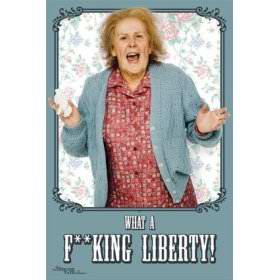 Ofcom have cleared BBC1's
Catherine Tate Show of breaching broadcast regulations with an expletive-littered Christmas Day episode that became the most complained-about programme of the festive period. Ofcom have cleared BBC1's
Catherine Tate Show of breaching broadcast regulations with an expletive-littered Christmas Day episode that became the most complained-about programme of the festive period.
Forty-two people complained to Ofcom about the number of
four-letter words and stereotyping in the show, which featured a sketch in which a Northern Ireland family exchanged presents including a knuckleduster, balaclava and chocolate penis.
More than 100 viewers also complained to the BBC about the
show, including the excessive use of the word "fuck" by Tate's foul-mouthed character Nan Taylor in the first sketch of the show. Nan's catchphrase is "what a fucking liberty".
The regulator cleared the show, saying viewers
were already aware that the show was likely to contain offensive language. It said it had been preceded with a warning about offensive language and was broadcast 90 minutes after the watershed.
Overall this episode was typical of the Catherine
Tate Show and would not have gone beyond the expectations of its usual audience, said Ofcom in its ruling: For those not familiar with the show, the information given at the start was adequate.
The regulator said the depiction of the
Northern Irish family, who discover that their son is gay, did not breach broadcast standards: In Ofcom's view it would have been clear to the audience that, in a comedy show such as this, exchanging Christmas gifts of terrorist paraphernalia was
absurd in the extreme . Comedy has a long tradition of engaging with challenging subjects and confronting taboos.
The Catherine Tate Christmas Special, which guest-starred George Michael, was broadcast at 10.30pm on Christmas Day and
was watched by 6.4 million viewers. In all it received more than 100 complaints.
The regulator reported: As for the use of this language on Christmas Day, the BBC said that it does not regard any word as being more obscene on one day than on
another. It did take account of the different audience expectations on different occasions, but in its view it was not the general expectation of audiences that everything broadcast on Christmas Day should reflect its character as a religious
festival. John Beyer 'Confused' by Watershed Concept From Mediawatch-UK
Speaking today John Beyer, director of Mediawatch-uk said that this finding “is a disgrace” and “seriously inconsistent” with Ofcom's finding last week about the obscenities used in the Live Earth concert. No wonder the viewing public is
confused and have lost confidence in the regulation of broadcasting. Considering that Ofcom has itself found that the majority of viewers believe there is too much swearing on television, this finding is all the more extraordinary. The Communications Act
2003 requires that “generally accepted standards” are applied to the content of television and radio services and it seems to me that Ofcom is failing to take public opinion into account - and that is a breach of trust and certainly not what Parliament
intended when setting up the new regulatory regime.
|
| 10th April | | |
Ofcom propose that Babe Channels go PIN protected as tele-shopping
| If the Babe channels go PIN protected then surely they could at least offer softcore fun. Surely PIN protection would restrict the number of viewers but
allowing softcore may make it worth typing in a PIN See full article from the Times
see also
proposal from Ofcom
|
Babe channels featuring scantily clad women enticing viewers to call premium-rate phone lines will be forced out of business if new rules from Ofcom work as planned.
The communications regulator wants to crack down on the 17 “babe TV” channels,
which can be found, free to watch, on the outer reaches of cable and satellite services.
It is part of an exercise to control television phone-ins, which were hit by a series of scandals last year. As mainstream broadcasters have already cut back
on phone-ins, its principal impact is on unconventional broadcasters and channels such as Babe-station and Babeworld TV.
The new rules state that phone-ins can be used in programmes only whose primary purpose is editorial , such as Big
Brother . The “babe” channels, which transmit only phone-line advertisements, can continue only if they opt to be governed by similar rules as home-shopping channels. This means they will be allowed to remain on air only if viewers have to enter a
PIN to access the channel.
|
| 10th April | | |
Ofcom whinge at strong language in Live Earth
| Based on an article from
The Register
See also Ofcom adjudication [pdf]
|
Ofcom sanctioned the BBC over unexpurgated, pre-watershed swearing during its coverage of Live Earth on 7 July last year, and has directed the channel to broadcast a summary of its findings on both BBC1 and 2.
The Ofcom adjudication
explains: 22 viewers complained that the BBC broadcast unacceptable language before the watershed during this programme. There were six instances of performers using the most offensive language, such as 'motherfucker' and other variants of the word
'fuck'.
Although the BBC broadcast an apology for the multiple outrages, Ofcom notes that there was in some cases a considerable delay in the broadcast of an apology.
- The breaches involved the repeated use of the most offensive language before the watershed
- the breaches involved the transmission of some of the most offensive language at a time children were likely to be in the audience (in the
afternoon on a Saturday)
- the BBC had previously been made aware that Ofcom had serious concerns over compliance failures with regard to the broadcast of similar and/or comparable events
- the BBC had failed to deploy
effective and appropriate procedures to prevent the broadcast of the most offensive language in a 'live' music event.
Ofcom said it would not impose a financial penalty for the breaches, but ordered: The Committee considered that a direction to broadcast a statement of Ofcom's findings on each of BBC1 and BBC2 in a form to be determined by Ofcom and on a specified
occasion is a sufficient, and the most appropriate and proportionate sanction in this case.
Such a statement would alert viewers to Ofcom's decisions and the BBC's repeated failure to comply with the Code, and through the adverse publicity
created, act as an effective disincentive for the BBC not to repeat the sanctionable conduct.
|
| 5th April | | |
Ofcom whinge at afternoon repeat of MidSomer Murders
| See full article from the Telegraph |
ITV has been criticised by Ofcom for screening an episode of MidSomer Murders in the afternoon that showed a man being electrocuted.
Ofcom upheld a complaint that the episode, which featured a body with a severely burnt hand, was
"inappropriate" for a 4pm slot when "significant" numbers of children could be watching.
The ruling comes a few months after Ofcom criticised ITV and Channel Television, the company responsible for checking that the detective
series complies with the broadcasting code, for screening two episodes in the afternoon that showed strangulation, bad language and a man cutting his throat with a razor.
advertisement
In the latest incident, a viewer complained about the
second episode of a two-parter called The Electric Vendetta, which was aired last November.
Channel Television said that the electrocution scenes were "shortened and made less explicit" for the afternoon show, which was a repeat of an
episode normally screened at 8pm.
|
| 1st April | | |
Complaints about the Brit Awards not upheld
| Based on an article
from the Scotsman
|
The Brit Awards have been cleared of breaching the Ofcom's broadcasting code. The TV censor received 128 complaints about bad language and alcohol at the music awards ceremony.
The incident which provoked the most complaints saw the host Sharon
Osbourne verbally attack the comedian Vic Reeves, whom she accused of being drunk at the televised bash.
As Reeves apparently struggled to announce the award for Best British Album, Osbourne turned to him and said: Get on with it, you
pisshead! Shut up, you're pissed, piss off. Piss off you bastard piss off!
At another point, Sheffield band the Arctic Monkeys launched what appeared to be an alcohol-fuelled attack on the Brits school for performing arts, before being cut
off.
But watchdog Ofcom said the show, broadcast from 8pm on ITV1 in February, had a "particular reputation" and the swearing would be considered "quite mild". It also said images where alcohol appeared would have been
cautionary rather than glamorised.
It said: While we understand this language may have been offensive to some viewers, it was broadcast after the watershed and in a programme with a particular reputation.
We believe regular viewers
would have been aware of the likelihood of this kind of material. Further, Ofcom research indicates that the examples of language quoted are generally considered quite mild.
As to the portrayal of the use of alcohol, Ofcom considered this was
limited and incidental to the coverage.
|
|
|