
|
We don't care if you have forgotten the password
Give us the key or we'll break your legs!
|
An animal rights activist has been ordered to hand over her encryption keys to the authorities. Section Three of the Regulation of Investigatory Powers Act (RIPA) came into force at the start in October 2007, seven years after the original
legislation passed through parliament. Intended primarily to deal with terror suspects, it allows police to demand encryption keys or provide a clear text transcript of encrypted text. Failure to comply can result in up to two years imprisonment for
cases not involving national security, or five years for terrorism offences and the like. Orders can be made to turn over data months or even years old. The contentious measure, introduced after years of consultation, was sold to Parliament as a
necessary tool for law enforcement in the fight against organised crime and terrorism. But an animal rights activist is one of the first people at the receiving end of a notice to give up encryption keys. Her computer was seized by police in May, and
she has been given 12 days to hand over a pass-phrase to unlock encrypted data held on the drive - or face the consequences. The woman, who claims to have not used encryption, relates her experiences in an anonymous
posting on Indymedia: Now apparently they have found some encrypted files on my computer (which was stolen by police thugs in May this year) which they
think they have 'reasonable suspicion' to pry into using the excuse of 'preventing or detecting a crime' Now I have been 'invited' (how nice, will there be tea and biccies?) to reveal my keys to the police so they can look at these files. If I
do not comply and tell them to keep their great big hooters out of my private affairs I could be charged under RIPA.
|


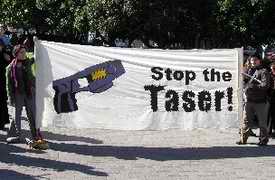 The death of a Polish man at Vancouver International Airport has sparked an intense debate in Canada over the increasing use of Tasers by law-enforcement officials. Concerns over the use of these electric shock guns has mounted in several other countries
after a UN Committee on Human Rights recently labeled their impact "torture."
The death of a Polish man at Vancouver International Airport has sparked an intense debate in Canada over the increasing use of Tasers by law-enforcement officials. Concerns over the use of these electric shock guns has mounted in several other countries
after a UN Committee on Human Rights recently labeled their impact "torture."  French web users caught pirating movies or music could soon be thrown offline.
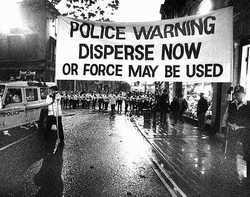 The Home Office has recently published a consultation paper which hints at what was really meant by Gordon Brown's promise to look again at the law which restricts demonstrations near parliament, far from repealing this legislation the consultation
indicates that the government wants to extend the restrictions on demonstrations to cover the whole country.
The Home Office has recently published a consultation paper which hints at what was really meant by Gordon Brown's promise to look again at the law which restricts demonstrations near parliament, far from repealing this legislation the consultation
indicates that the government wants to extend the restrictions on demonstrations to cover the whole country.  Passengers on flights and ferries between mainland Britain and Northern Ireland will be required to carry identity papers for the first time from next year.
  Lots of nasty things happen on the internet. So the US National Security Agency (NSA), charged with stopping people doing nasty things, has decided it would be best to have a copy of it. The entire web, that is.
 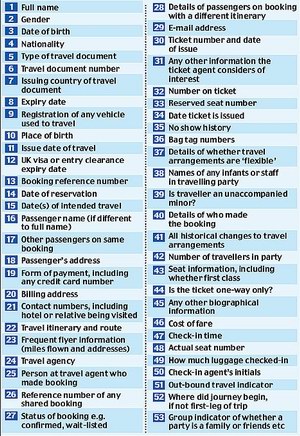 Travellers face price hikes and confusion after the Government unveiled plans to take up to 53 pieces of information from anyone entering or leaving Britain.
  Hushmail, a longtime provider of encrypted web-based email, markets itself by saying that not even a Hushmail employee with access to our servers can read your encrypted e-mail, since each message is uniquely encoded before it leaves your computer.
 Police in India wrongfully arrested and detained a Bangalore man for 50 days after internet service provider Airtel mis-identified him as the person who posted images on Orkut that insulted a revered historical figure.
  The first evidence was the bombs themselves, packed into a pair of suitcases and left on two passenger trains in northwest Germany.