| 14th December | | |
| Supporting the hype for Mum and Dad
| Based on article from
express.co.uk
A vailable at
UK Amazon for release on 26th December 2008
|
A horror film backed by the BBC, which echoes the story of serial killers Fred and Rose West, has sparked nutter fury after it emerged it will be shown on pay per view film channels and in cinemas over Christmas.
The low-budget feature-length
film, partly funded by £10,000 of licence-payers' money, shows scenes reminiscent of the Wests' campaign of murder in which they tortured at least 12 girls to death.
Relatives of the Wests' victims, MPs and nutters have slammed the timing
of the release of Mum & Dad and accused the BBC of insensitivity and misspending licence fee money.
The company distributing the film admits there are clear parallels with the Fred and Rosemary West story . And director Steven Sheil
says it is not for the faint-hearted.
It will be released in cinemas on Boxing Day and will be available on DVD, on Sky and Virgin pay per view channels and as an internet download.
The BBC said it was not responsible for the
release pattern and would not be showing it on any of its channels. Last night Peter Bastholm whose sister Mary, 15, vanished in 1968 and is thought to have been one of at least 20 more victims of the Wests whose bodies have never been found, said the
BBC had been hugely insensitive.
Tory MP Nigel Evans said the timing of the release and use of licence payers' money was a disgrace . He said: The timing is sick and it's a sick film. It confirms that the BBC do not live
in the real world as far as I'm concerned.”
|
| 12th December | | |
| Preston wants to put a stop to it's anti-social behaviour problem
| Based on article from telegraph.co.uk
|
People are being urged to keep Preston free of litter, dog fouling and anti-social behaviour as part of the Safer Preston Partnership's latest campaign.
The campaign, called Respect Our City , begins on Monday 8 December and will run
throughout the Christmas period and beyond. It will see eye-catching signs placed on buses, lampposts, litter bins, shops, restaurants, and pubs and clubs across Preston.
These signs will contain the Rules round town , which set out that
anti-social behaviour such as swearing, spitting, dropping litter, dog fouling and aggressive behaviour will not be tolerated in Preston - and that anyone caught breaking these rules could be arrested or face a fixed penalty fine.
Councillor Kate
Calder, cabinet member for community safety and community engagement, said: We want to put a stop to anti-social behaviour such as fighting, littering and swearing around town so that everyone can enjoy a happy, safe Christmas. We're spreading the
message in shops, pubs, restaurants and on buses and streets across the city. |
| 12th December | | |
|
Scandalous album covers See article from welt.de |
| 10th December | | |
Internet censors remove their ban on album cover
| See article from
iwf.org.uk
|
IWF posted the following statement on their website about the blocking of the original cover art for Scorpion's Virgin Killer album: A Wikipedia webpage was reported through the IWF's online reporting mechanism on 4 December
2008. As with all potentially illegal online child sexual abuse reports we receive, the image was assessed according to current UK legislation and in accordance with the UK Sentencing Guidelines Council. The content was considered to be a potentially
illegal indecent image of a child under the age of 18, hosted outside the UK. As such, in accordance with IWF procedures, the specific webpage was added to the IWF list. This list is provided to ISPs and other companies in the online sector to help
protect their customers from inadvertent exposure to potentially illegal indecent images of children.
Following representations from Wikipedia, IWF invoked its Appeals Procedure and has given careful consideration to the issues involved in this
case. The procedure is now complete and has confirmed that the image in question is potentially in breach of the Protection of Children Act 1978. However, the IWF Board has today (9 December 2008) considered these findings and the contextual issues
involved in this specific case and, in light of the length of time the image has existed and its wide availability, the decision has been taken to remove this webpage from our list.
Any further reported instances of this image which are hosted
abroad, will not be added to the list. Any further reported instances of this image which are hosted in the UK will be assessed in line with IWF procedures.
IWF's overriding objective is to minimise the availability of indecent images of children
on the internet, however, on this occasion our efforts have had the opposite effect. We regret the unintended consequences for Wikipedia and its users. Wikipedia have been informed of the outcome of this procedure and IWF Board's subsequent decision.
Offsite Comment: Scorpions tale leaves IWF exposed
'Look, that regulator isn't wearing any clothes' See
article from theregister.co.uk by John Ozimek
Image Censored
by the IWF
| | The Boy King's Clothes! |
According to the IWF, no one has ever questioned its judgements before. No doubt this would continue to be the case, so long as it confined its attentions to sites and imagery that are clearly produced by child abusers for child abusers. Unfortunately, it cannot pick and choose who to take on. The Children Act penalises the production and possession of
indecent images of children. The bulk of images against which the IWF acts are categorised as level one, involving some element of sexual posing of a child. This is both the least serious category, and the category where there is likely to be most
public debate as to whether an image actually is indecent.
Some images - shock, horror - are neither clearly one thing nor another.
So the scene was set for the IWF to take a fall. Gone is its record for 100% undisputed blocking. Gone,
too, is its reputation for being the undisputed good guy. Many people have looked at the image in question and have taken the view that it is not porn, or indecent, or abuse. Having made that judgement, they have started to ask questions about other
imagery that the IWF has sought to block. ...Read full article
|
| 9th December | | |
Internet censors review the over cautious ban on album cover
| The IWF should also take on board the responsibility not to criminalise innocent people by declaring a no sex image to suddenly be porn. In a time when
police are keen to take any excuse to prosecute, a blocked image becomes a de-facto illegal image, even if it is clear to everybody that there is no pornographic element whatsoever. It all makes you wonder what people have been imprisoned for up
until now. Have people been put in prison for similar images to this? Based on article from
guardian.co.uk
See also reader comments from
guardian.co.uk
|
The Internet Watch Foundation (IWF) is reviewing its decision to list as child pornography the image on one version of the album Virgin Killer by the rock band The Scorpions hosted on Wikipedia – and might yet add Amazon US to its list of
blocked sites for hosting the picture.
The initial decision to block the image, taken on Friday, prevented UK contributors from editing the site, and blocked some people from seeing the site at all (although they were still able to view it
through Google's cache).
The decision to ban the page, which was taken after consultation with the UK's Child Exploitation and Online Protection (CEOP) agency, is now being reviewed, Robertson said. The assessment was done in partnership with
law enforcement.
The Scorpions image was deemed to be 1 on a scale of 1 to 5, where 1 is the least offensive , said Robertson. The image was judged to be erotic posing with no sexual activity . It depicts a young naked girl with
her genitals obscured by a crack in the camera lens.
Robertson declined to say whether Amazon would be the next to be blocked. She confirmed that the Amazon page containing the offending cover was referred to the IWF today, but that no decision
would be taken while the review of the original decision was in progress.
The decision has put the IWF's methods and systems under the media spotlight. Normally the IWF, which is paid for by the EU and through a levy on the internet industry,
works quietly away in its Cambridge offices. A team of four police-trained analysts plough through 35,000 URLs sent to them each year that are under suspicion of being obscene.
If an image or text page contains obscene content and is
hosted in the UK, the relevant ISP is contacted and the content removed. But if it is hosted abroad, it is added instead to a blacklis" to which access is prevented by BT's CleanFeed technology. Any attempt to access that page returns a Page Not
Found response. Richard Clayton, one of the country's leading internet security experts said: We see this borderline stuff all the time; it's a no-win. The decision seems to have been based on taking the image out of context, something
which might seem pretty strange - particularly given that you can go into HMV and buy a copy on the high street.
The main outcome – apart from highlighting the way the British internet is censored – might be to highlight the lack of
cooperation between British authorities and other international bodies, he said.
The image under consideration was previously considered by the FBI in the US and they decided not to act against it.
|
| 8th December | | |
Suddenly bad taste gags are in the firing line of politicians
| An ominous statement from a Government minister? "I think most people think it to be both sick and insensitive and people will be disgusted with him at
a time when many people are looking very closely at the comic/comedian profession anyway". Based on article from
news.bbc.co.uk
|
Comedian Alan Carr has apologised for dedicating an award to Karen Matthews, who kidnapped her daughter Shannon.
Government minister Shahid Malik, called him sick and insensitive after he made the remark to reporters at Saturday's
British Comedy Awards.
At Saturday's awards, Carr was voted Best Comedy Entertainment Personality for his Friday Night Project and Sunday Night Project shows.
He said that he had originally planned his Celebrity Ding Dong
sketch to feature rough women not fashionistas: It didn't work out because they couldn't cast it. I suppose it is a bit difficult to find rough women. I suppose Shannon Matthew's mum was busy . Oh yeah, she would be my dream guest. I think
she's a gay icon. People like a bit of rough don't they?
Junior injustice minister Malik said the timing of the remarks, which come just days after Matthews was convicted, could not have been worse. Malik, MP for Matthews' constituency of
Dewsbury, West Yorkshire, said: I think Alan Carr can be funny on occasion but I think last night he really let himself down.
I think most people think it to be both sick and insensitive and people will be disgusted with him at a time when
many people are looking very closely at the comic/comedian profession anyway.
|
| 7th December | | |
Wikipedia is being partially blocked by UK ISPs
| Based on article from
community.zdnet.co.uk
|
The following notice has appeared on Wikipedia today when many UK users attempt to edit content: Wikipedia has been added to a Internet Watch Foundation UK website blacklist, and your Internet service provider has
decided to block part of your access. Unfortunately, this also makes it impossible for us to differentiate between different users, and block those abusing the site without blocking other innocent people as well.
According to
discussions on the Wikipedia administrators noticeboard, this is because a transparent proxy has been enabled for customers of Virgin Media, Be/O2/Telefonica, EasyNet/UK Online, PlusNet, Demon and Opal. This has two effects: users cannot see content
filtered by the proxies, and all user traffic passing through the proxies is given a single IP address per proxy. As Wikipedia's anti-vandalism system blocks users by IP address, one single case of vandalism by a single UK user prevents all users on that
user's ISP from editing. The effect is to block all editing from anonymous UK users on that list of ISPs. Registered users can continue to edit.
The content being filtered is apparently that deemed to meet the Internet Watch Foundation's critera
for child pornography – in one case, this involves a 1970s LP cover art for Scorpion's Virgin Killer which, although controversial, is still widely available.
Reports on the admin noticeboard say that this filtering is easy to circumvent, either
by using Wikipedia's secure server or by sending a request to find the page via parameters in the URL. However, no fix has been found – nor is one expected – for the blocking of anonymous authors problem. Comment:
Makes you wonder what is being prosecuted these days 8th December 2008. From Harvey on the Melon Farmers Forum Whether a particular image is or is not indecent and of a child
will be facts to be determined by a particular jury on a particular day, when judging a particular image.
The IWF clearly believe that the Wikipedia images they are blocking access to would be so determined. The ISPs involved clearly must think
so too, and they will have taken legal advice before moving to block access to such a popular site. That alone should give you some idea of the kind of images which are being prosecuted in the courts in this country.
It also puts into perspective
some of the claims made previously by the IWF about the quantity of sites they encounter which contain child abuse images. From IanG Child porn allegations? Weird. It looks like an album cover to me - hardly something primarily
produced to cause sexual arousal is it? That is the current legal definition of pornography if I`m not mistaken. And I can hardly see this photo being classified as an indecent image of a child either. I can`t see how an artistic shot
of a reclining 8 year-old with all the naughty bits obscured by a broken glass effect could be.
|
| 29th November | |
| Computer files can be considered deleted when it is beyond your control to undelete them
| A law judgment suggesting that computer files can be considered deleted if it is beyond your capability to undelete them. Previously files that could be
undeleted by computer forensics could still be considered as in your possession. From lawgazette.co.uk |
R v Christopher Rowe: CA (Crim Div): 3 November 2008
The appellant (R) appealed against his conviction for 12 counts of possessing indecent photographs of children on a reference by the Criminal Cases Review Commission.
The
police seized R's computer and 8 disks which contained several deleted files and two non-deleted files of images of child pornography, and two movie images. There were also three deleted files of child pornography on the computer. At trial,
experts agreed that R would have needed specialist software to access the deleted files, which he did not appear to have. It was not possible for them to prove whether the deleted files had actually been viewed. The last time that the non-deleted files
had been accessed was years before the date on the indictment.
Held: The convictions on the counts relating to the deleted files were unsafe as R no longer had custody or control of the images, R v Porter (Ross Warwick) [2006] EWCA Crim 560,
[2006] 1 WLR 2633 applied. The original jury were not directed to consider the potential significance that the deleted files had on R's ability to have had knowledge of the images. The counts relating to the deleted images were quashed.
|
| 25th November | | |
DVLA easily offended by number plates
| From telegraph.co.uk |
Car registration plates that spell out words related to terrorism, religion, sex or other potentially provocative themes have been banned, it has emerged.
The Driver and Vehicle Licensing Agency (DVLA) keeps a list of plates that it has not
approved because of words formed by their sequence of numbers and letters, an MP has found.
Reportedly included on the list is 054MA, which could be seen to resemble the first name of Osama bin Laden, the al-Qa'eda chief. Other terrorism-related
banned plates are H057AGE (hostage), MA56ACA (massacre), HE580LA (Hezbollah) and even BU580MB (bus bomb). The DVLA is also thought to prohibit combinations resembling jihad or Hamas.
Also said to be on the banned list are plates whose contents
refer to religions or that could be seen to incite racial hatred. Included on these grounds are reportedly M056LEM (Muslim) and others resembling words like Jesus or Koran. GA550VN (gas oven) and G005TEP (goose step), both of which could be seen to have
connections with activities by Nazi Germany during the Second World War, are also reported to have been prevented.
The list even spans themes including sexual activity and alcohol, it is claimed, with combinations such as B004ZZY (boozy) and
anything containing SEX also prohibited.
Norman Baker, the Liberal Democrat transport spokesman, who unearthed the list, told the newspaper: Some combinations would be deeply offensive. But it's over the top to ban words about booze and sex.
It's a bit 'nanny state'.
|
| 19th November | | |
Billy Suicide creator justifies his game
| Based on article from
eurogamer.net
See Billy Suicide Game
See also
The Samaritans
|
Dave Lasala, creator of controversial Flash game Billy Suicide , has hit back at organisations campaigning for its removal from the internet.
His comments come after The Telegraph contacted the Samaritans and PAPYRUS (Prevention of
Young Suicide), and printed responses claiming the game was both irresponsible and a catalyst to influence the behaviour of people who are already vulnerable to suicide.
I wanted the game Billy Suicide to be an exaggerated
self-portrait, Dave Lasala explained to Eurogamer. I also wanted to use it to look at a difficult subject with a sense of humour. I feel I have some authority on the subject, having rescued two brothers from suicide attempts.
Anyway, it seems to me that people blame violent art, angry music and horror movies for negative behaviour because it's easier to reduce complex issues down to a neat one-sentence solution, like, 'If there were no violent movies there would be no violence.
I would encourage everyone to check out the Oscar-winning documentary Bowling for Columbine for an in-depth examination of this behaviour. That being said, the object of the game Billy Suicide is to keep him alive.
|
| 18th November | |
| Sectarian football song condemned in the European Parliament
| Based on article from
thescotsman.scotsman.com
|
THE notorious Famine Song sung by Rangers fans was condemned on the floor of the European Parliament last night.
Irish MEP Eoin Ryan described the chant aimed at Celtic supporters as despicable, and has written to all Scotland's MEP's,
seeking their support to end the sectarian behaviour. The Famine Song I often wonder where they would have been
If we hadn't have taken them in
Fed them and washed
them
Thousands in Glasgow alone
From Ireland they came
Brought us nothing but trouble and shame
Well the famine is over
Why don't they go home?
Now Athenry Mike was a thief
And Large John he was fully briefed
And that wee
traitor from Castlemilk
Turned his back on his own
They've all their Papists in Rome
They have U2 and Bono
Well the famine is over
Why don't they go home?
Now they raped and fondled their kids
That's what those perverts from
the dark side did
And they swept it under the carpet
And Large John he hid
Their evils seeds have been sown
Cause they're not of our own
Well the famine is over
Why don't you go home?
Now Timmy don't take it from me
Cause
if you know your history
You've persecuted thousands of people
In Ireland alone
You turned on the lights
Fuelled U boats by night
That's how you repay us
It's time to go home.
|
| 17th November | |
| Anti-Scientology book unlisted by UK Amazon
| Thanks to Nick
Based on article from
theregister.co.uk
|
Amazon UK has barred the sale of a new Scientology exposé penned by a former member of the church's elite paramilitary group.
The British incarnation of the world's most popular etailer is no longer offering The Complex: An
Insider Exposes the Covert World of the Church of Scientology , by John Duignan, who spent 22 years inside the top secret organization.
In a recent post to an anti-Scientology discussion forum, an Anonymous Brit says that after pre-ordering
the book, he received an email from Amazon announcing it had been removed from sale for legal reasons. The book is also no longer available at Waterstone's and is out of stock at US Amazon
The US listing describes the book like
this: For the first time ever, a former high-ranking member of the Church of Scientology is lifting the lid on life inside the world s fastest growing cult. The Complex reveals the true story behind the religion
that has ensnared a Who's Who list of celebrities such as Tom Cruise and John Travolta, and convinced thousands of ordinary people to join up.
Duignan describes how two years ago he staged a dramatic escape from the elite paramilitary group at
the core of the Church, the Sea Organisation, and how he narrowly evaded pursuit by Scientologists from the Office of Special Affairs. He looks back on the 22 years he served in the Church's secret army and describes the hours of sleep deprivation,
brain-washing and intense auditing or religious counselling he endured, as he was moulded into a soldier of Scientology.
He talks about the money-making-machine at the heart of the Church, the Scientology goal to Clear the Planet and Get Ethics
In, the training programmes, the Rehabilitation Project Force and the punishments meted out to anyone who transgresses, including children. We follow his journey through the Church and the painful investigation that leads to his eventual realisation that
there is something very wrong at Scientology's core.
The Complex was published by the Dublin, Ireland-based Merlin Publishing.
|
| 14th November | | |
Art banned by Harrow council on show to the public in Watford
| Based on article from
harrowtimes.co.uk
|
A Watford arts organisation is making a stand against censorship as its latest exhibition opens in a local shopping centre.
Artwork from members of the Watford Area Arts Forum (WAAF) will go on show this weekend in the public gallery at the top
of The Harlequin shopping centre.
Included in the exhibition will be a drawing by Cheryl Gould, one of the forum's members, whose recently was forced to take one of her pieces of work down from Harrow Arts Centre.
Harrow Council objected
to the drawing, depicting a nude man, and decided it had to be removed from the exhibition to avoid offending religious members of the community and children.
Several artists have walked away from the arts centre, in Hatch End, and members of the
WAAF have criticised Harrow Council's censorship of the paintings.
Jonathan Hutchins, another artist whose life paintings were withdrawn from the Harrow exhibition, has been invited to show the censored artwork in the exhibition in The Harlequin.
The upper gallery in the shopping centre, where the exhibition is taking place from tomorrow until Sunday, November 23, is open to the public and artwork on show can be seen from outside the gallery.
|
| 12th November | | |
The next stop for the FrightFest Express is Glasgow
| See www.frightfest.co.uk
|
FrightFest at the Glasgow Film Festival
20th & 21st of February The next stop for the FrightFest Express is Glasgow. For the fourth time, we are heading North of the border for an extended two day event, which is part of the
Glasgow Film Festival. Dates for this year's jaunt are the 20th & 21st of February. Tickets will be on sale in early January 2009.
|
| 7th November | | |
Grand Theft Auto takes the rap for sex assaults
| Based on
article from
dailymail.co.uk
|
A judge attacked a violent video game as he jailed a teenager. Ryan Chinnery had subjected four women to degrading sex assaults.
Sentencing Chinnery to eight years, Judge Philip Statman said: It is not for this court to enter the
controversy as to whether such conduct is encouraged by pornographic material and video games such as Grand Theft Auto. But there is a worrying mirror of conduct between that which pornography presented to you and that which you have carried out.'
He said: You were driving alone at night to select a female victim, replicating that which was in your fantasy. You have sought to dominate and humiliate women to gain sexual satisfaction. You thrive on the feeling of power and control.
Maidstone Crown Court was told that Chinnery had a secret dark side when he would spend hours playing video games, watching pornography and taking cannabis.
He attacked his first victim under a railway bridge, groping her breasts and pulling
down her trousers. A month later, Chinnery stalked another woman, dragging her along a path before he was scared off by passers-by. He set upon a third woman as she made her way home from work – grabbing her arm and fleeing only when another man
approached. In August last year, he grabbed a 42-year-old woman around the throat as she walked home at 2am. Her arm was broken in the struggle. Her clothes were torn off and she was sexually assaulted.
Patsy McKie, from Mothers Against Violence,
said last night: The Government must ban these games as soon as possible. The only people they benefit are the makers, who cash in on the misery they have generated.
|
| 4th November | | |
HMV to withdraw Joker's knife badge
| Based on
article from dailymail.co.uk
|
Record store HMV has removed badges from its shelves that customers said glorified knife crime.
The £2.99 packet of four badges, based on the recent Batman film, The Dark Knight , was in the centre of a display aimed at primary
school children.
One image features the bloodied face of the Joker surrounded by a circle of 12 gleaming blades and flick knives.
Another contains the slogan Let's put a smile on that face, the line used by the Joker before
slashing open the mouth of a victim.
Now the store has removed the items from sale pending a review because of the sensitivities surrounding knife crime in Britain.
A spokesman for HMV said the badges would be removed from
all its stores. He said: The badges are part of a licensed range from the Dark Knight/Batman film franchise, and are stocked by numerous retailers.
Whilst we have not received any direct complaints regarding their sale, and whilst we do not
believe that HMV should censor the choice that it makes available to its customers, we do recognise the particular sensitivities surrounding this issue at the present time, and will therefore instruct our stores to withdraw this item from sale pending a
review.
We sincerely apologise for any concern and offence caused, and we thank the Daily Mail for bringing this matter to our attention.
|
| 3rd November | | |
Councils expunge Latin words from the English language, eg vice versa etc
| Based on
article from
dailymail.co.uk
|
Local authorities are claim that Latin words are elitist and discriminatory, and have ordered employees to use often-wordier alternatives in documents or when speaking to the public.
Bournemouth Council has listed 19 terms it no longer
considers acceptable for use. They include ad hoc, bona fide, status quo, vice versa and even via.
Mary Beard, a Cambridge professor of classics, said: 'This is absolutely bonkers and the linguistic equivalent of ethnic cleansing: English is
and always has been a language full of foreign words. It has never been an ethnically pure language.
Harry Mount, author of the best-selling book Amo, Amos, Amat and All That , a light-hearted guide to the language, said: Latin
words and phrases can often sum up thoughts and ideas more often than the alternatives which are put forward. They are tremendously useful, quicker and nicer sounding. They are also English words. You will find etc or et cetera in an English dictionary.
Of other local authorities to prohibit the use of Latin, Salisbury has asked staff to avoid the phrases ad hoc, ergo and QED, while Fife has banned ad hoc as well as ex officio.
|
| 1st November | | |
Labour censors unimpressed by Olympic critique
| Based on
article
from islingtongazette.co.uk
|
An author banned from launching his book at a Hackney library because of his views has been welcomed to Islington with open arms.
Ian Sinclair was due to appear at the Stoke Newington Library to talk about his upcoming book Hackney, That
Red Rose Empire .
But Hackney's Labour leaders intervened to cancel his reading after he published an article in the London Review of Books entitled The Olympics Scam .
A spokesman for Hackney Council said it would be
inappropriate to host a book expressing controversial or political opinions.
But Councillor Ruth Polling, Islington's executive member in charge of libraries and culture, called the decision deeply troubling. She said: There will
never be censorship of this sort as long as the Lib-Dems run Islington. Banning an author from speaking because of his views about the Government's incompetence is monstrous. But what's worse is the Labour council's blanket statement that controversial
opinions are no longer welcome in their libraries. Libraries should be a place for discourse and free thinking. I'm pleased to offer Islington's libraries for Mr Sinclair's book launch.
|
| 1st November | |
| Golly gosh in Enid Blyton country
| Based on
article from dailymail.co.uk
|
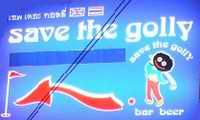 | A local bar sign |
The owner of the Ginger Pop shop - a shrine to the children's author, Enid Blyton, who lived nearby - has received hate mail branding her a racist and urging her to stop selling the rag dolls.
Viv Endecott has also received verbal complaints
which she has informed the police about.
She insists the golliwogs are harmless soft toys synonymous with Enid Blyton who regularly featured them in her famous books, including Noddy.
In recent years the golliwogs have been 'cleansed'
from the novels as many people began to see them as a crude racial stereotype.
But Miss Endecott claims there is demand for the toys in the Dorset village of Corfe Castle - immortalised in Blyton's Famous Five books. She said she has sold more
than 500 in the last six months to customers of varying ages and ethnic backgrounds.
She said despite the complaints she will continue to sell the doll: No offence has ever been intended by me and therefore none should be taken.
Councillor Gary Suttle, leader of Purbeck District Council, said:
'I can understand why she is selling them because they are part of the heritage of Enid Blyton. There is a great move in this country to be politically correct and sometimes it goes beyond its remit. I don't think she is in anyway being non-PC. Four
people may have complained but 500 people have bought them, so I would err on the side of democracy.'
Adnan Chaudry, chief officer of the Dorset Race Equality Council, said golliwogs had no place in today's society, even in Enid Blyton
country. |
| 30th October | | |
| Westminster Council want Banksy CCTV mural removed
| Thanks to Nick
From time.com
|
The case of Westminster council versus Banksy raises an interesting legal precedent. Normally permission to paint a wall is only required from a local authority if the building is of listed historic value or the painting is commercial in nature, but
now artistic judgement appears to come into it.
Westminster council first sought to remove Banksy's painting One nation under CCTV on Newman street in central London on the grounds it was an unlicensed commercial.
The owner of the
property itself is apparently happy for the painting to remain in place so Westminster council has now sought consultation with local residents in order to prove the painting is having a detrimental affect on the area.
Referring to the adjacent
Post Office building who have sought the paintings removal since it first appeared Banksy said I don't know what next door is complaining about — their building is so ugly the 'No Trespassing' sign reads like an insult.
All of which leaves
the possibility for what is believed to be the first recorded use of the 2003 Anti-social Behaviour act which for the first time gives councils the ability to enter private premises and force the removal of graffiti. A measure introduced by David
Blunkett and which Banksy attacked at the time in a series of paintings and statements.
|
| 30th October | | |
Private members bill to restrict lap dancing dropped
| Based on article from
morningadvertiser.co.uk
|
A Private Members' Bill seeking to re-licence lap-dancing clubs as Sex Encounter Establishments with repressive new guidelines has been dropped.
The Bill had been proposed by Dr. Roberta Blackman-Woods under the Ten Minute Rule but has now been
dropped at its second stage.
Although private members' bills rarely became law, Blackman-Woods has created a great deal of publicity for the campaign.
The Government have signalled that they will pick up the suggestion for future
legislation.
|
| 27th October | | |
| IWF transforms from laudable child protector to reprehensible snitch
| Based on article from
news.bbc.co.uk
|
The Internet Watch Foundation (IWF) has extended its remit and now urges web users to snitch on illegal and obscene adult content online. Previously the organisation had laudably concentrated on child abuse images The awareness campaign comes in
response to IWF research which suggests 77% of people who find illegal content do not know how to report what they have seen.
Sarah Robertson, a spokeswoman for the IWF, said that in 2007 the organisation handled 34,781 reports from members of
the public who stumbled across illegal content. It was the IWF that reported the sex fantasy text story that is currently being prosecuted under the Obscene Publications Act.
|
| 27th October | | |
Westminster Council wound up by Banksy CCTV mural
| From cbc.ca
|
Westminster city council in London decided to paint over guerilla-artist Banksy's largest work in the city.
The council ordered the removal to send a message to graffiti artists.
Robert Davis, deputy leader of the council and chair,
told BBC News, If you condone this then you condone graffiti all over London.
Banksy, who conceals his identity, is famous for his political and satirical street art. His works have been found everywhere from the Gaza Strip to New Orleans.
The seven-metre-tall mural being removed depicts a child painting the words One Nation Under CCTV on the wall. A dog and police officer holding a camera are painted next to the graffiti artist.
The mural is painted on the wall of a
building shared by Royal Mail and another business.
|
| 23rd October | | |
The Obscene Publications used against text story
| Based on article from
news.bbc.co.uk
|
A man from South Tyneside has appeared in court over a text story which detailed the kidnap, torture and murder of the pop group Girls Aloud.
Darryn Walker is accused of writing and posting the Girls (Scream) Aloud story on a sex stories
site.
He is charged under the Obscene Publications Act.
No pleas were entered at the hearing at Newcastle Crown Court. A trial was set for 16 March.
Walker was granted unconditional bail until the trial.
|
| 23rd October | | |
Artists boycott Harrow Council Arts Centre
| Based on article
from harrowtimes.co.uk
|
Artists are walking out en masse from Harrow Arts Centre in a storm over the censorship of five paintings.
Melvyn Leach, censor and business manager at the arts centre, had the paintings depicting nude figures removed from an exhibition the night
before it was due to open.
Artists from across the borough have reacted in horror at the decision and some have threatened to walk away from the arts venue because of the censorship.
Shanti Panchal, a distinguished artist said: I think
it is terrible, it sounds like something from the middle ages. I was so shocked when I heard and think all artists should stand up and speak out about what's happening.
The rebellion is being led by Cheryl Gould, an artist with long-standing
ties to the centre. She was furious after Leach told her and fellow artist Jonathan Hutchins to remove their artwork, which they had offered to be in the exhibition. She is now calling for a boycott of the arts centre until the council rethinks its
position.
She said: The paintings and drawings were not rude, crude or remotely suggestive. They were just what you would expect to see from any normal life class anywhere.
Her calls for a boycott have been backed by a host of
artists from across Harrow and beyond, including members of the Harrow Visual Arts Forum and the Wembley Arts Society.
Norma Stephenson, chairman of the Harrow Arts Society, which is putting on the exhibition at the arts centre until October 26,
has called on the council to clarify its position, which at the moment is undefined . She said: Is it really that bad for children to walk past pictures of people with no clothes on?
Councillor Chris Mote has continued to defend the
decision taken by Leach and has said nude works could be displayed in a private room in the arts centre with a health warning on the door.
|
| 18th October | | |
Police make up their own blasphemy law
| Based on
article from
new.edp24.co.uk
|
An offensive photograph of Madonna in a window of a Norwich gallery has prompted a formal request for its removal following further complaints to the police.
The image of the singer posing on a crucifix and wearing a crown of thorns has
adorned the St Giles Street Gallery for more than a week as part of a retrospective of celebrity photography.
The gallery owner David Koppel moved the picture into the window on Saturday and less than 24 hours later had received a telephone call
from an officer following up a single complaint that it had caused offence.
He refused a request to remove it from public view and was then visited by two officers. I'm obviously such a threat to society that they thought it necessary to send
two police officers, said Mr Koppel: They formally asked me to take the picture down or turn it round, which is rather pointless, and I have refused. I've no doubt they will be back. They said they had had complaints, plural, but I find that
absolutely unbelievable.
|
| 18th October | |
| Harrow Council gets all stuffy over nude paintings
| Based on
article from harrowobserver.co.uk
|
Three nude paintings have been moved out of general public view at Harrow Arts Centre to avoid offending nutters.
The trio of pictures by Jonathan Hutchings was due to go up alongside less controversial works in the corridors of Elliot Hall as
part of Harrow Arts Society's annual exhibition that began on Monday.
But Harrow Council stepped in on the day the artists hung their pieces to demand the three are shown separately in a side room, the board room, which is still accessible on
request.
Harrow College employee Hutchings' paintings each measure 30in by 24in and are figurative illustrations made during a weekly life drawing class he has attended at the arts centre in Uxbridge Road, Harrow Weald, for the past eight years.
Margaret Mountstephens, exhibition co-ordinator for Harrow Arts Society, said: I'm disappointed and I wanted to have a nice exhibition. The council are being stricter than they have been. Two or three years ago the life class paintings went on
show and they OK'd it. I think the paintings may be 'questionable' but it depends on who's calling it offensive.
The Observer understands the council was concerned about the sensitivity of displaying the pictures in a corridor that was
generally accessible to the public.
Harrow Arts Centre is not a dedicated gallery space and is run as much more of a community centre nowadays with multicultural family activities taking place together with one-off events like weddings.
|
| 15th October | | |
UK Police say that lap dancing clubs simply don't generate crime and disorder problems
| Based on article from
news.bbc.co.uk
|
Police find it difficult to close down lap dancing clubs because their customers are usually well-behaved, a vice squad chief has told MPs.
Chief Inspector Adrian Studd, of the Metropolitan Police, said local residents often wanted officers to
take action on "moral" grounds.
But the police were restricted to crime and disorder laws.
He told the Commons culture committee such clubs were usually well-run and had a high staff ratio to customers.
Often people look for a moral decision, which is sometimes very difficult for police and local authorities to make, said Chief Inspector Studd, of the Met's clubs and vice unit.
He added: It is true to say there is no evidence they
cause any crime and disorder, or very rarely, because they tend to be fairly well-run, they tend to have a fairly high staff ratio to customers, the people who tend to go there tend to be a bit older, so they don't tend to drink so excessively and
cause... problems outside.
The government has said it is considering a change in the law so that the clubs are categorised as "sex encounter" establishments - the same as sex shops. This would mean stricter rules about what is
allowed to take place inside but Chief Inspector Studd suggested that even this might not make it any easier for police to take action.
In the few local authority areas where lap dancing clubs were regulated in this way, the rules, on how close
customers can come to the dancers, for example, had proved difficult to enforce.
With the best will in the world, when you get into the fine detail of it, as we have tried to do, on a couple of occasions, it's incredibly difficult to try and
do that, added Chief Inspector Studd.
|
| 13th October | | |
Supporting the hype for Little Hooliganz online game
| Based on article from telegraph.co.uk
See also Littlehooliganz.com
|
To win the Little Hooliganz online game, 7yo+ boys must train their thug to take on rival hooligan firms and attack members of the public including pensioners.
Characters must steal money to buy beer and weapons, which also
include scimitars, chainsaws, cricket bats, crow bars and knuckledusters. The hooligan firms are named after Premiership teams.
The game is targeted at youngsters aged between seven and 16 and has attracted over 10,500 members in the early days
of its launch.
On its website, the game's creator, Wood Green north London-based company Blouzar, invites children to become the most notorious, respected and meanest hooligan the world has ever known.
The new game has been
condemned by football's governing body, the Football Association, and by the Football Supporters' Federation. After viewing the game, a Football Association spokesman said: We deplore anything that celebrates hooliganism in any form. Lawyers for the FA Premier League were also studying the game to see whether it infringes its or Premiership clubs' intellectual property rights.
Malcolm Clarke, chairman of the Football Supporters' Federation, branded the company totally irresponsible. We are totally opposed to anything which glamorises any form of violent behaviour associated with football.
Anti-gun
and knife crime campaigners also reacted with horror to the game. Danny Bryan, chairman of Communities against Guns and Knives, accused the game's creators of being opportunistic . This game is crazy, encouraging children to carry guns and
swords. Too many parents have lost their loved ones through guns and knives and games like this are a negative influence on children. We are trying to educate kids against getting angry and using weapons that kill and hurt but this makes our job more
difficult. This game is just an opportunistic attempt to make money out of the present climate of violence.
But Blouzar director Chris Evans claimed the game merely satirises football violence: We are not condoning violence. Just because
we are giving our members the chance to buy a gun, sword, baseball bat or knuckleduster and attack their rivals' characters doesn't mean they are going to do it in real life. People understand the difference between cartoon violence on an internet game
and the horrific results of violence in real life. This will not encourage copycat attacks.
|
| 12th October | | |
Bournemouth euthanasia workshop banned
| Based on article from
independent.co.uk
The Peaceful Pill Handbook is available at
US Amazon
The Peaceful Pill Handbook is also
available as a download
|
An Australian doctor was banned from holding a workshop on how people could end their lives. Dr Philip Nitschke, who has been nicknamed Dr Death, had planned to hold a session on euthanasia in Bournemouth next week but the owners of his first and
second venue choices, the local council and Hermitage Hotel, cancelled his bookings.
Dr Nitschke chose the Dorset town because of its large elderly population. His workshops cover the merits of a helium exit bag , Mexican drugs, morphine
and peaceful pills . He will host a session in central London on Monday and said he hoped to still be able to speak in Bournemouth on Thursday.
The pressure group Dignity in Dying attacked the way Dr Nitschke ran his sessions, saying it
was irresponsible and potentially dangerous to provide information on how to end life without safeguards or control over where the information goes. It said terminally ill adults should have access to better care and treatment, and the option of
an assisted death within legal safeguards.
Dr Nitschke said the ban on his workshop would deny people access to the best information on euthanasia: Elderly people want access to good information. It empowers them, they have a better quality of
life and paradoxically they live longer because they have the peace of mind of an exit strategy.
|
| 9th October | | |
|
Blogger details some notable BBFC bans See article from daysarenumbers.net |
| 7th October | | |
|
The Obscene Publications Act rides again See article from theregister.co.uk |
| 6th October | |
| Max Mosley takes on journalism in the European Court
| Based on article from
guardian.co.uk
|
Max Mosley, the president of formula one's governing body, is to continue his challenge to the law of privacy by taking his case to the European court of human rights in Strasbourg.
Mosley, whose private sexual practices became national news in
July when the News of the World published details of his involvement in an orgy, says that the £60,000 damages he received for some of the claims the paper made were not an adequate remedy.
He wants a change in the law that will force
editors to contact the subject of their revelations before publishing articles that could invade their privacy.
I think it's wrong that a tabloid editor can destroy a family and wreck a life without being answerable to anybody just to sell
newspapers, Mosley said.
The law allows a practice described as publish and be damned , meaning that newspapers can publish stories that may infringe privacy, knowing that they may face legal consequences after the event.
These tabloids go for somebody almost every Sunday, and apparently it's become routine for them to keep it a secret to prevent the person from seeking an injunction,
Mosley said: The chance of being sued is very small, the damages are not very big, and it is a worthwhile risk.
Mosley's battle is no longer against the News of the World but against the state: I have been able to put right the
wrong done to me within the limits of English law. But to remedy it completely I need to challenge English law.
His legal team will argue that the law failed to protect Mosley's right to privacy under the European convention on human rights
because of the absence of any obligation on editors. Although [£60,000] is the highest sum ever achieved in a claim for an invasion of privacy, it is not an effective remedy, said Dominic Crossley, the lawyer representing Mosley : The
only effective remedy would have been to prevent the publication in the first place by means of an injunction.
|
| 4th October | | |
UN complains about the UK's demonisation of children
| Based on article from
guardian.co.uk
|
Too many children are being imprisoned in Britain and demonised as criminals, said a report published by the UN Committee on the Rights of the Child. In a document presenting more than 150 recommendations, and described by some campaign groups
as devastating, the body set out a detailed critique of Britain's legal and social shortcomings.
The demonisation of young people was a prominent theme. The report regretted a general climate of intolerance and negative public attitudes
towards children in the media and elsewhere. It suggested the government should regulate children's participation in TV programmes, notably reality shows, so as to ensure [the shows] do not violate their rights.
During public hearings
in Geneva, questions were raised about the TV series Supernanny . Responding, Channel 4 said yesterday it worked within Ofcom guidelines to safeguard children's welfare.
|
| 3rd October | | |
Writer prosecuted over fantasy story of the murder of Girls Aloud
| Thanks to Nick
Based on
article from
dailymail.co.uk
|
A man who allegedly wrote an internet story imagining the kidnap and murder of pop group Girls Aloud is being prosecuted under obscenity laws.
The prosecution of Darryn Walker is regarded as a historic test case which could affect censorship of
the internet.
Walker allegedly described the kidnap, mutilation, rape and murder of the girl band in a 12-page story posted on a fantasy website (or maybe on Usenet newsgroups). The story was headlined Girls (Scream) Aloud.
Experts
are claiming the action is one of the most significant obscenity cases since the trial over the novel Lady Chatterley's Lover .
It is expected to be the first test of the law since pornography became easily available online and is one of
the first involving the written word in recent years.
Scotland Yard's Obscene Publications Unit brought the case after discussions with the Crown Prosecution Service. It had been made aware of the story by The Internet Watch Foundation, which
monitors illegal online content, which itself had been alerted last year.
The website where the blog was published is hosted abroad. But prosecution has been able to go ahead because the alleged author was identified as a UK citizen living in
Britain.
|
|
|


