| 6th November | |
| Dangerous Cartoon legislation ends its parliamentary scrutiny unamended
| Thanks to pbr on the Melon Farmers Forum
|
The Coroners and Justice Bill has just completed its 3rd Reading on the House of Lords and will now go back to the Commons to review the Lords amendments. There were no change to the dangerous drawings provisions though. Anime fans in
particular should surely be at great risk with state bullies contending that indeterminate age anime features under 18 year olds.
|
| 11th July | | |
Nutter Lord proposes new ban on the possession of extreme pornographic writings
| Thanks to Angelus, pbr & phantom
5th July 2009. See
proposed amendments to Coroners & Justice Bill from
publications.parliament.uk
|
Baroness O'Cathain is a Tory Lord. According to Wikipedia she is Irish born convent educated Catholic: She is known for her socially conservative views, in particular her efforts to retain the ban on same-sex couples from adopting, and has taken
on a leadership role in the movement after the death of Lady Young.
She has proposed a couple of amendments to teh Dangerous Cartoons clause of the Coroners & Injustice Bill which criminalises the possession of pornographic cartoons depicting
under 18s. O'Cathain firstly suggests the removal of the clause giving people protection from prosecution from material approved by the BBFC. Secondly she proposes a new clause: Possession of extreme
pornographic writings (1) It is an offence for a person to be in possession of extreme pornographic writing. (2) "Extreme pornographic writing" is writing which is both— (a) pornographic, and
(b)
extreme writing.
(3) Writing is "pornographic" if it is of such a nature that it must reasonably be assumed to have been produced solely or principally for the purpose of sexual arousal. (4) Where (as found in the
person's possession) the writing forms part of a series of writings, the question whether the writing is of such a nature as is mentioned in subsection (3) is to be determined by reference to— (a) the writing itself, and
(b) (if
the series of writings is such as to be capable of providing a context for the writing) the context in which it occurs in the series of writings.
(5) So, for example, where— (a) the writing forms an integral part of
a narrative constituted by a series of writings, and
(b) having regard to those writings as a whole, they are not of such a nature that they must reasonably be assumed to have been produced solely or principally for the purpose of sexual arousal, the
writing may, by virtue of being part of that narrative, be found not to be pornographic, even though it might have been found to be pornographic if taken by itself.
(6) "Extreme writing" is writing which— (a) falls within subsection (7), and
(b) is grossly offensive, disgusting or otherwise of an obscene character.
(7) Writing falls within this subsection if it portrays, in an explicit and realistic way, any of the following— (a) an act which
threatens a person's life,
(b) an act which results, or is likely to result, in serious injury to a person's anus, breasts or genitals,
(c) an act which involves sexual interference with a human corpse, or
(d) a person performing an act of
intercourse or oral sex with an animal (whether dead or alive), and a reasonable person looking at the writing would think that any portrayal of such person or animal was realistic.
(8) In this section "writing" means
written words (including but not limited to those published or otherwise available on the internet), books, leaflets or other printed matter. (9) In this section references to a part of the body include references to a part surgically constructed
(in particular through gender reassignment surgery). (10) Proceedings for an offence under this section may not be instituted— (a) in England and Wales, except by or with the consent of the Director of Public Prosecutions; or
(b) in Northern Ireland, except by or with the consent of the Director of Public Prosecutions for Northern Ireland."
Update: No Comment 9th
July 2009. See Hansard from publications.parliament.uk
, Thanks to pbr Dangerous Cartoons will soon be a reality. The Dangerous Cartoons clauses of the Coroners and Injustice Bill sailed through Lords Committee without discussion. The Dangerous Text amendments were left by the
wayside. Offsite: Written material saved from censor's big black pen - for now 11th July 2009. See
article from theregister.co.uk by John Ozimek Such
was the interest in the suicide amendment that debate dragged on well past the point when their Lordships usually adjourned for their supper. House business, which usually takes place at half seven, was delayed until twenty past eight, when a stampede of
hungry Lords headed for their canteen. Debate on the Coroners' Bill did not resume until an hour later.
Sadly for the Baroness, New Labour reforms to the way parliament works means that the Lords now shut up shop at 10 pm – and debate on
amendments cannot carry on between sessions without prior agreement between parties. Although not the case in this instance, the streamlining of parliamentary business through excess guillotining of debate has been bitterly resisted by opposition
parties, who claim that important legislation is now passed with little or no formal scrutiny.
The Baroness' amendment was eventually called at three minutes to ten – at which point she appears to have decided it was not worth putting, and did
not stand up to propose it. ...Read the full article
|
| 31st March | | |
Ben Westwood highlights Jacqui Smith's tirade against adult entertainment
| Based on
article from politics.co.uk
|
Jacqui Smith's work pushing through anti-porn laws has been highlighted now she is embroiled in a scandal involving adult movies.
Ben Westwood, who campaigned against the introduction of Section 63 of the Criminal Justice and Immigration Act 2008
banning 'extreme' pornography, said today: This proves that censorship and restriction of individual liberties in England is occurring because of members of the government's personal hang-ups.
The focus comes as the home secretary faces
calls for her resignation over her husband's use of public money to pay for blue movies.
The oldest son of Dame Vivienne Westwood accused Jacqui Smith of embarking on a crusade on the sex industry, which, he said: is not to protect
people but to protect herself.
Bookmakers today made Ms Smith odds-on to be out of her job by the end of the year.
This Labour puritan's restriction of individual freedom has been so that she can restrict her own husband, Westwood added:
She has attacked prostitution, lap-dancing clubs and pornography in her role as home secretary, and now we know why. Timney offered full disclosure at Stringfellows From women.timesonline.co.uk
Peter Stringfellow calls for a chat about Jacqui Smith, which cannot bode well for the beleaguered Home Secretary. Does she have the moral authority, he asks, to pilot through legislation proposing stricter rules for lap-dancing
establishments?
She said it was ‘bizarre' for City firms to take clients to clubs where women take their clothes off yet she is personally pushing this legislation. I don't mind her putting a couple of porno films through on the taxpayers'
bill but I do think it is breathtaking hypocrisy.
Generously, he says that Mrs Smith is welcome to “park” her husband, Richard Timney, in his West End “gentleman's club” while she attends to Commons business. As long as it's not claimed on
expenses. The bill might add up to a little more than £10 though.
|
| 30th March | | |
CAAN calls on Jacqui Smith to sign up to the right to bedroom privacy
| Thanks to eMark
From consentingadultactionnet.spaces.live.com
|
Clair Lewis, national convenor for Consenting Adult Action Network (CAAN), today reflected on the irony of Jacqui Smith being caught out over the porn habits of her own husband and issued an invitation to the Home Secretary and her husband to sign up to
CAAN's statement of aims. This endorses the right of individuals not to be pilloried for legitimate sexual activity between adults. CAAN statement of aims:
We believe in the right of consenting adults to
make their own sexual choices, in respect of what they do, see and enjoy alone or with other consenting adults, unhindered and unfettered by government.
We believe that it is not the business of government to intrude into the sex lives of
consenting adults.
Clair Lewis said: It is ironic that Jacqui Smith, who has done more than almost any other politician to meddle in the private sex lives of consenting adults, should be placed in
this position. We would hesitate to suggest it was richly deserved.
If public money has been misused, then Ms Smith and her husband must face the consequences: however, the sexual focus, whilst no doubt titillating, is really not relevant.
CAAN works to protect consenting adults from having their lives wrecked by this type of press voyeurism.
We shall therefore be contacting Richard Timney - and also his wife - to see if they would now agree that what adults get up to in the
privacy of their own bedrooms is not the business of either government or an over-intrusive press, and whether they would now be prepared to sign up to our statement of aims on this issue.
|
| 30th March | | |
|
Political charity NSPCC supports the government ban on dangerous cartoons See politics.co.uk |
| 30th March | |
| Government announce key players in UKCCIS
| From dcsf.gov.uk
|
The Government's UK Council for Child Internet Safety launches working groups to take forward the Byron Review recommendations -
Children's Minister Delyth Morgan announced the membership for four groups of professionals tasked with taking
forward the work of the UK Council for Child Internet Safety (UKCCIS).
The Council has established four working groups to take forward priority actions over the coming year and leading the groups will be four senior figures from the world of
child internet safety.
The working groups are as follows:
- Industry standards:
Chaired by Amanda Jordan, Chair and co-founder, Corporate Citizenship
Aim: To develop clearer common standards (in the form of codes of practice or other guidelines) that are
adopted, monitored and consistent with EU partners and are widely recognised as good practice.
- Better education:
Chaired by Niel McLean, Executive Director, Becta
Aim: To ensure that
children, families and the children's workforce have access to consistent and comprehensive support and information that improves their knowledge, skills and understanding of internet safety.
- Video games:
Chaired by Brian Leonard, Retired Director at the Department for Culture, Media and Sport, previous roles included responsibility for the Byron Review
Aim: To ensure that children and young people have a safer gaming experience and
parents are aware of the issues, and support mechanisms around gaming.
- Public information and awareness:
Chaired by Clive Michel, Head of Communications and Public Awareness, Child
Exploitation & Online Protection (CEOP)
Aim: To develop a comprehensive and joined-up public awareness campaign on internet safety for children and families based on consistent messages which forms the basis of the one stop shop for all aspects
of internet safety.
|
| 29th March | | |
Daily Mail catches Jacqui Smith's husband watching cable softcore porn at the tax payers expense
| It seems that TV subscriptions are claimable for the 2nd home so no real transgressions beyond the ludicrous porn smear. But as always, the hypocrisy is always
funny. Now just need to find a few good quotes from Smith on the subject of men enjoying 'exploitative' adult entertainment Based on
article from
dailymail.co.uk
See also Jacqui Smith under pressure from telegraph.co.uk |
|
| I wouldn't worry about the press Jacqui,
but Harriet and your man hating mates
aren't going to be very pleased |
Home Secretary Jacqui Smith's political future was in jeopardy after it was revealed that her husband used her Commons expenses allowance to pay to watch softcore pornographic films.
Richard Timney, who works as Smith's Commons adviser, used
part of the Minister's second-homes allowance to pay for the not so blue movies he watched on a subscription television channel.
Tory MP Philip Davies said last night that if the porn-movie claims were true, the Home Secretary would have to
resign: Claiming that her sister's back bedroom is her main home is one thing but this could push her over the cliff. It is surely not legitimate to use Commons' second-home allowances to buy blue movies. If this is true, I cannot see how she can
survive.
Just three months ago, The Mail on Sunday revealed that Timney – who is paid £40,000 of public money a year as Smith's to run her Redditch constituency office – was behind a letter-writing campaign defending the Government in
her local paper.
Timney had a series of letters published in the Redditch Advertiser backing Smith's identity card plans and attacking the Tories over schools, without revealing that he was married to the woman responsible for the policies.
The ACA allows MPs to claim for television subscriptions at their second home. Last year, under freedom of information requests, it emerged that Gordon Brown claimed for a Sky TV subscription and television licence. |
| 26th March | | |
Comic book artists voice justifiable concerns over the dangerous cartoons bill
| From inthenews.co.uk
|
Comic book artists are to fight a law which bans depictions of children in sexual situations, saying it could criminalise legitimate artists and fans.
The law was buried deep in the coroners and justice bill, which passed through the Commons
earlier this week, and is now on its way to the Lords. The law was originally laid out following consultation with children's groups and the entertainment industry, although, as GM Jordan points out in a comment piece for politics.co.uk today,
comic professionals were not invited to contribute to the process.
The government also had an eye on the increasingly extreme animated pornography - called Hentai - originating in Japan. This sometimes includes scenes of child abuse, but would
have not been illegal under previous laws.
But a growing coalition of artists are increasingly concerned about the effect the law will have on artistic expression.
Critics have pointed to the comic The Lost Girls , written by
infamous comic creator Alan Moore – the mind behind current blockbuster movie Watchmen.
The comic, a piece of erotic fiction envisaging the sexual awakening of three famous fairy tale characters – Alice from Alice in Wonderland, Dorothy from The
Wizard of Oz and Wendy from Peter Pan.
The women meet in their 30s but certain pages deal with their experiences in their late teens. Despite the girls in the book being above the age of consent, the law defines child as anyone under 18.
Opponents of the bill argue that if it is followed through, those who had bought the comic would be automatically criminalised by having it in their possession.
A group called the Comic Book Alliance has formed to challenge the law. Its founding members include Moore's daughter, Leah. Several high-profile comic creators have joined the campaign, including Bryan Talbot and Neil Gaiman, writer of Stardust,
which was recently turned into a Hollywood film starring Robert De Niro, and The Sandman series.
But the activists are concerned not enough fellow professionals will join the campaign for fear of appearing sympathetic to paedophile animation.
|
| 15th March | | |
| Nutters get wound up by teen magazines featuring articles on sex
| Presumably the teen consumers enjoy their magazines. How come someone working for 'Consumer Focus' is supporting the nutters who want to ban them From telegraph.co.uk
|
Ed Mayo, chief executive of Consumer Focus, a government quango, said the magazines were pushing the envelope and warned that parents would be shocked by much of their content.
An article by the Sunday Telegraph featured several
magazines aimed at teenage girls and found that they contained sexually-explicit material which was potentially in breach of the industry's editorial code.
Bliss magazine, whose readers have an average age of 15, features on the front of this
month's issue the cover lines The Sex Factor and Gang raped – for a mobile phone.
April's Sugar magazine, with readers aged 14 on average, features a spread entitled Is it a crush or are you gay? . This month's Top of the
Pops Magazine, with readers aged 11 to 15, is sold with a set of Kiss Me! stickers.
The Teenage Magazine Arbitration Panel (TMAP), the industry's self-regulatory body whose members include publishers and editors, is tasked to ensure that
the sexual content of teenage magazines is presented in a responsible and appropriate manner.
However, critics say that few parents know about TMAP. Since it was launched in 1996, to head off the threat of legislation clamping down on the
magazines' sexual content, it has ruled on only three complaints, and in the past three years it has received only one.
Mayo said: Teenage magazines do have a role to play in guiding teenagers through difficult issues, but
when it comes to what is responsible and what is not, clearly the envelope is being pushed and parents would be shocked by much of their content.
There is no doubt that some of these magazines are responsible for the early sexualisation of
children. If you let industry set the rules, the industry will often find a way through. The answer is not always new rules, but I would welcome the current guidelines actually being enforced.
Michael Gove, the shadow children's secretary,
said: These magazines are pushing the boundaries of what parents would consider acceptable. Their publishers have to explain why publications aimed at girls below the age of consent carry this sort of material. The industry needs to
look again at how it regulates itself.
Sue Palmer, an educational consultant and the author of Toxic Childhood, said: The reality is that children as young as 10 read these magazines, and what they are being exposed
to is often horrific and entirely inappropriate. The very blatantly sexual ethos expressed in them is becoming normalised among young girls. Then we wonder why we have such high teenage pregnancy rates and a booming ladette culture. The regulatory body
is clearly a toothless watchdog. Magazines are blatantly flouting the guidelines, which need to be tightened up and have a real force of law behind them, with a watchdog that is independent of the industry.
|
| 12th March | | |
Burnham will create co-regulatory censor for Video on Demand services
| From paidcontent.co.uk
|
Culture secretary Andy Burnham has confirmed he will create a co-regulatory body, led and funded by the industry, to take on responsibility for regulating programme content on video-on-demand services. Under the new rules, all UK providers of
VOD services will need to notify the co-regulator that they are providing a service, Burnham's department for culture, media and sport said. Burnham's announcement signals the UK government's acceptance of most of the provisions in the
European Commission's new Audiovisual Media Services directive (AVMS), drafted in 2007 to replace its 20-year-old Television Without Frontiers rules. AVMS, which is being implemented by EU member states, makes the first regulatory distinction between
linear and on-demand media, which was designated to get only light-touch regulation. Burnham's implementation through co-regulation will throw the spotlight on the existing Association for Television On Demand (ATVOD), which has operated
since 2003 to self-regulate the sector.
Burnham said: Video-on-demand services only come within the scope of the AVMS directive if they are mass media services whose principal purpose is to provide TV programmes to the public on demand.
But technology is changing rapidly and the interpretation already appears out-dated. Not only is YouTube already available on TV sets through Apple TV, Nintendo Wii etc, and not only do services like Joost absolutely want to provide TV shows
on-demand… most web-based VOD services ultimately also want carriage to the TV, too. In appealing to those such services, BBC's Project Canvas, for example, is aiming to make internet VOD mass media , just as Burnham defined.
|
| 7th March | |
| Dangerous cartoons bill discussed in House of Commons committee
| See article from
publications.parliament.uk
See also amendments
from publications.parliament.uk
See also Put down your pens:
Cartoons next on censor block from theregister.co.uk
|
Summarising, lots of valid points made about the over broad reach of the bill and its scope for injustice. But the bullying Maria Eagle just points out the images could possibly play a part in the process of child abuse or else lead on to
child abuse. And then all reasonable concerns are overruled. So we will get a law that will ruin the lives of many innocent people just in the unlikely case that prosecutors can't find more concrete evidence against real abusers. Coroners and Injustice Bill
House of Commons Committee
3rd March 2009 Edward Garnier: ...I want to know what the use of “disgusting” in the clause adds to the offence. “Offensive behaviour” is a term that criminal courts, and,
I think, most members of the public who come into contact with pornography or antisocial sexual behaviour, are aware of, while “disgusting” seems to be simply an emotive term that does not—unless I can be persuaded otherwise—help the shape of the clause
very much. It is a great word to spit out and it adds emphasis to one's sense of abhorrence at the thing that one is looking at, but I wonder why the Government think that it is appropriate to use that word in addition to “grossly offensive”. It leads
one to wonder, if the prohibited image is grossly offensive and disgusting, or otherwise of an obscene character, where that paragraph leads one to. I think that the Director of Public Prosecutions, Mr. Starmer, told us in the evidence sessions that
“disgusting” was not an unusual word to be used in criminal statutes, dealing with this particular area of the criminal law, and while I am happy to be corrected, I think that it is unnecessary and over-egging the pudding. That is the half part of my two
and a half parts that deal with prohibited images. The first main part leads us to a discussion on whether the evil or wrong that we seek to prohibit is best captured by attacking possession of prohibited images of children or, as we suggest in
our amendment, their publication. For those purposes, publication means the making known of an image to a third party. It is not the technical process of publishing a newspaper or book. Making known to a third party is drawn from defamation law. My suggestion—I am entirely open to others—is that we are dealing with unreal people, not with human beings or children. If we were, the position would be different, because someone taking an obscene photograph or creating an obscene drawing of a real child needs to have the child in front of them doing the obscene act, or depicted doing it. Here, we are talking about images of children that do not require the presence of a child to create the image. A silly example is a disgusting old man. A pervert in his office or the back room of his house could be creating grossly offensive, disgusting or otherwise obscene images. Having drawn them or created them on his computer, however people do such things, he would be in possession of it. One could go through the whole of this part of the Bill and decide that he fits into this, that or the other category, but he would not have done anyone else any harm. He may have drawn the image for his own gratification and may look at it, but what he does with it in his house will not damage the public or the wider world.
Maria Eagle: Would the hon. and learned Gentleman be making a similar distinction if the images were used to groom real children for abuse?
Edward Garnier: The
Minister is making my point for me. There must be third party interaction to groom. The child must look at the image, and as soon as the dirty old man shows it to the child for the purposes of grooming, there is publication under my definition, because
he will have made the image known to a third party. That is why we must work out whether we are trying to stop publication in various forms—by internet, e-mail or physically showing someone a hard copy document—for all the sensible, catch-all provisions
in clause 49, or whether mere possession is sufficient to create a criminal offence.
Maria Eagle: I accept the hon. and learned Gentleman's point, but the image in his example is not illegal. That is the point.
Edward Garnier: I am not seeking to blow the whole clause out of the water. I want to amend it in a way that deals with the public policy point that we should concentrate on. We want to protect people from being
affected by other people's revolting behaviour. The dirty old man, to whom my hon. Friend the Member for North-West Norfolk referred, may create an image for his own gratification, but as long as he does not show it to anyone else there is no public
harm, which the criminal law needs to think about. ... Edward Garnier: Let me make it clear that I do not approve of things such as the prohibited images. I think they are revolting. But should the
criminal law make it an offence for an individual to make for his own gratification drawings or pseudo-images, which are not real children?
George Howarth: ...The fact that it is not a real child in the
image—that it could have been conjured from the person's imagination—does not make it any less a paedophile activity. How can the hon. and learned Gentleman say, for example, that what the elderly gentleman who seems to have been evoked may do with an
image that he has conjured up from his imagination in the privacy of his own home as part of a paedophile activity, will not lead to other things? It seems self-evident that if somebody can get gratification from that sort of activity, it may be but a
short step towards involving real images of children and real activities. I honestly think that the hon. and learned Gentleman has got it wrong in principle as well as in terms of interpreting the Bill.
Edward
Garnier: If things lead on to other things, that will create other offences and lead that person to be guilty of them. To take a ludicrous example, the right hon. Gentleman and I may be doodling in this Committee room while other people are
speaking; of course, we would not do so, but let us assume that for the purpose of this argument he and I were separately doodling the sorts of images described in the measure and that once we finished we tore them up, threw them away, and showed them to
nobody. Would he expect that that doodling should lead us to be prosecuted under the clause? That is the sharp point that I am making.
I appreciate that the right hon. Gentleman may disagree with me; he may think that the act of making a private
drawing should be a criminal offence, but is that what we are after?
George Howarth: As the hon. and learned Gentleman said, it is a ludicrous example, but I accept that he was trying to find a way of
illustrating the argument. I will answer him very directly. If he doodles on the back of a piece of paper during the course of the Committee, screws it up and throws it away, but somebody retrieves it, and then it is discovered that it is grossly
offensive, disgusting or of an otherwise obscene character—an image that could be of such a nature that it would be solely or principally used for the purpose of sexual arousal—what he had engaged in would be improper and should not be approved of or
sanctioned by the law. I would like to make a broader point. The hon. and learned Gentleman said in an earlier intervention—I did not get around to responding to it before he intervened on me again—that if the drawings led to something else, those
offences would be subject to prosecution. What I am saying is that we want those offences prevented. If somebody is in the process of arousing themselves sexually by that process, it must be part of something. In a lot of cases, it will be part of
something that will lead on to something else. Jenny Willott: Having photographs is a completely different matter because there clearly is a victim. It should therefore be illegal. If there is no evidence that
non-photographic images lead to further harm, why should we make them illegal? The question is whether harm is caused as a result of owning such images; if they have an effect on people's behaviour, we should make it illegal. However, the evidence is not
strong enough to justify that. I should be grateful if the Minister were to clarify the matter.
I am a little concerned that we are legislating without any evidence, because the risk to children could increase. If the evidence showed that having
images that were not photographic acted as a release, and therefore reduced the risk of harm to children, legislating could increase the risk of harm. That is why I am concerned that we are legislating without sufficient evidence.
George Howarth: If the image in question is grossly offensive, disgusting or otherwise of an obscene character but does not have a child as a victim, is it not arguable that, by extension, all children are victims of
that image? Jenny Willott: That argument stands up only if one believes that all pornography should be illegal because it is degrading to women. I do not believe that all pornography should be illegal. The fact
is that I do not want to see these images—they probably are truly disgusting and repugnant. However, the question is whether they do harm. The fact that the image is something that I do not want to see does not mean that I believe it should be made
illegal. For me, that is where the balance lies. ... Madeleine Moon: Having spent a considerable amount of my professional life working with abused children, particularly those that have been sexually
abused, common experience is that sexual abuse does not start with the abuse itself. Gratification starts at a low level and gradually builds. It is rare that the first action of a perpetrator of sexual abuse is to assault a child. It is because they no
longer get gratification at lower levels of intensity that the need escalates. For me, this legislation is saying that we are placing the barrier of what is permissive and what society views as acceptable at the lowest possible level, so that an
individual is aware right from the start that their actions are unacceptable in society and in law. In that way, we are also seeking to protect children.
Jenny Willott: I am prepared to accept the point that
the hon. Lady is making, which is that the matter does not start with sexual abuse and that it escalates. I absolutely accept that that is the case. However, that is not the same as saying that the behaviour of every single person who looks at an
offensive and pornographic image escalates. That goes back to the point that I made a minute ago, which is whether or not having access to images such as that acts as a release to people and therefore makes them less of a risk to children. That issue is
at the heart of the decisions that we need to make on the clause.
I should be grateful if the Minister would clarify a couple of points in her response. First, the Protection of Children Act 1978 makes it an offence both to publish and possess
indecent images. Will she clarify why it has been decided in this legislation just to make it an offence to possess, rather than to publish? Why possess, rather than do both?
Also, there appears to be a lack of clarity—this was raised earlier—about
the issue of looking at images online. That was something that I mentioned in a couple of the evidence sessions. There are two different processes. There is the issue of someone downloading images so that they have them on their computer and the fact
that under this legislation, someone would be in possession of them and therefore it would be an offence. However, if someone watches a streamed image, it is held somewhere else so they never download it on to their computer. The evidence given to us by
the DPP was that he thought that probably would be illegal, but I am unclear about how the legislation as currently drafted would make it illegal, because someone does not download the image. They do not possess the image; they watch it somewhere else on
a remote system. I shall be grateful for clarification on that. Overall, personally and as a party, we have real concerns about the breadth of the proposals in the Bill. Maria Eagle: The Government take
very seriously all matters relating to the sexual abuse of children. Any material that might appear to derive from or encourage such activity is something that all Members of this House should disapprove. All hon. Members know that the UK has an absolute
prohibition on the production, distribution and possession of indecent photographs of children. We have recently extended the law to cover tracings and derivatives of such photographs. However, the possession of images that have no connection with
photographs is not covered by the current criminal law, which is the gap that we are seeking to close with this provision.
The police have reported finding increasing numbers of such images alongside indecent photographs of children. More of
those images are also being found on the internet and are often blatantly advertised as legal child pornography. I remind hon. Members that child pornography is illegal in this country and if there are loopholes, we need to close them. Police and child
welfare groups have expressed concerns that such images could be used for the purposes to which my hon. Friend the Member for Bridgend referred, and lead to escalation and real harm.
Just because we cannot prove real harm to specific children at
this minute, we should not allow such loopholes—effectively, created by developments in technology—to continue to make a mockery of the law that is intended to protect our children. These images are at the highest, most explicit and disgusting,
unpleasant end of any spectrum that might be considered to be the end result of a doodle. They are highly detailed, explicit drawings, cartoons and computer-generated images that look real and depict horrific scenes of child sexual abuse, as my right
hon. Friend the Member for Knowsley, North and Sefton, East made clear in his remarks. This is not about generally cracking down on artistic doodles or on art, but about cracking down on a loophole that the police and others who deal with child
protection are increasingly drawing to the attention of policy makers and Government. We should be taking that seriously. I will not rehearse the way in which the offence works, because my right hon. Friend did that well in his remarks. This is
just to say that we are talking about the highest, most explicit, unpleasant end of things and about images that are already illegal in respect of publication under the Obscene Publications Act 1959. That answers the point made about why this provision
only deals with possession: it does so because publication is already illegal under the 1959 Act. However, possession of these images at present is not illegal because of the way that they are created. We need the possession offence because we are
talking about the internet. Specifying publication in the past would have dealt with this. Possession offences are a way of trying to control these images when the internet is the main means of distribution; otherwise we shall not have any control over
them.
Let me move on to the amendments, about which I should like to make two major points. The hon. and learned Member for Harborough wants to turn the possession offence into a publication offence, for reasons that he has outlined. He mentioned a
narrow range of dirty old men, if I may put it that way, who would be keeping the image that they create themselves very much for themselves. It would be hard to catch a person who produced an image or drawing in that way and for that to come to
anybody's attention, if that is what they did in their little back room. It would be difficult to know how that would come to the attention of the authorities. Certainly, if it did come to the authorities' attention I would expect them to be concerned
about it, because we are talking about images that are produced for the purposes of sexual arousal, primarily in those categories that it is already illegal to publish under the 1959 Act. But in recognition of the sensitivity of this matter, we require
the consent of the DPP to bring prosecutions. We tried to construct the offence carefully to ensure that it captures the material that has raised the most concern.
If we remove “disgusting” from the second element of the offence—I remind the
Committee that the DPP thought that although “disgusting” was not used often in legislation, he did not find it too great a concern—as the hon. and learned Gentleman suggests we do, that would reduce the clarity of the offence and detract from the
formula accepted by Parliament last year for the offence of possession of extreme pornography, which has similarities to the offence we are talking about. I think that I have dealt with the point about turning the possession offence into a publication
offence.
Turning to the new clause, we see no need for an additional defence. As the hon. and learned Gentleman said, that element is imported from the Defamation Act 1996 and has no precedent within the criminal law. It is a civil provision.
Amending our new possession offence to a publication offence would not achieve anything. Altering the burden of proof in respect of the defences to our offence, which mirror well understood and long-established defences, is unnecessary and will place
additional difficult burdens on those prosecuting the possession of these horrific images.
We ought to remind ourselves that these are the worst kind of images at the top end of unacceptability in our society and at the most dangerous end of
potential to harm our children. We are determined to ensure that we protect our children and not to allow loopholes like this to make a mockery of the law. On that basis, I hope that the hon. and learned Gentleman will ask leave to withdraw his
amendment.
Edward Garnier: I will do so and I will not move my new clause formally. But we need to be careful. The context within which are debating this matter is the context of some disgusting images. It
becomes difficult in the court of public opinion—to use a phrase which the Government now seem so fond of—to discuss this rationally. No reasonable person doubts that the sorts of things set out in clause 49 are revolting. They arouse our understandable
and natural personal distaste and revulsion. I just think we need to be very careful about what we mean by “possession” Having listened to the Minister say what she meant by possession, I think she actually meant “publication.”
I suspect that
beyond the practical difficulty of policing the dirty old man who creates drawings for himself and leaves them in his drawer and shows them to nobody, the sorts of things the Minister was talking about—forget the abhorrent nature of the images—are things
that appear to her, if I understand her correctly, to have been uploaded on to the computer system, on to the web. To that extent, they have been published, so there is no difference between us. She seems to call that possession; I call it publication.
So I think what we need to do between now and Royal Assent is to understand what people mean by possession. Maria Eagle: Downloading. Edward Garnier: I hear the
Minister say “downloading” from a sedentary position. There again, in order for it to be downloaded, it must have been placed on the web by somebody, so there is a publication on to the web address, presumably suspects.
Between now and Royal Assent
we have to be careful to make sure what we mean by “possession.” As I understand from what the Minister said a moment ago, she is talking about publication. It is the transfer of an image from its creator on to the web and from the web to somebody else's
screen. That is publication. It may also happen to be possession, but publication is what we are talking about. If she leaves it as simply possession, as it is currently in the Bill, we shall be in the ludicrous position where the thought police will go
around looking into people's top right-hand drawers.
I can see what will happen. Somebody will be raided for some other suspected offence—handling stolen goods or possession of drugs—and the police will search the premises and find in this
imbecile's top right-hand drawer an image that falls within clause 49(2). He will then fall foul of being charged with that offence, albeit that that disgusting image has never been seen by anybody else apart from the person who has been raided for drugs
or possessing stolen goods.
I will leave it there, but I think we need to be careful about this. I refuse to be put off the case I am making simply because the subject we are talking about is one that arouses entirely proper revulsion. But, Mr.
Gale, I ask you to ask the Committee if I can shut up and sit down. I beg to ask leave to withdraw the amendment. ... Jenny Willott: Clearly, when we have a photograph of an actual person it is
much easier to determine someone's age. We can work out how old they were when the photograph was taken. When it is an imaginary figure that is drawn, a number of concerns have been raised— including in some of the responses to the consultation—that
Japanese art forms in particular are often ambiguous, so it is difficult to decide how old the figure is. My amendment proposes to delete the entire subsection. I know the thinking behind it is obvious, but I am not sure how it can be properly
implemented without pulling into it all manner of things that probably should not be illegal. For example, images of an 18-year-old who is dressed as a child, such as Britney Spears in a pop video, clearly is not illegal. If it was a drawing, however, it
could be illegal because it would be very difficult to work out whether the person in the picture was supposed to be over 18 or under 18 and dressed up as a school girl.
Maria Eagle: Has the hon. Lady looked at
the images listed in the clause?
Jenny Willott: No, I have not, but I know what the Government intend and they have made it very clear. However, the definitions in the Bill are much broader, so it could include
all manner of things that the Government do not intend to make illegal. The Minister is shaking her head and clearly disagrees, but a number of people have contacted members of this Committee to raise their concerns about how broad the measure is. I have
no doubt that the Minister's intention is to cover the most horrific group of images. My concern is that the definitions in the Bill are vague and subjective and do not focus down to that very small group. I should be grateful if the Minister could
comment on that. As these are probing amendments, I do not intend to push any of them to a vote.
Maria Eagle: I will deal with the amendments, but let me just say something about the definitions. The hon. Lady
said that she has not seen any of the images and does not want to look at them. I do not blame her, but let me explain the definitions, which she has suggested are far too wide, of the mischief that we are trying to deal with.
An image can be a
moving or a still image. It would also include data stored by any means, for example electronic files, which is capable of being converted into an image. This means that the term image will cover material available on computers, mobile phones or other
electronic devices. The law on photographic images will remain unchanged. Therefore, for the purposes of this offence, the definition of an image excludes an indecent photograph, or indecent pseudo-photograph, as defined in the Protection of Children Act
1978 and the equivalent Northern Ireland legislation.
In respect to the meaning of a child, which she has expressed some concern about, that means a person under the age of 18 years. The law covers indecent photographs and pseudo-photographs and,
therefore, includes computer-generated images that appear to be photographs. The development of this new offence, as I explained before, has been prompted by the concerns of the police and child protection agencies, dealing with an emerging, serious gap
in the law that they have perceived, about the rise and discovery of explicit, non-photographic images depicting the kind of horrific sexual abuse of children that all of us would want to prevent, including, for example, computer-generated images that
would not meet the definition of pseudo-photographs, and explicit cartoon and hand-drawn images. The images that we are discussing, such as computer-generated images, would not meet the definition of pseudo-photographs—significantly explicit
cartoon or hand-drawn images. Although the images are likely to fall foul of our publication and distribution provision, it is currently lawful to possess them. One of our major concerns is that the images could be used for grooming a child in
preparation for actual abuse, and in the way that my hon. Friend the Member for Bridgend set out in her contribution to a previous group of amendments.
Amendment 489 would remove images such as cartoons or drawings from the scope of the offence.
We believe that that is an unacceptable limitation. Children see cartoon images regularly in day-to-day life. They are a well-accepted form of entertainment for children, and the characters are often well known. An offender could easily exploit that
familiarity, using explicit images created in such formats, and such graphic cartoon images could be a powerful grooming tool. Reducing the scope of the offences described in amendment 489 by the hon. Member for Cardiff, Central could leave explicit
cartoon images in circulation and open to serious misuse, and without the provision the police would be unable to remove them from people's possession. The amendment would create a loophole in the law and in the new offence, which would be exploited.
Amendment 491 would remove subsection (6)(b) from the definitions. Subsection (6) provides that an image of a person should be treated as an image of a child if
“the predominant impression conveyed is that the person shown is a child despite
the fact that some of the physical characteristics shown are not those of a child.”
I appreciate that that last point may sound unusual, but it is important to cover circumstance in which a person may try to avoid prosecution by amending the
image of a child slightly—for example, by adding antennae or animal ears, and then suggesting that the subsequent image is not a child. That is a real concern. The people who seek to exploit the provisions and to continue to create what they call legal
child pornography on the internet will use every loophole to try to escape the offence. It has been carefully structured and amendment 491 could create another loophole that would render ineffective the offence that we are seeking to create. We
structured the provision carefully to capture only the images that cause concern. We believe that it is a robust and sensible response to the concerns raised with us by the police and agencies at the forefront of child protection.
Amendments 489
and 491 would only water down the offence, leaving it incapable of dealing with some of the worst images available, and providing a pointer to those who wish to exploit the situation about how to avoid the law. They would leave a gap that could be easily
exploited.
Amendment 490 seeks to add a further element to our definitions. It would add a reasonable person test so that an image would be treated as one of a child if a reasonable person would consider the impression conveyed by the image of
the person shown to be that of a child. We believe that that test is unnecessary and unhelpful because the words in clause 52(6) are deliberately similar to those that are well established in section 7(8) of the Protection of Children Act 1978, which
have helped to clarify the content of pseudo-photographs. Those definitions have been in use for some years, the courts are familiar with them, and the definitions in our new offence have been tailored to ensure continued clarity and ease of
understanding. Amending the definitions in the way proposed by the hon. Lady in amendment 490 would lose that continuity of understanding and reduce the clarity of the definition. For those reasons, I hope that the she will consider withdrawing her
amendment.
Jenny Willott: One of the Minister's first comments was that I had raised a concern about the definition of a child. I want to make it clear that that is not an issue that I raised. I raised a
specific concern about the definition of an image and how we know the age of a person in the image. The Minister has responded to both issues, but I want her to clarify again the fundamental point, because I am not entirely sure that she understood where
I am coming from or my argument.
The argument is not a libertarian one that people should be able to do what they want as long as they do not cause harm to others. That is not the argument that I am framing. We know, as the hon. Member for
Bridgend said, that the behaviour of people with paedophile tendencies escalates. I absolutely accept that. However, the argument that I make is that there is evidence that access to non-photographic materials acts as a release for people who would
otherwise go on and harm children.
At some point, possibly on Report, we need to return to the issue of what evidence there is about whether the measures we are debating are likely to cause more harm to children because there will not be that
access to a release. I am prepared to accept the clause if the Government are able to show that there is evidence that such materials cause harm and generate more problems for children. So far, I have not seen any evidence and the Minister has not
referred to any in her comments about the arguments on both sides of that debate. I am not arguing for a libertarian approach—this concerns what is best for children while not criminalising people who are not doing any harm. That said, I beg to
ask leave to withdraw the amendment. Update: Criminalising One's Own Imagination 21st March 2009. See
transcript from publications.parliament.uk
The dangerous cartons debate continued into parliamentary questions to the Justice Secretary on 17th March 2009: The Parliamentary Under-Secretary of State for Justice (Bridget Prentice): In 2000, we
increased the maximum sentences available for production and distribution of indecent images of children from three years to 10 years, and for the simple possession of indecent images from six months to five years' imprisonment.
George Howarth (Lab): I thank my hon. Friend for that answer. Does she agree that not only are images based on real children unacceptable, but so too are images that people use for these purposes that they have generated
either from their own imagination or electronically? Will she give the House an assurance that her Department will not be going down the route of believing that those sorts of images are a matter for the individual concerned and their own conscience?
Bridget Prentice: I can absolutely give my right hon. Friend that assurance. He will have been as surprised as I was when in the Coroners and Justice Public Bill Committee the Opposition spokesman, the hon. and
learned Member for Harborough (Mr. Garnier), said that he felt that our clause was, perhaps, over-egging the pudding. I do not for one minute think that taking action against these people in this way is over-egging the pudding. We need to protect our
children.
|
| 23rd February | | |
Vaz self destructs into a stream of liquid bullshit on Newsnight
| Based on article from bakelblog.com
See also video Keith Vaz is a Disgrace
See also video, Fitna
|
The chairman of the British Home Affairs Select Committee, Keith Vaz, was among the top decision makers who, last week, bravely denied Geert " Fitna " Wilders the right to open his mouth anywhere on U.K. soil.
It's painful to
watch Vaz pretending to misunderstand what free speech means, but even more gobsmacking to hear him admit, below, that he hasn't seen the film that he's deemed so hateful that its Dutch maker must be banned from England.
The co-host of BBC Newsnight
, Kirsty Wark, is momentarily speechless. You're chairman of the Home Affairs Select Committee ... it's fourteen minutes long ... and you haven't seen it? V az splutters that he's had more important things to do than go a private screening of
Fitna at the House of Lords — willfully oblivious to the fact that the short film has been streaming on thousands of websites, including mine, for almost a year.
In the slightly intemperate words of Pickled Politics, He then proceeds to
self-destruct in a thunderous self-inflicted detonation, causing blood, sperm and liquid bullshit dripping off the studio furniture. Leaving the other protagonists in the discussion to carry on with the semblance of a conversation, while the fulminated
entrails of Vaz's credibility twitched involuntarily around them.
|
| 23rd February | | |
Government slip in bill to mandate CCTV in pubs
| Based on article from
dailymail.co.uk
|
Big Brother CCTV cameras are to be fitted inside shops and supermarkets on the orders of the state to keep track on anybody buying alcohol.
A law is being quietly pushed through Parliament giving councils the power to order licensed premises to
fit the surveillance cameras. Pubs will also be covered.
The footage of people innocently buying a bottle of wine in a shop or a pint of beer in a bar must be stored for at least 60 days, and be handed over to the police on demand.
The
measures form part of the Policing and Crime Bill, but have not been highlighted by Ministers. Under a code of conduct, which will be enforced by the Bill, any business that intends to sell alcohol will have to agree to install the cameras.
Phil
Booth, of the NO2ID privacy campaign, said: We are already a country with more CCTV cameras than anywhere else in the civilised world, but this law is systemising the surveillance of a nation. People will be treated like suspects wherever they go.
Earlier this week, the Mail revealed how police were warning pubs they would not support their licensing applications unless they agreed to train the intrusive cameras on their customers.
The first blanket policy has been introduced in
the London borough of Islington, where all applicants wanting a licence to sell alcohol are being told they must fit CCTV.
Other forces are adopting similar tactics. But the planned new law goes much further, as it will allow councils – which
ultimately hand out all licences – to insist on the CCTV cameras. Home Office Minister Alan Campbell, who is piloting the CCTV measure through the Commons, recently admitted that he couldn't remember the last time he was in a pub.
Mark
Hastings, spokesman for the British Beer and Pub Association, said: It's an extraordinary admission from someone who is proposing measures that, on the Government's own admission, will cost the pub sector hundreds of millions of pounds a year. It
shows how disconnected he is from the realities of what it's like trying to stay in business in the current environment. Comment: Grade 1 Listed Prodnoses 23rd
February 2009. Thanks to Alan Haven't these absurd prodnoses got anything better to do? What about the many pubs which are listed buildings, maybe unchanged for a century or more, that have got to have these things installed? Their
appearance could be ruined.
|
| 21st February | | |
Burlesque shows falling victim to anti lap dancing legislation
| Thanks to JAK
from ministryofburlesque.com
|
In my spare time I run a small Burlesque event in a small music venue. Since the introduction of the Adult Entertainment License the Burlesque and cabaret scene has been put under threat of being forced into Lap Dancing Bars or to close down. The AEL
was aimed to curtail the Lap Dancing scene, but the Lap Dancing scene is far more likely to raise the £8K fee whilst cabaret and burlesque nights rarely make money - for my next show I would need to sell out the entire show in advance to make a
profit of £100 so £8K is a joke.
A lot of the burlesque scene are not comfortable going into Lap Dancing bars - they are not saying Lap Dancing Bars should be closed down, they just want to leave the Lap Dancing Bars to those who want
to enjoy them, but with these new rules we could lose a wide portion of our audience. I liken this to someone who wants to watch Evil Dead 2 also having to sit through Schindlers List, one is light hearted black comedy horror whilst the other is a deeply
upsetting slice of reality, people should have the choice of what they want to do, not be forced to do something else also.
Equity are fighting the government - so far they've lost - Labour have forced through another inept law that has far
ranging implications, and their main target of the legislation is far better suited to survive the law than the other shows that have been swept into it.
|
| 15th February | | |
|
Jacqui's jihad on web extremism flops See article from theregister.co.uk |
| 11th February | | |
New censor on the block has a whinge about Playboy merchandising
| Based on
article from
dailymail.co.uk
|
Consumer Focus has applauded WH Smith for ditching Playboy stationery, claiming pornography was becoming a feature of the playground.
Ed Mayo, chief executive of Consumer Focus, spoke out after WH Smith discontinued the pencil cases and folder
bearing the famous bunny ears logo.
Mayo said stocking the Playboy items was part of a wider sexualisation of children and represented the continuing loss of youngsters' innocence. It was all part of a warped bombardment of children's
lives with adult sexuality which could lead to mental problems in the young, he said.
In some senses it may seem harmless, but we know the stationery range was purchased by primary and secondary school girls - in other ways it's the tip of the
iceberg. We know from research we did that young people like the brand but know it's connected with pornography and becomes a feature in the playground. One 14-year-old said 'It's posh, makes you feel good but it's pornography'. I am delighted WH Smith
have done the right thing.
Mayo also spoke out about the dangers sexualisation of young girls yesterday, warning it triggers 'emotional distress, anxiety, low self-esteem and eating disorders'. Describing the consequences of exposing children
to adult sexuality as dire today, Mayo said: There is a wider exposure of children to things and it's about too much, too young. Early sexualisation on children has a real impact in terms of mental distress.
WH Smith would not be drawn on
whether the decision to withdraw the Playboy merchandise was because of pressure. A company spokesman said: We continually review and update our range to offer our customers a wide range of products. Each spring we renew our range of fashion
stationery and as part of this update we have chosen to discontinue the Playboy range.' Consumer
Focus is a government funded statutory organisation, created through the merger of three organisations – energywatch, Postwatch and the National Consumer Council which:
- establishes a new body to provide a stronger, more coherent consumer advocacy body – Consumer Focus – able to address consumer issues across different sectors, undertake cross-sectoral research, and provide a voice for consumers
in dialogue with companies, regulators, Government and Europe
- extends redress schemes to all licensed energy suppliers and postal services providers to resolve complaints where suppliers and service
providers have not been able to do so, and provide compensation for consumers where it is appropriate
- enables Consumer Direct to become the single point of contact for all consumers to obtain information
and impartial advice as well as signpost consumers and provide them with help when making a complaint. Consumer Direct is a government-funded telephone and online consumer advice service offering clear, practical and impartial consumer advice (08454 04
05 06). Go to Consumer Direct website
Sounds like a another bunch of good for nothing moralising censors to me
|
| 2nd February | | |
Too much sex for Brighton's prudes
| Based on article
from theargus.co.uk
|
Pubs and clubs hosting monthly lap dancing evenings will be exempt from new legislation aimed at tackling the spread of strip clubs, it has emerged.
Councillor Gill Mitchell, prudish leader of the Labour group on Brighton and Hove City Council,
has claimed that venues could exploit the loophole to compensate for a drop in alcohol sales during the economic downturn.
While she welcomed measures under the Policing and Crime Bill to reclassify lap dancing clubs as sex encounter venues,
giving councillors more freedom to turn down licence applications, she said there were still problems with the plans. She pointed out that the Bill, which has passed its second reading in Parliament, would exempt premises that hosted lap and pole
dance nights once a month or less frequently.
Three fully naked lap dancing clubs now operate in Brighton - The Pussycat Club in Grand Parade, Grace of Brighton in North Street, and Spearmint Rhino Rouge in East Street.
Mitchell has asked
the MPs to lobby the Home Secretary to ensure that this loophole for clubs holding occasional nights was closed and that the reforms were made mandatory for all local councils: Also, the legislation should be mandatory to avoid the creation of
a postcode lottery where some communities would have more control over lap dancing clubs in their areas than others where councils do not take up the new powers.
A Home Office spokesman defended the Bill and said: The new powers are not
mandatory for local authorities as not all areas have a problem with lap dancing establishments, but will be available where local authorise believe they are necessary.
Venues holding one-off or infrequent nude entertainment were being
exempted to prevent the provisions from having a disproportionate impact on nightlife, he added.
|
| 29th January | |
| Jack Straw outlines his ominous changes to human rights law
| See Changing the face of human rights from justice.gov.uk
|
Jack Straw seems to be introducing the idea that it is our responsibility do do what the government tells us before we qualify for any rights: He explains his approach in a speech that he has just given at the annual conference of the British
Institute of Human Rights: I wanted the process by which we develop the Bill of Rights and Responsibilities to be a genuine dialectic. So I make no apology for the delay in publishing the Green Paper which
outlines the government's thinking in this area. We are dealing here with the fundamental building blocks of our constitution, and it goes without saying it is something we need to get right. But if this entire process
is to work, it needs to have legitimacy in the eyes of the public. And that means making the case for why we need a Bill of Rights and Responsibilities and giving them a stake in the process. Just as fundamental human rights are not in the gift of
governments or lawyers, the public must have sense of ownership over a Bill of Rights and Responsibilities if it is to become a defining constitutional document of our times.
I do not dismiss ideas about the many different forms this process
might take; but I do believe that if one is to build up a political consensus, and develop democratic legitimacy, the process necessarily has to be initiated by government and Parliament. But it will not succeed unless individuals and organisations
across the country, not least those here today, are able to help to secure the necessary broad public consent across UK society that can ensure that any Bill of Rights and Responsibilities endures.
|
| 27th January | | |
Beat: Life on the Street TV programme confirmed as government propaganda
| From ofcom.org.uk
|
Beat: Life on the Street
ITV1, Series 1: 29 October - 3 December 2006, 18:00.
Series 2: 27 January - 2 March 2008, 18:00 Beat: Life on the Street is an observational documentary series about the work of Police Community Support
Officers (“PCSOs”) in Oxford and Lancashire. The series was fully funded by the Home Office. Two complainants, who became aware of the Home Office’s involvement with the series following press reports, objected that the
programmes were essentially government “propaganda” and the Home Office’s relationship with the series should have been made clear to viewers. Ofcom considered:
- Rule 9.4 – a sponsor must not influence the content and/or scheduling of a programme in such a way as to impair the responsibility and editorial independence of the broadcaster.
- Rule 9.5 – there must be no promotional reference
to the sponsor, its name, trademark, image, activities, services or products or to any of its other direct or indirect interests. There must be no promotional generic references. Nonpromotional references are permitted only where they are editorially
justified and incidental.
- Rule 9.7 - The relationship between the sponsor and the sponsored programme must be transparent.
Channel Television (“Channel TV”), which complied the programmes on behalf of ITV
Network, confirmed that the Home Office fully funded the series. The sponsorship
was arranged through the Central Office of Information
(“COI”). The programmes
were made by an independent production company, TwoFour Productions. Ofcom Decision: Breach of Rules 9.5 and 9.7 A sponsored programme is a programme that has had
some or all of its costs met by the sponsor with a view to promoting its own or another’s name, trademark, image, activities, services, products or any other direct or indirect interest. There is no evidence to suggest that the sponsor
influenced the content of the programme so as to undermine the independence of the broadcaster and, as such, we do not find the series in breach of Rule 9.4. Ofcom judged that overall the series portrayed the PCSOs and the contribution they made
to communities in a positive light. There were several elements in the programmes that contributed to this overall positive tone, including interviews with serving officers, who talked in detail about why they enjoyed their role. Ofcom considered
that the overriding tone of the programmes was supportive and likely to leave viewers with a favourable impression of the PCSO service. Taking into account the fact that the Home Office sponsored these series, and that the PCSO service is at least an
indirect interest of the Home Office, Ofcom therefore considered that these references within the programmes were promotional, in breach of Rule 9.5. Ofcom noted that the message displayed on screen during the credits immediately preceding the
programme contained the text: Let’s Keep Crime Down, and the strapline Keep It Safe, Keep it Hidden - In Association with Beat: Life on the Street. We considered these credits, broadcast at the start and end of each programme would
have notified viewers that the programmes were sponsored. However, the text did not tell viewers who the sponsor was. Ofcom judged that the Home Office’s role and relationship with the series, as its sponsor, was not made sufficiently clear.
While a small, inconspicuous Home Office logo was displayed in the top right hand corner of the screen for a very brief period at the end of the sponsor credits, Ofcom considered that the sponsorship arrangement was not made transparent since the size of
its text and the brevity of the logo’s appearance on screen meant it was likely to have been missed by viewers. In Ofcom’s view, the relationship between the sponsored programme and the Home Office’s role as its sponsor was
therefore not made transparent to the audience, in breach of Rule 9.7.
|
| 26th January | | |
Gordon Brown whinges at overweight newspaper cartoons
| Based on article
from independent.co.uk
|
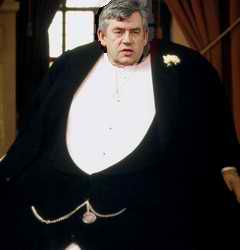 | Just one more waffer thin
slice off interest rates monsieur? |
He considers himself to be a political heavyweight, but it appears that Gordon Brown doesn't like being drawn as one. It has emerged this weekend that he has complained to newspaper cartoonists that they draw him on the rather large side –
"fat" was the word the PM used.
Brown is known to have brought the subject up with at least two national newspaper artists, including The Independent's Dave Brown, pulling them up on their portrayal of him and insisting: I'm not that
fat. A touch vain? Perhaps. |
| 19th January | | |
Websites encouraging suicide made illegal under the Justice Coronary Bill
| See article from
publications.parliament.uk |
The Government have included a clause in the Coroners And Justice Bill to extend the crime of encouraging suicide to websites and internet messaging services etc. Part 2- Criminal Offences
Clause 46:
Encouraging or assisting suicide: England and Wales
It provides that a person will commit an offence if he or she does an act which is capable of encouraging or assisting another person to commit or attempt to
commit suicide, and if he or she intends the act to encourage another person to commit or attempt to commit suicide. The person committing the offence need not know, or even be able to identify, the other person. So,
for example, the author of a website promoting suicide who intends that one or more of his or her readers will commit or attempt to commit suicide is guilty of an offence, even though he or she may never know the identity of those who access the website.
Clause 48 and Schedule 10: Encouraging or assisting suicide: providers of information society services
Ensures that providers of information society services who are established in England, Wales or Northern Ireland are covered by
the offence of encouraging or assisting suicide even when they are operating in other European Economic Area states. Paragraphs 4 to 6 of the Schedule provide exemptions for internet service providers from the offence
in limited circumstances, such as where they are acting as mere conduits for information that is capable, and provided with the intention, of encouraging or assisting suicide or are storing it as caches or hosts.
The Coroners
And Justice Bill also reinforces the general internet position that laws apply to a person or company that is established within the jurisdiction of the law even if the website or service is operated from elsewhere. Eg if British residents
use foreign internet services or web hosting they are still liable to UK law.
|
| 16th January | |
| Religious homophobia exemption clause to be deleted from UK Law
| Based on article from
pinknews.co.uk |
The new injustice bill contains a measure to protect people from incitement to hatred on the grounds of sexual orientation.
In May the Criminal Justice and Immigration Bill created for the first time an offence of incitement to hatred on the
grounds of sexual orientation.
However, an amendment by Tory peer Lord Waddington, a former Home Secretary under Margaret Thatcher, was added to the legislation.
His amendment to the offence of using threatening language with intent to
stir up hatred on grounds of sexual orientation said that urging someone to change their sexuality should not count of itself as threatening or as intended to stir up hatred.
While he claimed his amendment was about free speech, in
effect it gives people leeway to claim they were just following their religious beliefs when inciting others to hate gay, lesbian or bisexual people.
If Christians can argue that their faith gives them a get-out clause, it could make a
prosecution more difficult.
The Coroners and Injustice Bill, part of the government's legislative programme for this session of Parliament, contains a clause removing the Waddington amendment.
A spokesperson for gay equality organisation
Stonewall, told PinkNews.co.uk:
Last year, the House of Lords voted to retain an exemption to the new incitement to hatred protections. Stonewall believes this is unnecessary and could mean that a very small number of people of extreme views
attempt to avoid prosecution by citing a 'religious defence'. Stonewall is pleased that the government is now seeking to remove this exemption. It will mean stronger protection for lesbian, gay and bisexual people from those who stir up hatred against
them.
|
| 11th January | | |
|
Andy Burnham takes a pounding on fellow MP's website See article from tom-watson.co.uk |
| 5th January | | |
|
The Guardian comments on Burnham's bollox internet censorship idea See article from guardian.co.uk |
| 2nd January | | |
|
Government pipedreams on internet ratings doomed to fail See article from theregister.co.uk |
|
|