| 31st December | A Town fit for Nutters
From the Jakarta Post The Tangerang municipal administrationin Indonesia destroyed thousands of bottles of name-brand alcoholic drinks, pornographic pirated VCDs and six gambling machines
confiscated in a string of raids this month.
The raids were made as the introduction to the newly endorsed Bylaw No. 7/2005 that limits the sales of alcohol and includes regulations against piracy and gambling, said Mayor Wahidin Halim who
presided over the destruction at his office compound.
Tangerang Police chief Raja Erizman, Council speaker Krisna Gunata, chief judge Suhadi, chief prosecutor Bambang Rajardjo and religious figures also witnessed the mayor and staff as they
bulldozed at least 19,000 bottles of liquor and burned 31,061 VCDs and the gambling machines.
The municipal administration has set out to make Tangerang a "religious city" ... therefore I have also ordered officers to seize and
destroy pornographic calendars and posters sold by sidewalk vendors, Wahidin added.
|
| 29th December | Muslim Countries Called to
Boycott Danish Bacon From Denmark.dk An Islamic cultural organisation encouraged its members to boycott Denmark until an official apology was offered for drawings printed
in a national newspaper depicting the prophet Mohammed
The Islamic cultural organisation, ISESCO, has encouraged its 51 members to boycott Denmark, Danish daily Information reported on Wednesday.
Abdul Aziz Othman al-Twaijri, the
organisation's secretary general, told Arabic TV station Arabiya that a boycott was necessary until an apology was offered for the drawings printed in national newspaper Jyllands-Postent that depicted the prophet Mohammed: We encourage the
organisation's members to boycott Denmark both economically and politically until Denmark presents an official apology for the drawings that have offended the world's Muslims.
Tensions between Muslims in Denmark and abroad have run high since
the newspaper Jyllands-Posten published 12 cartoons in September that depicted the prophet Mohammed. The newspaper said printing the cartoons was a way to ensure the freedom of speech in the face of intimidation from radical Islamists.
Egypt's
ambassador to Denmark, Mona Omar Attiah, warned against not taking the boycott seriously: There is talk of a popular sentiment that could mean people stop buying Danish products.
Lars Erslev Andersen, a Middle East expert, suggested that
the international organisation's call for a boycott represented an attempt by individual countries to avoid a confrontation with Denmark.
The Ministry of Foreign Affairs told Information, however, that it had not been contacted by ISECO yet, nor
could trade organisation Danish Industry report that any of its members had experienced the effects of a boycott.
|
| 26th December | Tolerantly Baying for Execution
From the Washington Post An Afghan journalist who was recently sentenced to two years in prison for
publishing controversial magazine articles about Islam, women's rights and the Afghan justice system will be released from jail later this week, officials said.
Before gaining his freedom, however, Ali Mohaqeq Nasab had to confront an agonizing
choice: formally apologize for what he had published or risk being sent to the gallows.
Ali Mohaqeq Nasab, pictured in a newspaper photo, was sentenced to two years in prison for publishing offensive articles and is scheduled to be released this
week. After refusing for three months to retract his comments, Nasab told an appeals court this week that he was sorry for printing stories that asserted women should be given status equal to men in court, questioned the use of physical punishments for
crimes and suggested converts from Islam should not face execution.
A panel of three judges responded Wednesday by shortening his punishment to a six-month suspended sentence, allowing him to walk free.
The case has aroused concern among
international human rights groups and stirred contradictory passions in Afghanistan. Religious hard-liners here had called for Nasab's death; free speech advocates, women's rights backers and fellow ethnic Hazaras had asked that he be shown mercy.
As postwar Afghanistan tries to chart a path between religious traditions and modern democracy, Nasab's fate is being seen as an indicator of how much -- and how little -- the country has changed since the ouster of Taliban rule in 2001.
Nasab's release is an encouraging sign,
said Nader Nadery, who heads Afghanistan's Independent Human Rights Commission. But the case sets a bad precedent in the area of freedom of expression. It discourages journalists and promotes self-censorship. Nadery said other Afghan
journalists had already told him that they have to be very, very careful in the way that they talk.
Afghan news media have proliferated rapidly in the past four years, with newspapers, radio and television stations sprouting after more
than two decades of conflict. According to the new constitution, the media have broad freedom to publish and broadcast without fear of reprisal. But local leaders have physically intimidated reporters, and conservative judges have occasionally tried to
punish journalists who broach controversial topics.
Nasab returned to Afghanistan last year following a long exile in Iran and began publishing a magazine called Women's Rights. Articles in the May issue attracted the attention of a Muslim
cleric, who denounced Nasab as an infidel during Friday sermons.
When Nasab complained to officials in the justice system in September, he was detained on charges of blasphemy. Prosecutors said Nasab's articles -- including one that claimed God,
not the courts, should punish those who leave Islam -- proved he had abandoned his religion. They pushed for the death penalty, but a lower court gave him a two-year sentence.
That decision provoked an outcry among religious conservatives. A
council of 200 religious leaders in the southern city of Kandahar issued a fatwa , or religious edict, calling for Nasab to be hanged unless he repented. A division of the Supreme Court took a similar step.
Meanwhile, international human rights
groups lobbied on Nasab's behalf, and Western embassies here indicated to the government that they were watching the case closely. President Hamid Karzai carefully straddled the line, expressing support for a free press but insisting he could not
interfere in the decisions of an independent judiciary.
One of the appeals judges, Abdul Muqeem Atarud, said Thursday that he had heard from many people on both sides of the issue. We told them that if he did not repent, he would be executed.
It's the only way. It says in sharia that if someone repents for leaving Islam, he should be forgiven. So that is what happened.
|
| 23rd December | A Delicate Veil of Latex
Condoms save lives. I wonder how many more millions of lives would have been saved if Mary had been protected by a delicate veil of latex. From
The Guardian A British artist has outraged Roman Catholics around the world by advertising a statuette of the Virgin Mary enveloped in a condom in a
respected Jesuit weekly.
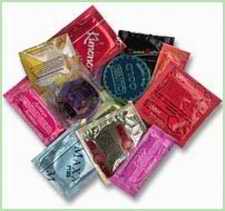 The artist, Steve Rosenthal, offered readers a chance to buy a "a stunning 22cm statue of the Virgin Mary
standing atop a serpent, wearing a delicate veil of latex". It provided an email address at which prospective buyers could register interest. The artist, Steve Rosenthal, offered readers a chance to buy a "a stunning 22cm statue of the Virgin Mary
standing atop a serpent, wearing a delicate veil of latex". It provided an email address at which prospective buyers could register interest.
In a front-page article in the Italian daily Corriere della Sera, Vittorio Messori, a literary
collaborator of the late pope John Paul, expressed horror at the way the sperm cup at the end of the condom had been arranged so as to sit on top of the Virgin's head, "like a grotesque cap replacing the royal crown of tradition". The Jesuit
weekly, America, which calls itself the US "national Catholic weekly", apologised in its latest issue. A spokesman told the Guardian: We made a terrible mistake by publishing this. We only saw the ad in black and white, so we didn't see how
serious it was.
Rosenthal, who is based in London, said last night his work had been "orchestrated" for publication coinciding with World Aids Day on December 1. The primary aim of the work is to highlight
the Vatican's continuance of non-advocation regarding the use of condoms. The description of the work was clear from both the text included and the image provided. America magazine happily accepted the insertion and billed me for $391. It has
subsequently refused to accept payment."
|
| 23rd December | Politically
Correct Christmas Proves Politically Incorrect From the Islington Gazette Muslims are
protesting at the Islington Council's "moronic anti-Christian purge" of Christmas.
The council declined to use the name "Christmas lights" this year - insisting on calling them "festive lights" instead. In Newington
Green there was an "inter-faith Celebration of Light" ceremony. Even many Islington schools now refer to the Christmas holiday as "the winter festival".
But Abuse Munassir, of the Al Nehar Mosque in Caledonian Road, King's
Cross, said: Blaming Christian traditions for being offensive to Islam is ridiculous and completely untrue. This practice is absolute madness. Islington's councillors must wake up and strive to create harmony and diversity rather than destroying it.
My younger Islamic community members are considering marching on Islington Town Hall in a peaceful protest against this anti-Christian moronic purge. I feel race incidents will occur unless this political-correctness nonsense ceases to exist.
Other faith leaders have backed Munassir's comments.
John Bradford, the information manager of the North London Buddhist Centre in Holloway Road, said: I can't imagine any Buddhists getting offended by Christmas lights and people celebrating
Christmas. The only sort of people who would get offended are the people who are over-sensitive and get offended by anything. But Buddhists are quite pluralistic about this sort of thing.
Father Jim Kennedy, of the Church of the Blessed
Sacrament in Copenhagen Street, King's Cross, added: All faiths support each other's festivals. As a multi-cultural society where, according to the 2001 census, religion is important to 77 per cent of the population, we need to celebrate each others'
festivals. Of the 77% of people claiming a faith allegiance, 72% claim Christianity as their faith. Are the majority not allowed to have their fun? What we should be doing is ensuring the minority religions have their fun as well and we should join in.
Generally the killjoys are those who have no faith and wish to expunge all concept of faith.
But councillor Laura Willoughby (Liberal Democrat), executive member for communities, said: Christmas is and always has been
coming to Islington. The only difference is that this year it's bigger and better than last year.
|
| 21st December | Ban is Music to the Ears of Nutters
From the Tahlequah Daily Press Iran's hard-line President Mahmoud Ahmadinejad has banned all
Western music from state radio and TV stations _ an eerie reminder of the 1979 Islamic revolution when popular music was outlawed as "un-Islamic" under Ayatollah Ruhollah Khomeini.
Today, though, the sounds of hip-hop can be heard
blaring from car radios in Tehran's streets, and Eric Clapton's Rush and the Eagles' Hotel California regularly accompany Iranian broadcasts.
No more _ the official Iran Persian daily reported Monday that Ahmadinejad, as head of the
Supreme Cultural Revolutionary Council, ordered the enactment of an October ruling by the council to ban all Western music, including classical music, on state broadcast outlets. Blocking indecent and Western music from the Islamic Republic of Iran
Broadcasting is required, according to a statement on the council's official Web site.
Music was outlawed by Khomeini soon after the 1979 revolution; Khomeini claimed it was "intoxicating." Many musicians went abroad and built an
Iranian music industry in Los Angeles. But as revolutionary fervor started to fade, some light classical music was allowed on Iranian radio and television; some public concerts reappeared in the late 1980s. But later, Khomeini allowed classical music to
be played over state radio. Since his death, pop music has been creeping into Iranian shops.
In the 1990s, particularly during the presidency of reformist Mohammad Khatami starting in 1997, authorities began relaxing restrictions further. These
days in Iran, Western music, films and clothing are widely available in Iran. Bootleg videos and DVDs of films banned by the state are widely available on the black market.
However, women are prohibited from singing in public, except to a
segregated female-only audience. Hard-liners were afraid the voice of a woman soloist might arouse impure thoughts in men. Women are allowed to sing as part of a chorus.
Earlier this month, Ali Rahbari, conductor of Tehran's symphony orchestra,
resigned and left Iran to protest the treatment of the music industry in Iran. Before leaving, he played Beethoven's Ninth Symphony to packed Tehran theater houses over several nights last month _ its first performance in Tehran since the 1979
revolution. The performances angered many conservatives and prompted newspaper columns accusing Rahbari of promoting Western values.
Ahmadinejad's order means the state broadcasting authority must execute the decree and prepare a report on its
implementation within six months. Ahmadinejad won office in August on a platform of reverting to ultraconservative principles, following eight years of reformist-led rule under Khatami. During his presidential campaign, Ahmadinejad also promised to
confront what he called the Western cultural invasion of Iran and promote Islamic values.
The latest media ban also includes censorship of content of films. Supervision of content from films, TV series and their voice-overs is emphasized in
order to support spiritual cinema and to eliminate triteness and violence, the council said in a statement on its Web site. The council has also issued a ban on foreign movies that promote "arrogant powers," an apparent reference to the
United States.
|
| 17th December | Feeding Frenzy of the 5000 Nutters
Based on an article from The Sun A Christmas magic show has sparked outrage amongst nutters by attempting
to recreate Bible miracles. Nutters slammed Channel 4’s The Magic of Jesus – which aims to see if eight New Testament ‘feat’ are really possible. Illusionists raise a headless corpse from the dead, cure a blind person, feed 5,000 football fans
with five loaves and two fishes and walk on water. John "Concentration Camp" Beyer, of mediawatch-uk, said: Channel 4 are, true to form, trying to court controversy by putting on a show like this at Christmas
time. An awful lot of people will be upset and this seems to me a calculated attempt to cause offence.
The hour long show from Objective Productions was commissioned by C4 and will be followed by 3BM Television’s controversial Tsunami:
Where was God? – scheduled for Christmas Day. C4 has also confirmed that Jamie Oliver will deliver its annual alternative yuletide address on Christmas Day.
|
| 13th December | Brethren Against Jerry Springer
Based on an article from the BNP The following is the report received from one of our British National Party
representatives who attended the recent meeting, called by concerned Christians to organise protest against next month’s showing of the Jerry Springer “musical” at Plymouth’s Barbican theatre.
The meeting was held in Catherine Street Baptist
Church and attended by over a hundred people representing the City’s Christian communities.
The meeting was opened with the motto of the city being read out, taken from Proverbs, “The Name of the Lord is a strong tower”, which continues, “The
righteous run into it and they are safe”!
There then followed a shared prayer led by Roy Beaumont of “Prayer for the City”, who had previously highlighted the reasons why Christians find the ”musical” so offensive. He was followed, in addressing
the gathering, by Stephen Green of Christian Voice.
Green suggested that a series of activities could be initiated which may persuade the Barbican theatre to abandon the production. He expressed enthusiasm for many activities like letter writing
to the theatre and local media, and for leafleting the audiences as they enter the theatre.
The meeting gave a round of applause on being told that Sainsbury’s had withdrawn the DVD of the “musical” from their shelves following representations
from Christian Voice.
At one point Councillor David Salter, Conservative member for Plympton Chaddlewood ward addressed the gathering.
Attendees were then invited to ask questions.
However one speaker was emphatic in blaming the
City Council for their implicit support of the production, particularly in the degree of financial support that they gave to the theatre and outlined a number of political issues closely related to the subject matter of the meeting.
Councillor
Salter predictably, in the opinions of our representatives, rebutted these criticisms of the Council, saying that it could not be blamed for an independent decision of the governing board of the theatre.
In conclusion the gathering was asked if
they felt that, after all that had been said, they were in favour of something practical being attempted? The general impression gained by the meeting organisers was in the affirmative. The points were made that everybody should act in accordance with
their own consciences and to undertake those protests that they felt able to do.
|
| 10th December | With All Due respect, We'll Look
Into It. From Denmark.dk . Daily newspaper Jyllands-Posten's twelve cartoons of the Muslim prophet Mohammed
are causing ripples across the world and worries at the Office of the United Nations' High Commissioner for Human Rights, Louise Arbour.
Arbour has sent a letter to the Organisation of Islamic Conferences (OIC), an international organisation of
56 Muslim states, which had complained over the cartoons.
In September, Jyllands-Posten called for and printed the cartoons by various Danish illustrators, after reports that artists were refusing to illustrate works about Islam, out of fear of
fundamentalist retribution. The newspaper said it printed the cartoons as a test of whether Muslim fundamentalists had begun affecting the freedom of expression in Denmark.
Muslims in Denmark and abroad have protested against the newspaper,
calling the caricatures blasphemous and a deliberate attempt to provoke and insult their religious sensitivities.
Arbour said she understood their concerns. I would like to emphasise that I deplore any statement or act showing a lack of
respect towards other people's religion, she said.
Daily newspaper Berlingske Tidende reported that it held a copy of the letter, which stated that Arbour had appointed UN experts in the areas of religious freedom and racism to investigate
the matter. I'm confident that they will take action in an adequate manner,' Arbour said in her letter to the 56 governments, which have requested the UN to address the issue with Denmark.
A diplomat from one of the countries told the
newspaper that the governments were pleased with Arbour's answer.
Foreign Minister Per Stig Møller said Arbour's involvement in the matter was natural, given her position. It's her job. She was contacted by the IOC, and she needs to look into
it. The wrong thing to do would have been if she ignored their request.
While Møller said Denmark would cooperate with a UN investigation, he reinforced that freedom of speech was a matter to be decided by the courts. It's up to the
courts to decide if Jyllands-Posten is guilty of blasphemy. The government has no say in that, Møller said.
|
| 8th December | In the Lap of Nutters
Based on an article from Unison A group working with women involved in prostitution is campaigning against the opening of Peter Stringfellow's lap dancing club on Parnell Street in Dublin.
RUHAMA is supporting the North Inner City Concerned Nutters in their attempt to prevent the club from being granted a dance license.
RUHAMA spokesperson Geraldine Rowley said it is internationally recognised that such clubs are part and
parcel of the sex industry.
Rowley said she is concerned that the club would create yet another breeding ground for prostitution.
She said she knew of women who went to clubs expecting to dance, only to discover that their contract had
changed, and that they would not get paid unless they provided private dances.
|
| 6th December | John "Concentration Camp" Beyer
See Response from John "Concentration Camp" Beyer of Mediawatch-UK From the Mediawatch-UK response to the Government consultation on the possession of violent pornography. We agree that the
possession of material listed in paragraph 39 of the consultation should be illegal but this list is too limited and should be extended to include material listed by the BBFC as suitable for classification at ‘R18’. The penalty appropriate for
these new offences should be a minimum of three years imprisonment with heavy fines and confiscation of assets and destruction of the guilty person’s pornographic articles, computer and/or video and DVD copying equipment. Penalties should also be
available for those who upload such images, Internet Service Providers who host it and telecommunications companies who allow access to it. Did I read something in the bible along the lines of : If thy neighbour's private bedroom pleasures offend
you, then pluck out his eyes and send him to prison for three years? Even if it does not appear quite like this in the bible I believe that it must have been an error in translation and the sense was indeed as above. I simply cannot believe
the depths of intolerance and persecution that supposedly religious people are descending too. How can any civilised person wish a 3 year prison sentence on the totally harmless bedroom activities of say a couple of million people. It is about
time religious bosses got their act together and stopped their religion from being hijacked by warmongers, torturers, child molestors, terrorists, violent mobs and Mediawatch-UK.
|
| 6th December | Voice of Intolerance
Based on an article from ic Liverpool Nutter Christian groups last night vowed to ban Jerry Springer: the Opera from being staged in Liverpool. The opera has been scheduled to appear at
the city's Empire theatre.
Christians in Liverpool say they will launch demonstrations against the musical in a bid to stop anyone watching it when it comes to the city next June. Alan Chester, of Christian Voice, who
is spearheading the demonstrations, said watching the opera made him feel physically ill: It did have a physical effect on me and I had to watch it in parts because to see it the whole way through would have made me sick. We pray to God in the name of
Jesus and ask for blessings for our city, but why should He when this is allowed and He is held up to foul, mocking ridicule in the name of so-called entertainment.
Chester said that, although he would not be advocating any form of violence,
he would try his hardest to persuade people not to see what he considers to be a deeply offensive play.
Catholic campaigner Kay Kelly said she had already telephoned the theatre to register her protest. She said she could not believe the play was
going to be staged in Liverpool, and wanted it taken off. |
| 6th December | Enlightened Moderation
From The Telegraph A poem in a school textbook has been removed by embarrassed education officials in
Pakistan after it was found that the first letters of each line spelt out "President George W Bush."
The 20-line anonymous poem, The Leader, lists the qualities of "a man who will do what he must" and bears a passing
resemblance to Rudyard Kipling's If.
An education ministry spokesman said it had no idea who wrote the poem nor how it found its way into A Textbook of English for 16-year-olds last year.
The acrostic is highly embarrassing for President
Pervez Musharraf, who is already under fire at home for being allegedly pro-American and supporting the US war against terrorism. America has even donated money to transform Pakistan's national curriculum into something
closer to western ideals. The result is a much-lampooned US-friendly philosophy called "enlightened moderation" which America has agreed to pay to disseminate in schools.
We have decided to delete the poem from the book, published by
the National Book Foundation and prescribed for federal board students, the spokesman told the Pakistani newspaper The News. It will be stretching the matter too far to assert that the poem was inserted in the book deliberately to enumerate the
qualities of the American president.
The official said the ministry was investigating how a series of committees employed to monitor and censor the contents of all textbooks failed to notice the acrostic. The poem would not appear in the next
edition of the book, he added. The book was printed in 2004 for the first time after the government in Islamabad decided to deregulate the publication of textbooks.
|
| 5th December updated 9th December updated 11th
December
updated 16th December Updated 26th December Updated 31st December |
Try Something New Today...A Different Shop Based on an article from
The Independent Shameful Sainsbury's & Woolworths have
bowed to pressure from a tiny fringe Christian nutters group by withdrawing copies of a DVD of Jerry Springer: The Opera from stores around the UK.
 Woolworths and
Sainsbury have both taken the unprecedented step of removing the film from shelves because of "customer" concerns about the content of the musical, released three weeks ago. Sainsbury has admitted it received just 10 complaints. Woolworths and
Sainsbury have both taken the unprecedented step of removing the film from shelves because of "customer" concerns about the content of the musical, released three weeks ago. Sainsbury has admitted it received just 10 complaints.
The
move has been condemned by those who see free speech being abandoned to self-appointed censors. Joan Bakewell, the chairman of the National Campaign for the Arts, said the withdrawal was "deplorable". The composer of the musical, Richard
Thomas, said: I think this is worrying for any artist.
The satirical production has been targeted by the campaign group Christian Voice since the start of the year after the BBC agreed to broadcast a performance of the show.
|
| 9th December | Update :
Sainsbury's told to Blog Off From the BBC
Shameful Woolworths said it does not wish to act as censor BUT ... it was responding to "numerous complaints" by customers.
Sainsbury's said it received 10 to 20 complaints which should be regarded in the context that it very rarely gets any complaints about DVDs
It's this big effect that a small number can have that's both infuriating and inspiring the bloggers who
want to get Jerry Springer: The Opera back in the shops.
Free-flowing information is much-valued in the blogosphere, and the anti-Springer campaigners have brought together in opposition pagans, secularists, one MP, some gay and lesbian
humanists, lawyers and Gagwatch, the anti-censorship blog which has as its logo a picture of Theo Van Gogh, the Dutch film-maker murdered by Islamic fundamentalists a year ago.
One such "concerned citizen" is Chicken Yoghurt:
Remember those heady days after July 7 and the stoicism showed by this Bulldog Nation (or whatever shorthand the papers coined for ease of consumption)? I thought we weren't in the business of letting fundamentalists dictate how we live
our lives and what we read and watch in our own homes, theatres, and cinemas. I thought we weren't going to give in to threats and blackmail. It would seem we are after all. So what have the bloggers got planned?
Well, one thing they've noticed is how the internet can be a better spur to action around an event than the event itself. 84% of the complaints to the BBC were before the programme had been shown; likewise Janet Jackson's nipple didn't prompt a single email complaint until the circular emails urging folk to "write the FCC" appeared in subsequent days. They're two of the more prominent examples of a trend described by Blithering Bunny as "protests from non-PC groups".
This is more or less the model that the pro-Springer bloggers are going for, too: letting the news of the decision bounce from political weblogs to free speech ones; from personal sites to religious ones. The chief - and familiar - tactic is a
consumer boycott - the letters are going out to Sainsbury's and Woolworths telling them they'll be losing Christmas trade, and Tim Ireland of Bloggerheads has even CC:ed Father Christmas.
Will they make themselves heard? Weary of receiving
standardised replies, they're also plotting to buy shares in the relevant corporations so as to be able to raise merry hell at AGMs. They're also pledging to complain to store managers in person.
But as we've seen, it's not force of numbers that
made the anti-Springer case compelling. Another approach would be to persuade the supermarket chains that bloggers can be just as zealous and single-minded as any religious followers. You never know - it might just work.
|
| 9th December | Update:
Inequity to Equity Letter from Martin Brown, Equity Campaigns, Press and PR Officer (Equity represent those that work in the media industry) You may have read in the press that both Sainsbury’s and Woolworths have withdrawn from sale DVDs of Jerry Springer - The Opera after receiving complaints from the public. This is the same production of Jerry Springer - The Opera which was subject to protests when the BBC screened it.
When Equity approached the two companies, Sainsbury's press office said that they had received around 20 complaints but Woolworths would not reveal the number of complaints it had received other than to say it was "substantial".
Equity is very concerned about the action of the two companies and General Secretary Christine Payne has issued the following statement
"Equity is opposed to the action which Woolworths and Sainsbury's have taken on two grounds. Firstly,
Equity strongly supports artistic freedom and equally strong opposes censorship in all its forms, however offended any individual may feel themselves to be by a particular piece of dramatic art.
“Secondly, Equity members derive income from the
sales of recorded material, including DVDs, and so stand to lose income from actions such as these.
"Equity is inviting all of its members to make their views known to Sainsbury’s and Woolworths about these acts of censorship."
|
| 11th December | Update:
Sainsbury's respond It seems that the 2nd weeks sales may have been so poor because Sainsbury's had already started to withdraw it from the
shelves. And thanks to Anthony: I wonder whether Sainsburys and Woolworths were so keen to listen to complaints from outraged Christians who complained about Halloween products, which clearly annoy many
Christians but are a huge moneyspinner for both companies. Thanks to Paul It would be interesting to find out if they follow this policy with all titles with low sales, although I
somehow doubt it. It would make sense for a small shop to do this, but a shop the size of Sainsburys would just swallow up any low sales of any one product. I sent an email to Sainsburys objecting to their decision to stop
selling Jerry Springer: The Opera . Thought you might be interested to read their response:
Thank you for contacting us. I am sorry you have been disappointed by our decision to withdraw Jerry Springer, The Opera from sale in our
stores. As there has been lots of interest in this matter I would like to clarify why the title was taken out of our range.
We sell many DVD titles throughout the year and our range changes from week to week based on what customers want and, of
course, sales. In the first week that Jerry Springer, The Opera was released, we sold only 111 copies in all stores nationwide and received a high number of complaints from unhappy customers. In the early part of the second week we sold only 21
more copies and received further complaints. Due to these very poor sales figures this DVD would have been withdrawn at the end of the week, but in view of the complaints we had received we removed it a few days earlier than planned.
Please be
assured that, as a company, we feel it is our responsibility to offer choice. We do not feel it is right for us to tell our customers what they should or should not buy. However, in this case sales were so low that we did not think removing this title
would have a negative impact on our customers and we wanted to give them a choice of more popular titles.
Thank you for taking the time to let us know your views on this matter and for giving us a chance to explain the reasons behind our
decision.
Scott Levers
Sainsbury's Customer Services
|
| 12th December |
Update : Institutionalised Nutters The uncut region 2 DVD is available at UK
Amazon . It has got to be great Melon Farming Chrsitams gift for any uptight distant family members
From MediawatchWatch Homophobic fundamentalists The Christian Institute have added their voice to the anti-Springer crowd. This from their mail shot: We
are absolutely delighted that Sainsbury’s has withdrawn from sale the DVD of Jerry Springer The Opera.
Woolworths says it has withdrawn the DVD from its stores because it has not been commercially popular. However, the DVD is
available to buy from its website.
The DVD is also being sold by ASDA, Tesco and WHSmith. Can you imagine these stores selling a DVD of a racist hate show, or an anti-Muslim video? Yet it seems to be OK to sell a DVD of an anti-Christian hate
show.
If you would like to object to these stores offensive decision to sell the DVD in the run up to Christmas, please see: www.christian.org.uk/js_opera Our website also provides more information about why
this show is so deeply offensive and blasphemous.
Their dedicated Springer page provides contact details to Tesco, Asda, and WHSmith - very useful for sending messages of support. Thanks, CI.
So, if
you are going to buy the DVD this Xmas, it might be a good idea to get it from one of those shops - and congratulate them on not being spineless appeasers.
|
|
16th December | Update : Parliament Spring into Motion
From MediawatchWatch Springer questions asked in Parliament.
Lib Dem MP for Bath, Don Foster, has tabled an early day motion deploring the decision by Sainsbury and
Woolworths to remove the Jerry Springer, The Opera DVD from their shelves. He calls on the Government to ensure that freedom of expression remains a central principle of our society.
The motion complains that vociferous minority
pressure groups now increasingly target works of art with the outcome that the majority are sometimes denied the choice to judge works for themselves.
And it calls on the Government to ensure that freedom of expression remains a central principle
of our society, and so protect the ability of individuals to explore comprehensively and lawfully all aspects of our culture. The EDM is already enjoying cross-party support with seven signatures from MPs including Labour’s
Glenda Jackson and the Conservative Party’s Peter Bottomley.
|
| 26th December |
Update : Tesco & Asda Pander to Nutters Based on an article from the
Christian Institute
Following complaints about the sale of the Jerry Springer the Opera DVD, Sainsbury's and Tesco have
stopped selling it in their stores. Asda and Woolworths are also not selling it, but because it has not been 'commercially popular'. Unfortunately, Tesco, Asda and Woolworths are still selling the DVD from their websites. WH
Smith have been harangued but are still selling the DVD The train operator GNER have encouraged the readers of their Livewire magazine to go and see something they describe as "crashing through every barrier of
taste".
|
| 31st December | Update :
Christian Institute and a Claim Too Far From MediawatchWatch It seems the Christian
Institute may have been mistaken about Tesco banishing Jerry Springer: The Opera from its shelves. A subscriber to the NSS mailing list received this response from Wayne Hansen at Tesco customer services:
I can advise we are still selling Jerry Springer the Opera. It has been certified for sale in the UK by the BBFC.
As such we feel it is the individuals choice as to which films they choose to watch. People who may be
offended by certain titles have the choice not to view them.
|
| 5th December | Nutters with Stars in their Eyes
Based on an article from The Telegraph A Christian mission that was founded by a former stripper
is helping lap dancers and porn viewers, actors and actresses to find God.
Members of JC's Girls are touring strip clubs in California, where they pay for private dances and use their time alone with the performers to try to convert them.
Heather Veitch, a former stripper and nude dancer, formed JC's Girls ‘a biblically-based Christian ministry’. So far, the six-month-old enterprise has encouraged several strippers to start going to church. She launched the project after a friend she had
worked with at Club 215 Showgirls in Colton, California, died of alcoholism: My friend was angry and bitter and never had a chance to know that what she had done in her life could be forgiven. I knew I had to go back into the clubs and talk to
strippers about God. There is nothing that they have ever done that God will not forgive them for.
She said that while she was working as a stripper with a big drink problem and an out of control lifestyle" she felt too intimidated to
go into churches. I thought, if it's like that for dancers, it must be a lot worse for porn stars. So we developed the website to reach out to them.
Veitch said that the missionaries had been asked to stop only once. Everything I thought would happen - that we would be hated, thrown out, yelled at - hasn't happened.
|
| 4th December | Tolerantly Offering a
Reward for Murder From Denmark.dk . Bounty put on prophet cartoonists' heads
The Ministry of
Foreign Affairs warns Danish travellers to Pakistan of increased hazard after a Danish newspaper published cartoons of Muslim prophet Mohammed
What began as a protest demonstration in Pakistani capital Islamabad two weeks ago, has ended in death
threats and a price on the heads of a number of Danish illustrators who heeded the call of daily newspaper Jyllands-Posten to send in cartoons of Muslim prophet Mohammed.
The newspaper published twelve of the cartoons in September, sparking angry
reactions from Denmark's Muslim population and a number of Muslim countries.
Daily newspaper Berlingske Tidende reported on Friday that a bounty of DKK 50,000 (EUR 7000) had been put on the head the cartoonist responsible for the drawings. The
Pakistani group offering the reward mistakenly believes that the 12 cartoons were created by just one person.
Danish Ambassador to Pakistan Bent Wigotski said the bounty had been promised by religious party Jamaate-Islami and its youth
organisation, which had also demanded Danish representatives expelled from the country.
Danish authorities immediately informed the Pakistani government about the death threats and bounty promised by the party, which is described as nationalistic
and fundamentalist.
Ever since the demonstrators marched through the streets of Islamabad, the party has been spreading its message through the media and flyers.
Wigotski said he had no plans to leave Pakistan, despite hundreds of angry
protest letters from Muslims around the world. But the situation is of course serious. They might want to get to the Danish illustrators, but if they can't reach them, they could make to with a scapegoat.
That scapegoat could be anybody,
the embassy warned, and the Ministry of Foreign Affairs has warned all travellers from visiting Pakistan because of heightened risk of violence.
Pakistani Ambassador to Denmark Javed Qureshi denounced the death threats. No Pakistani government would ever support such a thing, I'm sure that the current government will take action in the case. I can't imagine that a bounty like that doesn't violate Pakistani legislation
|
| 2nd December | A Nutters Kiss
Thanks to Dan A pre-watershed lesbian kiss on top BBC soap EastEnders triggered 20+ complaints from nutters, the corporation confirmed today.
The scene at the end of Monday night's
episode involving Sonia Fowler, played by Natalie Cassidy, and her student pal Naomi Julien, played by Petra Letang, ended in a snog after Sonia bemoaned the state of her marriage to barrow boy Martin Fowler.
John Beyer, of Mediawatch said: It's par for the course now for television soaps. The whole shockability has gone out of that thing these days. As it was before the watershed we urge people who found it offensive to contact the BBC. We are aiming to make producers and broadcasters more accountable for what they screen."
A BBC spokeswoman refused to reveal if the lesbian storyline would be developed further
|
| 1st December | Nutter Assistance with a Melon Farming Christmas Games List
From www.familymediaguide.com Family Media Guide has prepared a list of the Top 10 Most Violent Video Games released so far this year. Utilizing a proprietary audit process, the company's trained video game analysts capture and document instances of profanity, sex, violence, and substance abuse using a database-driven technology employing approximately 4000 rules and algorithms governing millions of potential rule combinations.
Here is the list, with the games ranked in no particular order:
- Resident Evil 4 – Player is a Special Forces agent sent to recover the President's kidnapped daughter. During the first minutes of play, it's possible to find the corpse of a woman pinned up on a wall — by
a pitchfork through her face.
- Grand Theft Auto: San Andreas – Player is a young man working with gangs to gain respect. His mission includes murder, theft, and destruction on every imaginable
level. Player recovers his health by visiting prostitutes then recovers funds by beating them to death and taking their money. Player can wreak as much havoc as he likes for no reason without progressing through the game's storyline.
-
God of War – Player becomes a ruthless warrior, seeking revenge against the gods who tricked him into murdering his own family. Prisoners are burned alive and player can use “finishing moves” to kill opponents
like tearing a victim in half.
- Narc – Player can choose between two narcotics agents attempting to take a dangerous drug off the streets and shut down the KRAK cartel while being subject to
temptations including drugs and money. To enhance abilities, player takes drugs including pot, Quaaludes, ecstasy, LSD and “Liquid Soul” – which provides the ability to kick enemies' heads off.
- Killer 7
- Player takes control of seven assassins who must combine skills to defeat a band of suicidal, monstrous terrorists. The game eventually escalates into a global conflict between the U.S. and Japan. Player collects the blood of fallen
victims to heal himself and must slit own wrists to spray blood to find hidden passages.
- The Warriors – Based on a 70's action flick that set new standards for “artistic violence,” a street gang
battles its way across NYC in an attempt to reach its home turf. Player issues several commands to his gang, including "mayhem," which causes the gang to smash everything in sight.
- 50 Cent: Bulletproof
– Game is loosely based on the gangster lifestyle of rapper Curtis “50 Cent” Jackson. Player engages in gangster shootouts and loots the bodies of victims to buy new 50 Cent recordings and music videos.
-
Crime Life: Gang Wars – Player is the leader of a ruthless street gang, spending time fighting, recruiting new gangsters, fighting, looting, and of course, more fighting. Player can roam the streets and fight or
kill anyone in sight for no apparent reason.
- Condemned: Criminal Origins - Player is an FBI serial killer hunter in one of the first titles for the Xbox 360. Game emphasizes the use of melee
weapons over firearms, allowing players to use virtually any part of their environment as a weapon. The next generation graphics provide a new level of detail to various injuries, especially “finishing moves.
- True Crime:
New York City - Player is a NYC cop looking for information regarding the mysterious death of a friend. Player can plant evidence on civilians and shake them down to earn extra money.
|
| 28th November | Uniform Nutterdom
From the Iran Press Service After a period of some tolerance under former president Mohammad Khatami, Iran is now experiencing a cultural clampdown. President Mahmoud Ahmadi Nezhad is implementing
the hardest of hardline ideological tendencies in the cultural arena, consistent with his belief that his administration should prepare the country for the reappearance of the hidden imam (who is now more than a thousand years old). To this end, Ahmadi
Nezhad has taken a host of provocative steps regarding:
The Ministry of Culture and Islamic Guidance. The new minister, Mohammad Hossein Saffar Harandi, was a member of the Revolutionary Guard. In his position as deputy editor of the hardline
“Kayhan” newspaper, Harandi wrote many articles condemning democracy as a Western model for governing, pluralism as an “effective weapon of the West to achieve their cultural invasion into Islamic world”, and freedom of speech as a way to destroy
people’s religious beliefs.
The Supreme Cultural Revolution Council (SCRC). In its first session under Ahmadi Nezhad, the SCRC adopted a circular banning all movies that propagandize for schools like secularism, liberalism, nihilism, or
feminism, and destroy the authentic cultures of religious societies and humiliate them. The circular emphasizes that all movies that explicitly or implicitly deny the right of religion to govern, or that show secular regimes as superior to their
religious counterparts, are forbidden. Many Iranian directors, like Bahram Bayza’i, experience delays lasting into years receiving permission to produce films, and many others, like Abbas Kiarostami, cannot show their work in Iran. Some Iranian
filmmakers, like Mohsen Makhmalbaf, prefer to live abroad in order to pursue their art in freedom and safety.
Journalism. Masha’allah Shamsolva’ezin, spokesman for the Tehran-based Association for Advocating Freedom of Press, said that state
pressure on journalists has increased since Ahmadi Nezhad took office. According to Shamsolvaezin, the culture ministry, in cooperation with intelligence and security forces, has in recent weeks called in many journalists for questioning without apparent
reasons.
The goal clearly is to intimidate them. Many of those pressing journalists are former employees of the Ministry of Intelligence who were fired under Khatami for their involvement in killing intellectuals and political activists. Instead
of arresting journalists and sending them to Evin Prison, Tehran seeks to reduce international notice of its intimidation of journalists and political activists by putting psychological pressure on them. Even the families of victims are threatened
against speaking about the intimidation.
Book publishing. The process of issuing permission to publish books of literature and the human sciences has practically ground to a halt. All books, even Qor’ans, must receive official permission for
publication from the culture ministry. Writers and publishers say that the censorship regulations have become stricter since Harandi took over the ministry. The young writer Hossein Sanapoor, for example, opted not to publish his planned book of short
stories because censors asked him to eliminate four stories that, taken together, represented the majority of the book.
Musical performances. Since September, the Culture Ministry has cancelled more than thirty concerts. The ministry has also
announced the cancellation of the Fajr Music Festival on the grounds that it would overlap with the period of Moharram, the mourning ceremonies for the Shi’ite third imam, but after seeing the extent of public dissatisfaction and its negative impact on
Ahmadi Nezhad’s image, the ministry allowed the festival to take place at a later date. The rescheduled festival will differ from recent years, though, focusing on religious music.
Restrictions on women. Since Ahmadi Nezhad’s election,
conservatives have been campaigning to impose a single national dress code for women. Parliamentarians have introduced numerous proposals for defining “national dress,” which would oblige all women in state offices, universities, and other public places
to wear a unique “Islamic” costume.
University curricula. Ahmadi Nezhad has promised to Islamize the universities. Ten university presidents have quit or have been dismissed as a result. In early November, the new minister of Sciences, Research,
and Technology, Mohammad Mehdi Zahidi, went to Qom, where the clergy urged him to cleanse the universities of “enemies of the Islamic revolution” and to incorporate religion into all levels of education. In Iran’s universities, this would mean making
fundamental modifications to the content of textbooks to make them compatible with religious tradition; erasing Western culture from textbooks; and forcing women to study in their native cities in order to maintain their morals by being in the family
home.
University dress codes. On the first day of the current academic year, security agents handed university students a flower and an announcement. Students were urged to respect Islamic values, specifically including a detailed dress code for
women, asking them to prefer a chador (a gown covering the full body) or to wear a simple long coat in a dark color. Perfumes and cosmetics are not to be used. Male students should wear loose-fitting, long-sleeved shirts that cannot be thought to
follow Western culture or other banal cultures . The announcement concludes with a warning that students who disrespect the recommendations will be punished in accordance with university rules.
The National Youth Organization. Ahmadi Nezhad
has appointed Ali Akbari to head the National Youth Organization, a state organization that has a large budget and enormous authority over government and nongovernmental organizations related to youth affairs. Under Akbari’s leadership, the National
Youth Organization is working closely with the Basij militia and other military organizations to advance radical propaganda.
Ahmadi Nezhad’s cultural strategy is to trust influential positions and institutional responsibilities either to former
Revolutionary Guard commanders or to young radical clerics. The president’s cadre of reactionary apparatchiks seek to control cultural production and creativity more than ever before in the history of Islamic Republic—but this does not mean that Iranian
society will surrender.
Despite great pressure, increasing restrictions, and the threat of punishment, underground culture has dominated Iran’s social and cultural scene for some years now. The gap between young people and the government is
growing wider and deeper. Despite the regime’s many mechanisms for keeping the Iranian people closed off from the world, Iranian youths are more Westernized now than at any other time in contemporary history.
|
| 28th November | Assemblies of Nutters
Based on an article from The Age A nutter campaign to try to stop Shepparton's first brothel from opening
helped elect two members of the Christian right to Greater Shepparton Council at the weekend.
Salvation Army welfare workers Sondrae Johnson and Dallas Terlich, who campaigned heavily against the brothel and a sex shop that is yet to open, got
strong voter support for seats on the seven-member council.
Johnson said she firmly believed the Shepparton community had "voted for change" by electing "Christian conservatives" to council. We've both been heavily involved
in stopping this brothel … we have huge concern in Shepparton about a brothel being established here and the council has chosen to ignore us.
Johnson, a member of the Mooroopna Christian Community Church — part of the Assemblies of God
movement gaining influence across the country — says her Christianity doesn't qualify me to do anything, but explains why I do it.
|
| 28th November | Burning Anger
From Christian Today The Archbishop of Canterbury Dr Rowan Williams has urged the reform of Pakistan’s Blasphemy laws
during an eight-day tour primarily of earthquake-stricken regions this week.
The Archbishop expressed his fear that the country’s blasphemy law, which makes desecration of the Koran punishable by death, was being used to “settle private scores”,
with many Christians arguing that the law is being used as an excuse to attack them.
The Christian community of Sangla Hill suffered an attack just last week in which around 2,000 Muslims destroyed churches and Christian properties, following
allegations that a young Christian man had burned a copy of the Koran.
Dr Williams told reporters the Sangla Hill incident had focussed attention on the problems caused by the blasphemy laws. I think it is widely recognised that the abuse of
the blasphemy laws is a major problem which this country has to tackle; the problem is not so much the idea of a law against blasphemy as about a law whose penalty is so severe and whose practice gives so much scope for allowing people to settle private
scores. I was able to speak to the President directly about this and the problem is certainly widely recognised.
AFP quoted one Christian community leader, Peter Jacob, as saying: Blasphemy law has always acted as a
lethal sword against the minority communities. Its repeal is our longstanding demand.
|
| 27th November | Catholics Aid AIDS
From Christian Today The Catholic Church in Scotland has criticised plans by a condom manufacturer to provide taxi
drivers in Edinburgh with condoms to give out to couples for free on their way home after a night out.
If the plans are approved by council officials, the Safe Ride scheme could be launched as early as January, reports the BBC.
The Family
Planning Association (FPA) in Scotland has welcomed the scheme, also under consideration by Glasgow City Council, against the concerns of the Catholic Church. FPA spokesman Tim Streets praised the plans: “I don’t really have a problem with people
finding it a bit funny, at least at first. Let’s get the giggles out of the way, We’re talking about protecting people’s health and getting them to see that, even after a night out on the town and maybe being inebriated, this is a serious issue.
Edinburgh’s City Council’s licensing committee has been considering the initiative involving Festival City Cars. Company manager David Coutts, said: It seems sensible that the cabbies, if they’re asked by the passenger, would make such
facilities available. I appreciate that some people might look upon this as being a bit humorous but it is a serious campaign.”
The Catholic Church in Scotland has raised serious concerns over the campaign, however. This will give the
green light to casual sex, ” cautioned Church spokesman Peter Kearney. It’s also very dangerous to suggest condoms absolutely prevent sexually transmitted infections as they don’t.
The 5,000 free contraceptives have been distributed to
the taxi firm, which has a fleet of 220 cars, by a US contraceptives company. The Edinburgh scheme follows the launch of a similar scheme earlier this year in Brighton, supported by boxer Chris Eubank.
|
| 26th November | Taking the Rap
We wouldn't like to think that the French unrest was caused by MPs' own policies now would we. Far better for them to pin the blame on some ludicrous media hook. If some MPs show this level of incompetence in their analysis of
the causes of unrest, then it is hardly surprising that they have proven incompetent in policy making. From the BBC
A French MP has publicly accused rappers of fuelling the country's recent riots with their songs. It comes a day after 200 politicians backed his petition calling for legal action against seven rap musicians and bands it alleges have incited racism.
The petition, handed to Justice Minister Pascal Clement, has been signed by 153 members of the lower house of parliament and 49 senators.
MP Francois Grosdidier said it was no surprise youths "saw red" after
listening to violent lyrics. Grosdidier, a member of President Jacques Chirac's conservative ruling UMP party, said songs like Monsieur R's FranSSe incite racism and hatred, and should be banned from radio play. When people hear
this all day long and when these words swirl round in their heads, it is no surprise that they then see red as soon as they walk past policemen or simply people who are different from them. The French Prime Minister,
Dominique de Villepin, however dismissed the claims by some of his party colleagues that rap music fuelled suburban rioting in France. de Villepin told French radio that he wanted to avoid finger-pointing about the origins of the unrest. But he said that
the courts should deal with lyrics that overstepped the mark.
Speaking on French radio, de Villepin said: I very much wish during this period - it is one of my primary responsibilities - to avoid any sort of confusion or finger-pointing.
Is rap responsible for the crisis in the suburbs? My answer is no.
Rapper Monsieur R, one of those singled out in the petition, rejected the idea, saying rap is not a call to violence.
As well as Monsieur R, it names artists
Smala, Fabe and Salif and bands Ministere Amer, 113 and Lunatic. Monsieur R, real name Richard Makela, already faces a separate lawsuit for "outrage to social decency" over the song FranSSe, brought by another
conservative MP and to be heard in February. The rapper told LCI television: Hip hop is a crude art, so we use crude words. It is not a call to violence. Four members of the rap group Sniper were
acquitted earlier this year in Rouen, northern France, in a case brought by the Interior Ministry over a song it alleged incited attacks on the police. An appeal is due to be heard next month. French authorities said the
situation had returned to normal last week, following three weeks of unrest that affected dozens of towns and cities. Nationwide, almost 9,000 cars were set ablaze and some 3,000 people were arrested. The French parliament last week approved a
three-month state of emergency.
|
| 26th November updated 27th November |
Fearing a Tolerant Backlash From The Times Marlowe's Koran-burning hero is censored to avoid Muslim anger
It was the surprise
hit of the autumn season, selling out for its entire run and inspiring rave reviews. But now the producers of Tamburlaine the Great have come under fire for censoring Christopher Marlowe’s 1580s masterpiece to avoid upsetting Muslims.
Audiences
at the Barbican in London did not see the Koran being burnt, as Marlowe intended, because David Farr, who directed and adapted the classic play, feared that it would inflame passions in the light of the London bombings.
Simon Reade, artistic
director of the Bristol Old Vic, said that if they had not altered the original it would have unnecessarily raised the hackles of a significant proportion of one of the world’s great religions. The burning of the Koran was “smoothed over”, he
said, so that it became just the destruction of “a load of books” relating to any culture or religion. That made it more powerful, they claimed.
Members of the audience also reported that key references to Muhammad had been dropped, particularly
in the passage where Tamburlaine says that he is “not worthy to be worshipped”. In the original Marlowe writes that Muhammad “remains in hell”.
The censorship aroused condemnation yesterday from senior figures in the theatre and scholars, as well
as religious leaders. Terry Hands, who directed Tamburlaine for the Royal Shakespeare Company in 1992, said: I don’t believe you should interfere with any classic for reasons of religious or political correctness.
Charles Nicholl, the
author of The Reckoning: The Murder of Christopher Marlowe, said it was wrong to tamper with Marlowe because he asked uncomfortable and confrontational questions — particularly aimed at those that held dogmatic, religious views. Why should Islam be
protected from the questioning gaze of Marlowe? Marlowe stands for provocative questions. This is a bit of an insult to him.
Reade said that Farr felt that burning the Koran “would have been unnecessarily inflammatory”. The play needed to be
seen in a 21stcentury context, he believed.He said: Marlowe was not challenging Muslims, he was attacking theism, saying, ‘I’m God, there isn’t a God’. If he had been in a Christian country, a Judaic country or a Hindu country, it would be their gods
he’d be attacking.
Inayat Bunglawala, the media secretary of the Muslim Council of Britain, disagreed, saying: In the context of a fictional play, I don’t think it will have offended many people.
|
| 27th November | Fearing a Tolerant Backlash: Update
From The Guardian The director and adaptor of Tamburlaine , David Farr, responds to
yesterday's story in the Times.
It is complete nonsense to suggest, as the Times did yesterday, that my decision to alter the burning-of-the-books scene in Tamburlaine was based on a desire to appease Islamic opinion. As I made clear, my decision
to adapt the text was purely artistic. Journalists and academics often forget that theatre directors are dealing with living texts. We constantly adapt, chop, cut and change to make the work vibrant and rigorous for a modern audience, to present our
particular vision in as limpid a way as possible.
Marlowe knew how to sell a play. Anti-Turkish feeling was running high in 1587 (think of the Turk's Head pubs still dotted around today). The Ottoman empire was a threat to the great western
hegemony - the unknown dark enemy threatening all that was great about Europe. The 23-year-old boy-wonder Marlowe tapped brilliantly into a well of anti-Turk feeling to make his first Tamburlaine (now known as part one) a huge hit, with the lead
character as a kind of surrogate Christian avenger tearing the heart out of the dark Ottoman soul.
When the play proved a smash hit, like all good Hollywood writers, Marlowe wrote a sequel (part two), with another Turkish antagonist, more
beatings and more cruelty. Marlowe's were not the only Turk-bashing plays of the time (others included A Christian Turned Turk by Robert Daborne and Selimus by Robert Greene), but his were the best. In both parts he gave his audience lashings of
anti-Turk delights - brainings, whippings and burnings. Tamburlaine is partly a gleefully racist comedy. And they loved it all the more for that.
Marlowe's play is remarkable, then, in that it is both anti-Turk tosh and a masterpiece of
philosophical defiance. What I did in my version was to focus ruthlessly on the philosophical freedom of my lead character in a pared-down version that took the two plays (seven hours) into one three-hour evening. This involved ripping apart the play,
and choosing to focus only on what interested me. That's my job. The scene in question is crucial to the play's narrative arc and was kept in - Tamburlaine did burn the Qur'an centre-stage in an old petrol drum - but I wanted to make it very clear that
his act was a giant two fingers to the entire theological system, not an piece of Christian triumphalism over the barbarous Turk. So, in our production, Marlowe's "heap of superstitious books" were the books of all religions. His act was a
hubristic and nihilistic defiant scream at what he saw as an empty universe.
In our production, Tamburlaine's god does not belong to any religion, for they are all in hell. "Seek out another godhead to adore. The god that lives in heaven, if
any god. For he is god alone, and none but he." The phrase "if any god" becomes key. Tamburlaine is positing what Marlowe could never have proposed at that time without literally risking his neck. He is proposing atheism.
One other
thing should be made clear. Never in our rehearsal discussions did we receive any pressure from the Muslim community - this was never the question. Never did we receive any pressure from the Young Vic or the Barbican to change any scenes. Never did I
receive external pressure of any kind. The decision to focus the play away from anti-Turkish pantomime to an existential epic was artistic, mine alone, and I stand by it.
|
| 18th November | Computer Games Club of Nutter MPs
From the Daily Mail
From Hastings Today
Shameful David Cameron has promised to campaign against violent music and computer games if he becomes Tory leader, saying they are fuelling the rise in
anti-social behaviour. The favourite to win the race to succeed Michael Howard said a government must demand help from those who shape popular culture if it is going to have any hope of tackling crime. He said he would build
a ‘comprehensive anti-crime policy’ that would ‘not only strengthen the criminal justice system, but re-civilise our society’. Meanwhile shameful MP Michael Foster is
backing calls for a ban which will prevent the video game called Bully being sold in Hastings shops.
Foster believes the game could glamourise bullying and lead to incidents in local schools. The game is due to be released by Rockstar
Games. Calls for the ban are being led by the nutter MP Keith Vaz. Michael Foster said: This game allows the person playing it to take on the persona of a bully, able for instance to kick and punch other pupils and spit in
their food. I think that can only encourage young people to find pleasure and excitement in abusing others."
A Rockstar Games spokesman said: Bully is still a work-in-progress, but when it's finished we believe
most people will agree it offers an exciting experience and tells an engaging story. More and more people are beginning to recognise the stories in video games have as many themes and plotlines as books and movies. Just as books aren't judged by their
covers, video games shouldn't be judged by their titles or individual scenes. The game would be "submitted to the appropriate bodies" to be rated, he added.
Roger Bennett, director general of the
Entertainment and Leisure Software Publishers Association, said: As Mr Vaz knows, any game can be automatically referred to the BBFC for a rating. It is disingenuous to suggest any game be banned when the content has yet to be finalised.
Foster said:
I understand the company has suggested the game might have an 18 rating but we all know this does not stop children accessing them. I really hope we can take action against this kind of irresponsible game. As a society we should
be encouraging children to be compassionate and understanding towards others, not glamourising bullying.
|
| 15th November | Hype will Prove a Shot in the Arm for
50 Cent Based on an biased article from The Times Anti-gun nutters have called on stores to withdraw a computer game starring the rapper 50 Cent and described as one of
the most violent to be released.
The BBFC have given 50 Cent: Bulletproof , released next week, an 18 rating for its frequent strong bloody violence . Players follow the rapper from crack-dealing gangster to superstar by gunning
down, stabbing or garroting rivals.
The £30 package includes an album of new material as an inducement to his audience of largely teenage fans. It is expected to be the top seller in a Christmas gaming market that promises a range of
18-rated games marketed on their violent content.
Nutters are angry that Bulletproof glamorises the “gangsta” lifestyle of 50 Cent. He claims to have been shot nine times and always wears a bulletproof vest. A
profanity-laced voiceover by 50 Cent explains that points are gained by rifling through the pockets of murdered opponents to steal “bling, wallets and weapons”. The advanced graphics allow for a “bullet’s-eye view” of a gunshot as it ploughs into a
rival’s exploding cranium. But 50 Cent’s bullet wounds magically heal, angering nutters who deal with gun crime.
Gleen Reid, co-founder of Mothers Against Guns, said: This game glorifies guns and gangs at a time when we are trying to prevent
real-life shootings. 50 Cent makes a profit out of the misery of parents who are burying their children. Reid’s son, Corey, was shot dead in a Birmingham nightclub five years ago. She believes the 18 restriction will be easily evaded by children and
called on shops to withdraw the game. “ Parents should boycott retailers who profit from it, she said.
However, the BBFC, which rates computer games, said it had no problems approving it without demanding any cuts. A spokesman said: The
‘shoot ’em up’ genre is very popular and appropriate for an adult audience. The violence is no more glamorised or amoral than in a particularly violent film.
Vivendi Universal Games is preparing a PlayStation Portable version of the 50 Cent
game and anticipates lucrative sequels with the star who has overtaken his mentor Eminem as Britain’s top-selling rap act. Criticised for thuggish lyrics selling a fantasy of urban street life to a mainly white audience, 50 Cent has become one of
America’s leading black entrepreneurs. He has amassed a £30 million empire through CD sales and merchandise endorsements, and last week released a semi-autobiographical feature film, Get Rich or Die Tryin , celebrating his rags-to-riches rise.
|
| 14th November | Singing Some Old Nutter Standards
Based on an article from Scoop The New Zealand nutters of the Society For Promotion Of Community Standards have
been whinging at the censor for passing the internationally successful films of Irreversible and 9 Songs From a Society For Promotion Of Community Standards press release:
The Office of Film and Literature Classification (OFLC) - notes in its Annual Report 2005, recently tabled in parliament, that the two films most complained about by members of the public over the last year, were 9 Songs and Irreversible
. Both were films that the Society sought unsuccessfully to have banned or cut, by seeking reviews of the classifications by the Film and Literature Board of Review. In both cases the Board unanimously upheld the R18 classifications issued by the
Classification Office. The OFLC Report 2005 states:
Most complaints about 9 Songs centred on the fact it contained explicit sex scenes and was to be shown at cinemas.... 9 Songs attracted the most inquiries and complaints of any
individual publication in 2004/05.
The film that attracted the second largest number of inquiries and complaints was Irreversible .... Complainants generally argued that the film should have been banned.
The Society remains
convinced that the film should have been banned. The OFLC, the Board and the Courts lacked the will to ban it. spokesman Mike Petrus said:
The widespread complaints over 9 Songs demonstrate that the Society is
continuing to play an effective "watchdog" role in the field of film censorship. In its Annual Report 2005 the Chief Censor's Office brushes aside the public's expressed indignation over the sexually explicit content in the film by stating that
in fact, any sexually explicit film classified R18 can be exhibited in a cinema. This illustrates how out of touch the Office is with mainstream New Zealanders who do not want such sexually explicit material in public cinemas.
|
| 14th November | Poetic Tolerance
From The Times She risked torture, imprisonment, perhaps even death to study literature and write poetry in secret under the Taliban. Last week, when she should have been celebrating the success of
her first book, Nadia Anjuman, was beaten to death in Herat, apparently murdered by her husband.
The 25-year-old Afghan had garnered wide praise in literary circles for the book Gule Dudi (Dark Flower) and was at work on a second volume.
Friends say her family was furious, believing that the publication of poetry by a woman about love and beauty had brought shame on it. She was a great poet and intellectual but, like so many Afghan women, she had to follow orders from her
husband, said Nahid Baqi, her best friend at Herat University.
Farid Ahmad Majid Mia, Anjuman’s husband, is in police custody after confessing to having slapped her during a row. But he denies murder and claims that his wife committed
suicide. The couple had a six-month-old son.
The death of the young writer has shocked a city which prides itself on its artistic heritage. It has also raised uncomfortable questions about how much the position of women in Afghanistan has
improved since the fall of the Taliban to American-led forces four years ago.
Anjuman’s poetry alluded to an acute sense of confinement. I am caged in this corner, full of melancholy and sorrow , she wrote in one lyrical poem, adding: My wings are closed and I cannot fly.” It concludes: “I am an Afghan woman and must wail.
Afghan human rights groups condemned Anjuman’s death as evidence that the government of President Hamid Karzai has failed to address the issue of domestic violence. It is especially tragic because she was one of a group of courageous women,
known as the Sewing Circles of Herat, who risked their lives to keep the city’s literary scene active under the Taliban regime.
Women were banned from working or studying by the Taliban, whose repressive edicts forbade women to laugh out loud or
wear shoes that clicked. Female writers belonging to Herat’s Literary Circle realised that one of the few things that women were still allowed to do was to sew. So three times a week groups of women in burqas would arrive at a doorway marked Golden
Needle Sewing School.
Had the authorities investigated, they would have discovered that the sewing students never made any clothes. Once inside the school, a brave professor of literature from Herat University would talk to them about
Shakespeare, Dostoevsky and other banned writers.
Under a regime where even teaching a daughter to read was a crime, they might have been hanged if they had been caught. Although Afghanistan’s new constitution guarantees equal rights for men and
women before the law, its conservative mindset has not changed. This is partly because of the continuing power of the American-backed warlords whose repressive views are similar to those of the Taliban.
|
| 13th November | Nutters Want A Red Light for Thomas
Cook 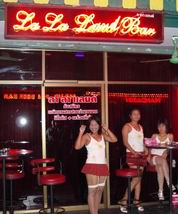 If anyone would like to partake in a red light tour of Pattaya, Thailand's City of Fun just let me know. The Melon Farming
Travel Service is always ready to take up where Thomas Cook fear to tread. If anyone would like to partake in a red light tour of Pattaya, Thailand's City of Fun just let me know. The Melon Farming
Travel Service is always ready to take up where Thomas Cook fear to tread.
We don't think of it as prostitution, we here in Pattaya think of it as hiring a short term girlfriend. No doubt the nutters of the Coalition Against Trafficking in
Women think we are in La La Land...And they are are right...we are! From The Guardian Thomas Cook, Britain's longest running tour operator, is launching family tours to
see prostitutes touting for trade in Amsterdam's red light district. The night-time excursions, which include a briefing about the 'system' from a former prostitute, are open to children of any age, and the company boasts 'under threes go free'.
Last
week parents and charities working to protect women in the sex industry reacted with shock and disbelief when alerted to the tours by Escape.
It is sick to propose a "prostitution tour" not only for adults, but even more so for
children,' said Esohe Aghatise, the European representative of the Coalition Against Trafficking in Women (CATW), which campaigns against sexual exploitation of women.
A press release issued by Thomas Cook to announce the new Walking Tour
Dark Amsterdam' describes how the two-hour tour, leaving at 8pm, will take visitors 'deep into the famous red light district, accompanied by a reliable and trustworthy guide, offering a fascinating insight into the oldest profession in the world!
The brochure details what is included in the experience: Begin with a drink at a prostitute information centre where a former prostitute will explain the system and answer any questions you may have. Then head for the Wallen (red light district)
and see for yourself.
CATW argues that taking children to see prostitutes is 'highly irresponsible' and risks traumatising them. The organisation estimates that 50-85 per cent of women in prostitution experience violence and debilitating
injuries, and that more than 80 of those working in the Netherlands are of foreign origin, with most of them likely to have arrived there as victims of sex trafficking.
Dr Janice Raymond, co-director of CATW, said: Thomas Cook Tours treats
prostitution as harmless fun. Women are sold as commodities in the Dutch sex industry, and Thomas Cook charges tourists to view the marketable products and chuckle at the human merchandise.
Thomas Cook said it has introduced the tour in its
2006 Thomas Cook Signature Cities and Short Breaks brochure in response to feedback from clients. We have added this excursion to our programme so that our clients who do not feel comfortable or safe walking through the red-light district on their own
can do so with an experienced guide, not only to escort them but to share his/her knowledge of this city's colourful past and present, said a spokeswoman.
|
| 13th November | WataNutter Many
politicians harp back to some mythical golden age of morality. In reality such a moral code was maintained not by choice but by abject poverty. There was no divorce as there was simply no option. Some politicians don't quite
get it and make ludicrous connections between modern times and the golden age. As if the clock can be wound back by a few insignificant traditions. Now that young people have a little more money, it is hardly surprising that they CHOOSE to spend
some of it on the pleasures of life such as drink and sex. The only way that nutter politicians will get their perverse way is to drive people back into poverty. Let us hope that they prove equally ineffective in achieving
this as they are in preventing young people from enjoying drink and sex. Based on an article f rom the
Bangkok Post An ancient Thai marriage rite in which wives prostrate before their husbands should be revived to bring back the disappearing happy family, Social Development and Human Security Minister
Watana Muangsook said yesterday. The minister's latest laughable idea to build a healthy society, was quickly criticised by women's rights activists. They asked why a husband could not pay such respect to his wife.
' A wife showing respect by
prostrating at her husband's feet reflects a Thai tradition, but it is viewed as a human rights violation, Watana told a seminar held by the faculty of medicine at Ramathibodi Hospital. Prostration was a polite Thai way to show respect and had
nothing to do with human rights violations. It would be accompanied by other marriage practices, including men being ordained as monks before marriage and husbands living with the families of their wives, he added.
Thai society does not learn
ancient wisdom that supports a happy family. Men should stay in the monkhood for three months to learn morality and then live in their wives' houses after marrying because men are stronger than women and should be subdued by wives' relatives, Watana
said.
Women's rights advocates and members of the National Human Rights Commission said his idea was odd. I wonder if Mr Watana's wife prostrates at his feet. If she does so, please do it as an example for others, said Ambhorn Meesook, a
national human rights commissioner.
Khunying Ambhorn said the minister should not have suggested this idea because prostration should be kept private in each family. The government should not recommend such contentious practices to the public.
Women's rights activist Ticha na Nakon was upset by the minister's idea, saying she was sorry to have to pay taxes to a government which came up with such ideas. Watana should, she said, use his power to launch more useful policies.
Rachadaporn Kaewsanit, chairwoman of the Association for the Promotion of Rights and Equity, said the idea was not practical.
If the husband and wife have a quarrel, could prostration solve it? If all men stop such behaviour, I would prostrate.
|
| 11th November | Rome Wasn't Complained about in a Day
From MediawatchWatch The predicted public outcry against the BBC/HBO production Rome has failed to materialise. An insider source informs MediawatchWatch
that last night’s episode chalked up one complaint from 4.7 million viewers - and that was about the use of the metric system to describe Hadrian’s Wall. As Hadrian’s Wall didn’t feature in last night’s episode, even that complaint was probably
directed at the show which followed Rome, What the Romans Did for Us. John Beyer must be very disappointed in you all.
|
| 1st November updated 3rd November updated 9th November
comment 11th November | Stamped on by Nutters
Based on an article from The Telegraph Hindu nutters are demanding that Royal Mail withdraws one of this year's Christmas
stamps, claiming the mother and child image it represents is insulting to their religion.
 The 68p Christmas stamp, which would be used
to send mail to India, features a man and woman with Hindu markings worshipping the infant Christ. The 68p Christmas stamp, which would be used
to send mail to India, features a man and woman with Hindu markings worshipping the infant Christ. Ramesh Kallidai, secretary general of the Hindu Forum of Britain, said the image was insensitive, because it showed people who
were clearly Hindu worshipping Christ.
The stamps were drawn from religious images around the world. The Hindu stamp was taken from a picture that hangs in Bombay, India, and was painted in the 17th century. It is an Indianised version of a
European print of The Holy family with St Anne and the two angels, according to the city art gallery. It has a European theme but a Mughal setting. The entire picture shows St Joseph trying to push aside a huge curtain so that St Anne can behold the
baby.
The picture was chosen for Royal Mail by this year's stamp designer, Irene Von Treskow, an Anglican priest in an English-speaking church in Berlin. She said she was fascinated by the image because it was so interesting to see a Mughal
painting with a Christian subject. She does not believe the picture is offensive. How can it be? It is 17th-century art. She said she found the painting in a book and then looked up the image on the internet.
Kallidai said the man in the
painting has a "tilak" marking on his forehead, clearly identifying him as a Vaishnava Hindu. The woman has the traditional "kumkum" mark on her forehead, identifying her as a married Hindu woman: These are exclusively used by
Hindus.
Royal Mail said no offence had been intended. We thought it would be nice to return to a religious theme, a spokesman said.
|
|
3rd November | Update Based on an article from
The Telegraph Hindus are being urged to attempt to clog up the postal service after the Royal Mail refused to withdraw a supposedly
"offensive" Christmas stamp. Ramesh Kallidai, the head nutter of the Hindu Forum of Britain, has asked its members, and members of other Hindu groups, to send unstamped protest letters to Royal Mail's headquarters.
He said he hoped this
would cause a logistical nightmare worse than withdrawing the stamp . The group, Britain's largest Hindu body, is also planning a mass protest outside the headquarters.
Royal Mail said yesterday that it was sorry for any "inadvertent
upset" caused, but that there were no plans to withdraw the stamp. Many have already been sold. Royal Mail is, of course, more than willing to meet representatives of the Hindu community and we will apologise personally to them for any
unintentional offence caused.
However, Hindu nutters said this response was unacceptable. We cannot accept the Royal Mail argument that the stamps cannot be recalled, said Ratilal Chohan, the general secretary of the Hindu Council of
the North.
|
| 9th November | Update No
doubt this will mean massive demand for the stamp from collectors now that it has rarity value. From MediawatchWatch As reported in various Indian news sources,
the Royal Mail has bowed to pressure from Hindu community leaders and agreed not to print any more of the offending stamps.
Joanne Davis, External Relations Manager of the company, said on Monday:
Following a conversation between Barry
Gardiner, Minister for Competitiveness, and the Royal Mail, the company has agreed to revise the arrangements for its special issue of 68 pence Christmas stamp.
The company will now tell Post Office branches not to issue the 68 pence Christmas
stamp to customers unless specifically requested. Royal Mail will not carry out a second print run of the stamp. Current stocks will be exhausted in two to three days.
The Royal Mail has also promised to “review its procedures” to make sure that
in future no offence is caused to any UK community. This means, no doubt, that it will consult with self-appointed community leaders before printing any more stamps.
|
|
11th November | Comment from Alan This is absurd! Given that the stamp is a copy of an image that's been around
for 300 years, this is quite ludicrous. Maybe Christians should now start hassling the Royal Mail.
What is more worrying is that the original work is in a church in India. What if Hindu nutters now decide to destroy it? (This isn't far-fetched. A
few years ago the Italian police foiled a plan to blow up San Petronio in Bologna. The church has one of those wall paintings of the Last Judgment in which the blessed sit in heaven with Jesus, looking dead bored, while the damned have a much more
interesting time in hell. In this case, the damned included Mohammed, and disaffected Muslims tried to blow up the offensive image!)
|
| 8th November | Nutters Maybe...But not Antisocial From ic Birmingham
Anti-social behaviour laws meant to curb yob behaviour should never have been used against Sikhs protesting over a controversial play highly offensive to their religious beliefs , the High Court was told .
The
stage play Behzti , which depicted acts of rape and violence in a Sikh temple, caused alarm to many Sikhs who viewed it as insulting and dangerou s when it was performed at the Birmingham Rep, two judges heard yesterday.
University
student Pritpal Singh is seeking a declaration that police unlawfully resorted to provisions of the 2003 Anti Social Behaviour Act to curb what was, in effect, a peaceful demonstration against the play on December 16 last year.
Later protests
turned violent and thousands of pounds worth of damage was caused over the weekend of December 18-19. The theatre was forced to cancel the play on safety grounds and playwright Gurpreet Kaur Bhatti fled into hiding after receiving death threats.
But the High Court in London yesterday was concerned only with the December 16 demonstration and whether anti-social behaviour laws can be used against peaceful protesters who normally have the right to demonstrate, and freedom of expression under human rights laws.
David Pievsky, appearing for Singh, said there was already a framework of laws designed to achieve a balanced approach to the right to demonstrate, and the use of antisocial behaviour legislation "drove a cart and horse" through that
framework, argued Pievsky. He told Lord Justice Maurice Kay and Mr Justice Penry-Davey that the protest on the afternoon of December 16 was peaceful, and the protesters had been allowed to go inside the theatre and hand out leaflets there.
It
appeared that the theatre's management then asked police to remove protesters. Once the protesters were removed, they were immediately ordered to disperse, and were banned from returning to the area that day. Pritpal Singh was arrested for failing to
disperse and was cautioned before being released.
The hearing continues.
|
| 7th November | Tolerantly Threatening Cartoonists
From The Telegraph A Danish experiment in testing "the limits of freedom of speech" has
backfired - or succeeded spectacularly - after newspaper cartoons of the Prophet Mohammed provoked an outcry.
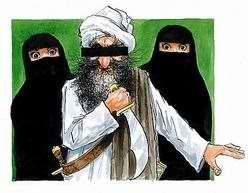 Thousands of Muslims have
taken to the streets in protest at the caricatures, the newspaper that published them has received death threats and two of its cartoonists have been forced into hiding. Thousands of Muslims have
taken to the streets in protest at the caricatures, the newspaper that published them has received death threats and two of its cartoonists have been forced into hiding.
Jyllands-Posten, Denmark's leading daily, defied Islam's ban on images of
the Prophet by printing cartoons by 12 different artists.
The ambassadors of 11 Muslim countries called on Anders Fogh Rasmussen, the prime minister, to take "necessary steps" against the "defamation of Islam". But Mr
Rasmussen, the head of a centre-Right minority coalition dependent for its survival on support from an anti-foreigner party, called the cartoons a "necessary provocation" and refused to act. I will never accept that respect for a religious
stance leads to the curtailment of criticism, humour and satire in the press.
The Danish debate over how to integrate Muslims has raged for years, but the cartoons satirising the Prophet have injected a dangerous new element into the
controversy. This is a pubescent demonstration of freedom of expression that consciously and totally without reason has trampled over the feelings of many people, said Uffe Ellemann Jensen, a former foreign minister and member of Rasmussen's
party.
Carsten Juste, the editor of Jyllands-Posten, spurned demands that he apologise, saying he "would not dream" of saying sorry. To demand that we take religious feelings into consideration is irreconcilable with western
democracy and freedom of expression. This doesn't mean that we want to insult any Muslims."
Juste commissioned the cartoons after learning of the difficulties a children's writer, Kare Bluitgen, had in finding an illustrator for his book
on the Koran and the Prophet's life. Bluitgen said all the artists he approached feared the wrath of Muslims if they drew images of Mohammed.
|
| 6th November | Jeez ! Based on an
article from the Washington Post One of the hottest-selling T-shirts around the country shows a simply drawn snowman with a menacing expression. The
image is popularized by drug-dealer-turned-rapper Young Jeezy and symbolizes those who sell a white substance known on the street as snow: cocaine.
 Nutters, anti-drug campaigners and education officials are alarmed, saying the T-shirt and others like it are part of sophisticated marketing campaigns
using coded symbols for drug culture that parents and teachers are not likely to understand. Some schools are banning kids from wearing the snowman images. Nutters, anti-drug campaigners and education officials are alarmed, saying the T-shirt and others like it are part of sophisticated marketing campaigns
using coded symbols for drug culture that parents and teachers are not likely to understand. Some schools are banning kids from wearing the snowman images.
The shirt was first produced solely for Jeezy by Miskeen Originals, a hip-hop fashion firm
in New Jersey, the company says. The owner, Yaniv Zaken, says his artists produced a handful for the rapper to wear on TV appearances. They then sold a larger batch to retailers, but pulled them when Zaken discovered that his employees had not licensed
the T-shirt from Jeezy: I wasn't sure what the snowman meant until the artist explained to me that it was a drug dealer, the man delivering snow, Now everyone is selling the snowman, all unlicensed. It's become a street-hood hit worldwide.
A spokesman for Young Jeezy's record label, Def Jam Records, confirmed that the rapper held the rights to the snowman image but declined to comment on complaints that it was sending children the wrong message.
This is part of a phenomena in
which parents have no idea what their children are exposed to. There is a code that children are aware of but not parents, says Sue Rusche, president and CEO of the anti-drug group National Families In Action. Rusche's organization has tried to
pressure companies that they believed were targeting children with drug messages, like fashion companies marketing "heroin chic" in the 1990s. She was unaware of the snowman T-shirt.
Dr. Gilbert Botvin, director of the Institute for
Prevention Research at Cornell University Medical College, has been studying what influences children to use drugs and alcohol. He believes that pop culture does play a role. The research tells us that influences coming from the media can have a
profound effect on kids and influence them to use drugs," he says. "All of these things help to convey the impression that engaging in these behaviors using drugs is normal and that drugs might help you be successful or sexy or something.
Botvin says parents need to educate themselves about the media their kids are consuming and pressure schools to monitor what messages they allow students to advertise. But sometimes it's hard to overcome the buzz on the street.
Ali
Kourani, a Manhattan wholesale salesman, says the T-shirt is their top seller across the country. It's big money, Kourani said.
|
| 5th November | Flandering to Nutters
Based on an article from Expatica Nutter opposition to the poster advertising the play Our Sweet Lady of Flanders is
gathering strength, attracting now the wrath of the extreme right Flemish Interest. The party is accusing Ghent theatre society Union Suspecte and the Royal Flemish Theatre of deliberately provoking thousands of Flemish people.
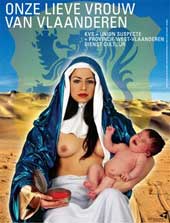 The poster advertising the show depicts a veiled Madonna with child in arms and a naked breast. By ridiculing the veneration of the
Blessed Virgin in Flanders, the deepest emotions of both Flemish families and Catholics are being hit, Flemish Interest MP Francis van den Eynde said. The poster advertising the show depicts a veiled Madonna with child in arms and a naked breast. By ridiculing the veneration of the
Blessed Virgin in Flanders, the deepest emotions of both Flemish families and Catholics are being hit, Flemish Interest MP Francis van den Eynde said.
The first showing of the play in Brussels sparked a protest by the group Belgium and
Christendom — and in its shadow the Francophone extreme-right movement Nation on 30 October. The groups claim the poster of Our Sweet Lady is blasphemous. Some 100 protestors gathered at the initiative of Belgium and Christendom, a group that works to
gain respect for the Jewish-Christian movement. Flags of the right-wing Nation groups were also seen among the protest.
The call to protest outside the Royal Flemish Theatre in Brussels was issued by Paul Belien — husband of the Flemish
Interest's Alexandra Colen, who is well known for her conservative views. The Flemish Interest has now taken up the protest officially, with Van den Eynde writing a letter to all playhouses and cultural centres who have scheduled the play "to
strongly protest" against these sorts "insults". I don't ask for this to be banned, but I have been spoken to by so many of my voters that I had to respond. Politicians must dare to complain about something like this,
However, Christian Democrat CD&V party chair Jo Vandeurzen pointed out there are differences in taste and that politics should not interfere with the cultural sector:
The Flemish Interest can evidently not refrain from doing so. That tends towards censorship.
|
| 4th November | Watching Nutters Watch the BBC
From Hindustan Times The BBC has been accused of an anti-religious attitude, its reporters having little
understanding of religious issues and misreporting the India-Pakistan conflict, the House of Lords select committee considering the future of the corporation, was told.
The BBC was also attacked by members of the committee for treating religion
"with kid gloves" and for employing reporters who tried to "fluff their way through complicated matters". Some of its popular serials like EastEnders ridicule religion, the committee heard this week, during the evidence being
given by representatives of the Christian, Muslim, Hindu and Sikh faiths - all broadcasters and contributors to BBC Radio 4's Thought for the Day - as well as members of the British Humanist Association, on coverage of faith and the role of religious
broadcasting to the committee on the BBC charter review.
Dr Ram Prasad Chakravarthi from the department of religious studies at the University of Lancaster said the anti-religious attitude is apparent in the way religion is featured in the BBC's
entertainment output. He said its soaps tend to use stereotypes - the Christians are mad fundamentalists, the Hindus are in arranged marriages . He pointed out that the corporation repeatedly made a fundamental error in reporting the
India-Pakistan conflict as a clash of religions, because its reporters lacked adequate understanding of the situation.
Rev Joel Edwards, the general director of the Evangelical Alliance UK and an honorary canon of St Paul's Cathedral, was
critical of what he called a pervasive anti-religious attitude that works very vigorously in editing suites (of the BBC) and that the interests of sensationalism often took over.
Dr Indarjit Singh, editor of the Sikh Messenger and
patron of the World Congress of Faiths, said: EastEnders' Dot Cotton is an example. She quotes endlessly from the Bible and it ridicules (religion) to some extent . He suggested the BBC should, instead, use its resources to educate people about
religion in order to combat prejudice. The BBC should look at the removal of ignorance about religion. We need to know and understand what essential beliefs are and how they contribute to society. The BBC should do a lot more of that. It is so easy in
atmosphere of ignorance for prejudice to arise.
The representatives from the faith communities urged the committee for a formal public service commitment to the fair reflection of religion in broadcasting, across the output, not just in
religious programmes, to be set down in the BBC's charter.
One select committee member, Lord Maxton, said, religion is treated at the BBC with kid gloves and is rarely criticised . But Lord Peston maintained claims that the BBC was against
religion were "ridiculous". However, he agreed there was not enough knowledge about religion at the corporation: The media is full of people trying to fluff their way through very complicated matters, he said.
One of the members
the Rt Rev Butler said that without understanding of religion "grave errors" occurred about world affairs and told the committee that BBC staff lacked sufficient "depth of knowledge" about religion.
Dr Mona Siddiqui, the chair
of the Scottish religious advisory committee, argued for the BBC to present religion in a way people can identify with, to make programmes about the way people live and believe and to show how religion sits side-by-side in contemporary debates.
People are hungry for real debate, they want to know how religion makes a person tick.
The committee also heard Hanne Stinson, the executive director of the British Humanist Association, which represents the interests of non-religious people.
She said there was a growing number of people with no religious beliefs who share humanist beliefs but would not call themselves humanists, simply because they do not know the name, and the BBC is partly to blame for that.
She disputed the
claim that the large majority of the BBC's coverage was secular. The BBC claims a small percentage of its coverage is religious and the rest is secular. We say a small percentage is religious and the rest is general, for everybody. The gap is positive
non-religious belief, she said.
The hearing was a second tier of inquiries into religion, sport, regional broadcasting and the World Service being carried out following the publication of the Lords' report earlier this week, which called the
government's plans for the BBC confusing and misguided, and called for a bigger role for media regulator Ofcom in overseeing the corporation.
|
| 3rd November | Nutter Senator Getting it Off his
Chest Based on an article from CBS 2 Chicago Abercrombie & Fitch, the US clothing retailer is
taking heat over its racy catalog. A state senator is fighting Fitch over some supposedly provocative T-shirts.
 Politicians are
objecting to Abercrombie’s latest fashion T-shirts -- tees with attitude as they're called. Politicians are
objecting to Abercrombie’s latest fashion T-shirts -- tees with attitude as they're called.
But the candidate for governor calls them smut. I think that's an unacceptable product, said State Senator Steve Rauschenberger. This is not
good for our children. It’s not good for society , Rauschenberger wants to pass a resolution forcing the store to pull the shirts off the market.
A selection of CBS viewers weren't impressed, All felt, government intervention is unnecessary.
It's the parent's role to restrict their kids, not our politicians, they said.
Store clerks say the shirts are flying off the shelves.
|
| 2nd November | Baying for the Moon I can
understand people campaigning for less sex/swearing/violence on TV. But I cannot believe the pits of humanity that John Beyer has sunk to. How can any 'respectful' person suggest that people should be locked up for 3 years in prison for merely
viewing R18 hardcore pornography? The amount of misery inflicted on people, their families and society in general would be incalculable. This sadistic wish for the infliction of so much pain on society is surely one of the worst cases of 'extreme
pornography' that has been reported to date. Does he also call for concentration camps to house all the people that he wants imprisoned? From Mediawatch-UK A new
international treaty on Internet content is urgently needed according to mediawatch-uk. In a letter to Home Secretary, The Rt Hon Charles Clarke MP, mediawatch-uk director, John Beyer, said that the corruption of our young people by pornography on the
Internet had become a major public concern. He said: It is vital that a new international treaty on Internet content is agreed at the World Summit on the Information Society taking place in Tunis later this month. This represents a most timely and
appropriate opportunity for the British government not only to make known again its concern about extreme internet content but also its determination to actively combat the phenomenon with new legislation.
In the letter to Mr Clarke, Mr Beyer
said: Our concern that a new treaty be drawn up is heightened by the rapid development of Broadband Television, already being tested in Britain, because such a system of television, via the Internet could circumvent national regulation of
broadcasting. If an International treaty were in place, sanctions could be more easily exercised by national governments that had signed up to it.
Our concern, as is yours, is with obscene and violent imagery that undermines human dignity
and respect for others. We take this opportunity to acknowledge the Home Office consultation on the possession of extreme pornographic material to which we shall be responding in due course. By way of an initial observation we believe that the scope of
the material under consideration should be substantially broadened to include a much wider range of obscene material, for example, that currently permitted by the British Board of Film Classification at ‘R18’.
If the international
community is serious about protecting the health and morals of the young and the vulnerable and protecting them from harmful and offensive material on the Internet, we believe that seriously effective international measures are urgently needed.
|
| 2nd November | Nutters vs Censors
From Scoop The New Zealand nutters, the Society For The Promotion Of Community Standards have written to the new Minister
of Internal Affairs, Rick Barker, to replace all nine members of the appeals body, the Film & Literature Board of Review, including the Governor-General's husband Peter Cartwright. Mr Cartwright’s term of office, along with those of seven other board
members, expired 15 months ago on 31 May 2004. Their re-appointment can only be made by his wife, Governor-General, Dame Sylvia Cartwright, on the recommendation of the Minister. The Society points out that in the case of the appointment or reappointment
of husband Peter, this involves obvious conflict of interests on the part of his wife.
The nutters claim that Mr Cartwright, formerly Chair of the Indecent Publications Tribunal and Chair of the Broadcasting Standards Authority, has demonstrated
a consistently liberal approach to the censorship of publications containing sexually explicit content and extreme violence. They cite examples of Baise-Moi , Visitor Q and Irreversible .
The Promotion Of Community Standards
outlined their concerns in the letter as follows:
1. The Board has demonstrated an extremely liberal approach to censorship. Rather than acting as a vigilant and competent "gate-keeper," it has given its stamp of approval for the
release of films, videos and DVDs for public adult cinema containing: extended, explicit and gratuitous depictions of brutal rape (mainstream release of Baise-Moi , Irreversible , Twenty-Nine Palm s), necrophilia, graphic violence
involving sexual mutilation ( Visitor Q ) and the degradation, demeaning and dehumanising of women (e.g. Sinners No Doctor ) etc. Hundreds of such explicit videos, DVDs and films depicting men ejaculating onto
the faces of women, multiple penetration (anal and vaginal), oral sex, "anal mania", sadomasochism (S & M), incest, homosexual and lesbian sex, prostitution, young people masturbating, "how-to-do" drug-taking, obscene language etc.
are approved every year by the Office of Film and Literature Classification headed by Chief Censor Bill Hastings. The Board gets to review only a tiny fraction of this toxic material approved by Hastings and his team. Publications are generally only
referred to it following applications under the Act by concerned groups such as the Society (which has a public "watchdog role") or by film distributors seeking to get the film's rating downgraded for commercial reasons (so it can reach a wider
audience). In the last 12 months since 1 October 2005, the Board has only issued ten decisions. The Society was the applicant for four of these publications ( Irreversible , 9 Songs , Playboy: The Mansion and Visitor Q ).
2. The Board has demonstrated its unwillingness to safeguard the interests of children and young persons accessing computer games that teach kids how to promote and succeed in the pornography trade ( Playboy: The Mansion ). It has demonstrated
its incompetence by approving films for young people that teach them how to indulge in illicit drugs, indulge in promiscuous sex, carry out gang rape etc.
3. The Board members are not representative of mainstream New Zealanders, the majority of
whom oppose the dissemination of "objectionable" content found in films like Baise-Moi which was banned in Australia. The Board decisions are almost always unanimous in support of a downgrading of a classification restriction (e.g. Closer
) or more often unanimous in opposition to any tightening to the existing OFLC classification rating so that the public good can be safeguarded. The liberal "mindset" appears to be so dominant and entrenched in this Board that any dissent
by a member reflecting a more conservative viewpoint is squashed.
4. A number of the important decisions issued by the Board president against granting relief to the Society, have been shown to be wrong in law when tested in the High Court (e.g.
Irreversible and Ken Park ). A number of the Board's decisions have been found to be wrong in law when tested in the High Court and Court of Appeal (e.g. Baise-Moi and Visitor Q ). The Courts have strongly criticised the Board
in a number of decisions that span four years of its deliberations.
|
| 31st October | Ambassadorial Incitement
to Hate Freedom of Speech From the Denmark.dk Eleven Muslim ambassadors in Denmark looking to meet with
Prime Minister Anders Fogh Rasmussen to discuss what they call a 'smear campaign' in the media against Islam and Muslims have had their request denied.
The prime minister had otherwise been encouraged by the opposition to meet with the group as a
way to increase understanding in an increasingly controversial public debate.
In recent weeks, both the minister of culture and a Copenhagen mayoral candidate have retracted statements they made about Muslims and Islamic culture.
Most
recently, national daily Jyllands-Posten has invoked Muslim ire by publishing twelve caricatures of the prophet Mohammed, some of which characterised him as a terrorist. Pictorial depictions of Mohammed are frowned upon by Islam.
This is a
matter of principle. I won't meet with them because it is so crystal clear what principles Danish democracy is built upon that there is no reason to do so, said Rasmussen.
Rasmussen reiterated his message that individuals who felt offended by
the tone of the public debate should bring their grievances to the courts. As prime minister, I have no power whatsoever to limit the press - nor do I want such a power. It is a basic principle of our democracy that a prime
minister cannot control the press.
|
| 27th October | Vaz Bullies Hoon
Based on an article from the BBC A video game featuring school bullying must be treated in the same way as a violent film, a
nutter MP has said. Ex Labour minister Keith Vaz urged the government to refer Bully , which has a pupil fight scene, to the BBFC. Failing that, it should be banned, he told the House of Commons.
Bully's publisher, Rockstar Vancouver, said
the game, not yet released, would be an "engaging story" and products should not be "judged by their titles".
Shameful Vaz, MP for Leicester East, asked Commons leader
Geoff Hoon: Do you share my concern at the decision of Rockstar to publish a new game called Bully in which players use their on-screen persona to kick and punch other schoolchildren? Will you ask the prime minister to refer this video to the British
Board of Film Classification? If they don't make any changes will the government use its powers to ban this video?
Hoon said the game's distributors had yet to put it to the BBFC to consider an appropriate rating. The precise contents,
"disturbing though they sound", and the degree to which it might be considered harmful to children were "not yet known", he added.
Liz Carnell, director of the charity Bullying Online, said: Our view is that bullying is not
a joke. It is not a suitable subject for computer games. Giving Bully an 18-rating would not stop children playing it, she said.
A Rockstar Games spokesman said: We support and admire the groups who are working hard to address the
long-standing problem of bullying. We all have different opinions about art and entertainment, but everyone agrees that real-life school violence is a serious issue which lacks easy answers. Bully is still a work-in-progress, but when it's
finished we believe most people will agree it offers an exciting experience and tells an engaging story. More and more people are beginning to recognise that the stories in video games have as many themes and plotlines as books and movies. Just as books
aren't judged by their covers, video games shouldn't be judged by their titles or individual scenes. The game would be "submitted to the appropriate bodies" to be rated, he added.
Roger Bennett, director general of the Entertainment
and Leisure Software Publishers Association, said: As Mr Vaz knows, any game can be automatically referred to the BBFC for a rating. It is disingenuous to suggest any game be banned when the content has yet to be finalised.
|
| 21st October | Stereotypical Death Threats
From the BBC The ambassadors of 10 Muslim countries have complained to the Danish prime minister about a major
newspaper's cartoons of the Prophet Muhammad.
A letter from the ambassadors said the cartoons published in Jyllands-Posten last month showed
the Prophet as a stereotypical fundamentalist.
Pictorial depictions of the Prophet Muhammad are forbidden in Islam. Danish Muslim community leaders who held talks with Mr Rasmussen in July complained about press
coverage of Islam.
A Danish government spokesman said Prime Minister Anders Fogh Rasmussen was preparing a response. At the time, he said he could not tell newspapers what to print - or what not to.
On Thursday, the Jyllands-Posten
reported that two illustrators who produced the cartoons had received death threats.
The daily published the series of cartoons, after a writer complained that nobody dared illustrate his book about Muhammad. We must quietly point out here
that the drawings illustrated an article on the self-censorship which rules large parts of the Western world , the paper said. Our right to say, write, photograph and draw what we want to within the framework of the law exists and must endure -
unconditionally!
The ambassadors who signed the letter to the prime minister included a number of Arab countries, Pakistan, Iran, Bosnia-Hercegovina and Indonesia. We hope there will be understanding of Muslims' feelings about Mohammad.
And we hope there will be an apology from Jyllands-Posten , Mascud Effendy Hutasuhut, counsellor at the Indonesian embassy in Denmark, told Danmarks radio.
|
| 20th October | The Godless are Corrupt and Evil
Based on an article from The Camden Chronicle A nutter priest has hit out at a pornographic art exhibition - branding the display "evil". Father Mark, of St Ann's Roman
Catholic Church, in Laxton Place, Camden Town, wants the explicit Candy Broke exhibition scrapped.
It is set to open at the Diorama Gallery in Osnaburgh Street - just a stone's throw from his church. Pornography is
bad and evil, said Father Mark. I'm against it and I'm always warning my parishioners about the dangers of pornography. We live in a Godless society - it's corrupt and evil because people in this country have abandoned God
and this is an indication of that. The Devil is loose and our society is very sick. He added: I'm worried that the word will go around and young people will turn up to look at it and it's worrying that pornography has become so mainstream.
Artist Sue Golden admits the exhibition - which includes graphic images of women - is explicit. She said the idea was to provoke debate and encourage people to question how pornography has "permeated society". This
exhibition is very much pro women - it's about getting people to think about these things. The exhibition is very sexual but it's presenting pornography that has permeated our society and hopefully it will get people to question it. I think it's an
appropriate time to address the issue - more and more girls seem to want to get into pornography.
|
| 15th October | Wakey Wakey Wakefield Based on an
article from Wakefield Today Nude artwork is at the centre of a troubles with nutters in Wakefield.
Student artist Sally Barton took down pictures depicting naked females embracing after police contacted her.
Barton has hit back at the claims her art is pornographic, and can't believe her first exhibition at a Horbury art gallery, has been censored by police.
She said: I am an artist not a pornographer and the work is very tasteful. The people are complaining it's about sex, but that's just what they see in it."
Disgusted nutters inundated councillor Janet Holmes with non-stop
phone calls and she contacted the police.
Councillor Holmes said: There are six and seven-year-old children passing the gallery and we do not want children as young as that seeing such images.
|
| 6th October | No Place for Fun & Games in Christianity
From Star Telegram Ireland's largest bookmaker, Paddy Power PLC, withdrew a billboard campaign Wednesday that portrayed Jesus and his disciples at the Last Supper table - and playing poker and
roulette alongside the slogan, "There's a place for fun and games." 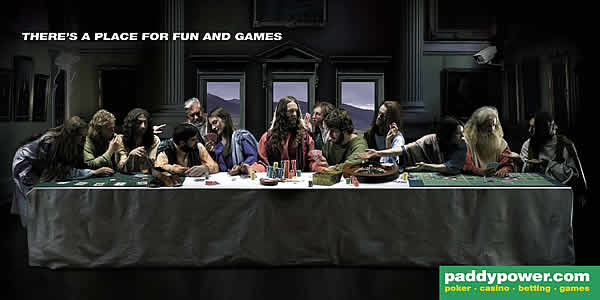
The
Dublin-based company was responding to legal threats from Ireland's Advertising Standards Authority, which reported receiving scores of complaints from the public in this predominantly Roman Catholic country.
At all 89 locations across Dublin,
the offending billboards were replaced Wednesday with new Paddy Power ads that said: "There's a place for fun and games. Apparently this isn't it."
Frank Goodman, chief executive of the Advertising Standards Authority for Ireland, said
Paddy Power had breached its guidelines for taste, decency and religion. This apparently has caused widespread offense
The ad provoked laughter and irritation aplenty in this city of 1.3 million. Dublin Archbishop John Neill, of the
Anglican-affiliated Church of Ireland, said it "would be offensive to most Christian people."
But on the editorial pages of The Irish Times newspaper, columnist John Waters called the ad a "rather good-humored piece of public
nonsense," and warned of the perils of censorship.
The company's main spokesman - who is also named Paddy Power but isn't related to the company's fictional namesake - said the ad campaign was using images where gambling wasn't appropriate.
He noted that an accompanying billboard, which wasn't withdrawn, pictured doctors gambling on the sex of a newborn as a woman is about to give birth.
Power said the Last Supper was ideal because it was absolutely the most inappropriate place
ever for fun and games. We still don't believe we've pushed the boundaries too far. Some people just take this stuff too seriously.
|
| 5th October | Filtering Out the Nutters
From Whirlpool News Days before the federal election, the Western Australian Internet Association (WAIA) has strongly
rejected calls from the ultra-conservative "Family First" political party for Internet censorship at all ISPs.
WAIA's Jeremy Malcolm says the policy is poorly thought out and unworkable. Internet content filters at ISP level are
expensive and ultimately, the user can get around them , he said.
Family First admits the proposed filtering scheme would have adverse effects on smaller ISPs but claims in its policy document that this isn't important because adequate
competition could be maintained with 30 ISPs rather than the hundreds in existence now"
It also wants internet users in Australia to pay $7 to $10 each per year to cover the cost of the filtering. WAIA issued a statement today saying it
was appalled at the callousness of this argument. If the same reasoning was used in respect of farmers, there would be national outrage, Malcolm said.
The association has debunked Family First's arguments saying ISP-level filtering can be
as ineffective as PC-based filtering. He used China as an example: the country attempts to carry out nationwide filtering but access speeds have simply been slowed down for end users, and many people simply use secure proxies outside of China.
ISPs already cooperate with law enforcement authorities in combatting child pornography and other crimes under Australian law. They have no interest in allowing paedophiles and similar criminals to operate using their network, Malcolm said.
|
| 4th October Updated 5th October |
This Little Piggy Undermined Islam From Gay & Lesbian Humanists
In this latest example of rank stupidity and bureaucratic absurdity, I do not blame the whinging whiner, but the authorities who acceded to his ridiculous objection – and those who supported it - need to be shown up for the idiots that
they are.
So, what happened? Well, it appears that a Muslim employee of Dudley Council complained about pig-shaped novelty items in the workplace – in this case a stuffed animal ‘stress reliever’ – saying they were ‘offensive to Muslims’. The
innocent promotional giveaway, it seems, has now caused anxiety rather than relieving it.
However, it doesn’t stop there. Now calendars showing cartoon pigs, porcelain figurines and even a tissue box with a picture of Winnie the Pooh’s friend
Piglet have been ordered removed or covered up by the Council honchos.
According to a report in the Express & Star News, the move has not improved office relationships. On the contrary, one staff member, who remains anonymous, told the paper: It's caused a bit of an atmosphere in the office. The staff did comply but it's just crazy - things like ornaments that have been on desks for years have had to be removed.
But not everyone agrees. Councillor Mahbubur Rahman, a practicing Muslim, said he agreed with the action taken: If it is a request made by an individual and other officers can reason a compromise it is a good thing, it is a tolerance and
acceptance of their beliefs and understanding
It is this sort of action that trivialises real oppression and real offence. Few would dispute that a pigs head left on the steps of a Mosque or a Synagogue is a vicious and offensive act, but to
ban cartoon pigs on a box of tissues from the workplace on similar grounds? Doesn’t that just make a mockery of tolerance? Update 5th October, Thanks to David:
Actually, according to a contact who works there, it's *only* the pig-shaped stress reliever that's been banned from Dudley Council offices. The rest of the stuff mentioned in the paper is just the product of a slow
news day, and *not*
actually banned.
|