|
30th November
|
|
|
|
Advert for campaign against ID cards cleared for comparing Blair to Hitler
|
From ASA
|
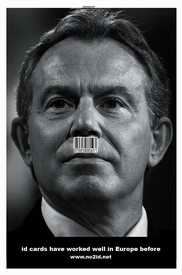 An ad for NO2ID , an anti-identity card campaign group, appeared in The Guardian. The ad showed a close-up photograph of Tony Blair; on his upper lip was a barcode. The
Text under the photograph stated id cards have worked well in Europe before. www.no2id.net .
An ad for NO2ID , an anti-identity card campaign group, appeared in The Guardian. The ad showed a close-up photograph of Tony Blair; on his upper lip was a barcode. The
Text under the photograph stated id cards have worked well in Europe before. www.no2id.net .
The complainants thought the barcode on Tony Blair's upper lip made him
resemble Hitler and the portrayal of a public figure as Hitler was offensive.
NO2ID said the photograph of Tony Blair was expertly retouched to make it look like a 1930s portrait and the layout was designed to recall the Nazi era. They said the
photograph did not portray Tony Blair as Hitler but was intended to be a comparison of Tony Blair with Hitler based on policy, not personality.
NO2ID believed free speech was a vital function of advertising and the ad, which made important points
about government policy, was unlikely to cause serious or widespread offence. They said the ad was intended to be insulting to Tony Blair but argued that insulting a politician was unlikely to offend. They pointed out that the print media they had chosen
frequently carried verbal and cartoon attacks on Tony Blair and other politicians in their editorial pages. They said such attacks on politicians for their policies were a fundamental part of debate in any democratic society as well as a customary one in
British society. They said they had intended to highlight an under-discussed aspect of an important issue and to stimulate debate and believed the message of the ad, that the introduction of ID cards was a policy with shocking implications, would be
adequately communicated to, and understood by, the likely readership.
The Guardian believed the ad did not make a serious comparison between Tony Blair and Hitler but sought to highlight a particularly contentious policy. They said the Guardian
was aimed at an adult and educated readership and, as such, they should allow a certain degree of latitude in the advertising they carried that depicted political figures.
ASA Assessment: Not upheld, No further action necessary. The ASA noted
the ad had been intended to encourage discussion on a sensitive political issue. We considered that, although the ad may have been distasteful to some, it was unlikely to be seen as making a serious comparison between Tony Blair and Hitler but instead as
highlighting a lobbying groups opinion that ID cards should not be introduced because of the threat to civil liberty they posed. We concluded that, as such, the ad was unlikely to cause serious or widespread offence.
|
|
23rd November
|
|
|
|
The first sex toy advert to appear on UK terrestrial TV
|
From the Daily Mail
|
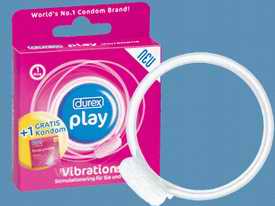 The first sex toy commercial to be shown on UK terrestrial TV will hit screens this week. A vibrating penis ring will appear in the 30-second advert on Channel 4 and Five and satellite channels. The commercial will be broadcast after 11pm from
this Friday.
The first sex toy commercial to be shown on UK terrestrial TV will hit screens this week. A vibrating penis ring will appear in the 30-second advert on Channel 4 and Five and satellite channels. The commercial will be broadcast after 11pm from
this Friday.
Durex, which makes the disposable toy, said the post-11pm broadcast restriction for the commercial was too severe. It wants permission to show the "tastefully shot" advert after the 9pm watershed.
The commercial
shows a couple sitting a dinner table. The man gives the woman what looks like an engagement ring box. She opens the box, smiles, and says "I do."
Durex managing director Martyn Ward said: There is nothing rude or crude about the
advert, which is tastefully shot, and we feel this restriction is hypocritical, given the images of a sexual nature you quite regularly see on TV at this time of night.
Durex has sold more than 400,000 of the £5.99 disposable vibrating rings
since they launched last year.
|
|
15th November
|
|
|
|
|
From the BBC
|
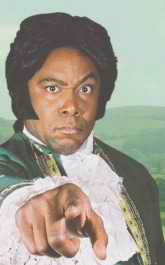 London Underground (LU) has been accused of censorship after refusing to put up posters for a comedy show.
LU said adverts for the show Pride and Prejudice and Niggas by African-American comedian Reginald D Hunter
were likely to offend .
Hunter told the BBC the term refers to people with "impoverished mentality" rather than their ethnicity or race.
LU said posters could be put up if the title was changed, but Hunter said that would
compromise his integrity. He said it was "censorship by a corporation rather than a government".
A statement from LU said: London Underground and Viacom work closely to ensure that when we consider advertising appropriate for the
Tube, we take into account words or phrases that may offend some passengers. On this occasion, it was felt that the poster is likely to offend, so we took the decision to turn it down.
The three-week show is due to open on 4 December and runs
until 23rd December 2006 at the Arts theatre, Great Newport Street, London, WC2H 7JB
|
|
27th October
|
|
|
|
|
From ASA
|
 A TV ad, for Original Source shower gel, featured a naked young woman sitting in a side-on pose under a lemon tree. The ad cut to a close-up of the young womans face. She said: Ten real lemons help make one zesty bottle of
Original Source shower gel.
A TV ad, for Original Source shower gel, featured a naked young woman sitting in a side-on pose under a lemon tree. The ad cut to a close-up of the young womans face. She said: Ten real lemons help make one zesty bottle of
Original Source shower gel.
29 viewers objected that the ad was offensive and inappropriate, because the model seemed to be under 16 years of age and was shown in a sexually provocative way.
Cussons said the ad was intended to
represent the naturalness of their product and gave their assurance that the model in the ad was an adult at the time of casting. They maintained that the question of how old she looked was entirely subjective. Cussons said, in order to emphasise the
theme of naturalness, they had chosen a model with naturally blonde loose, long hair who was "outdoorsy" but cool and had shown her with no make-up; they said the same model, in make-up and fashionable clothes would look much older. Cussons
pointed out that the model's demeanour was confident, not vulnerable; she maintained eye contact with the viewer to demonstrate that she was at one with the environment. They asserted that that attitude could hardly be considered that of a child.
Cussons said they had taken care not to cast a more voluptuous model so that the ad did not have sexual overtones. They pointed out that the model's pose adequately concealed her breasts and genitals and that she avoided any movements that could be
construed as sexually provocative. They said they had taken account of the Independent Television Commission's (ITC) research into 'Nudity within Advertising', which suggested that it was most suitable for nudity to appear in advertising for bath and
shower products. They pointed out that the model made clear in the dialogue that the product advertised was a shower gel. Cussons said they did not seek to offend viewers and the issue raised had taken them by surprise. However, when they started to
receive complaints directly, they decided to re-edit the ad so that the model was seen only from the shoulders upwards.
The BACC said they endorsed Cusson's comments and added that the model was, if anything, ethereal and androgynous, a sort of
creature of nature like a dryad or a nymph, and came across somehow as asexual rather than sexually suggestive.
The ASA understood that the model was an adult at the time of casting and noted she appeared naked for only two seconds. We noted the
BACCs argument that the model seemed to be androgynous and asexual but considered that viewers were likely to see the model as a young girl. We considered that the combination of nudity and the stylised shots of the models pose were likely to be
considered by viewers to have sexual overtones. Because some viewers were likely to believe that the model was a child, we considered the sexual overtones and nudity in the ad were offensive and inappropriate. We concluded that the ad was likely to cause
serious or widespread offence and noted Cussons action to change the ad.
The ad breached CAP (Broadcast) TV Advertising Standards Code rule 6.1 (Harm and Offence). The ad must not appear again in its original form.
Comment: Imaginary Standards
A letter to the Guardian from IanG I wonder how the ASA judge the rather worrying views of a mere 29 people to indicate possible widespread offence? The BBC received well over 29,000 complaints regarding Jerry Springer: The Opera yet that show
went on and, went on to tour the UK - and definitely caused nothing but narrow-band offence.
Are we now to understand that all adult women with petite figures will be discriminated against in bathing product advertising because of the rather
disturbed views of just 29 people and those on the ASA panel (who picked these perverts?) who believed they were witnessing an under 16-year-old in a sexually provocative situation? Is natural nudity in a natural setting so alien a scene that it
immediately conjures up images of sex in the minds of these town folk? Perhaps some time at a naturist resort would do them good and restore some balance to their judgement?
I'm afraid, as ever, the filthiest minds are being allowed to dictate
the supposed 'general standards' of the viewing public. Had there been 29,000 complaints then we might believe this advert was causing some offence on par with Jerry Springer: The Opera but, as it is, those 29 people and the members of the ASA are
causing me a great deal of concern with regard to their mental fitness to make sane judgements on what they actually see rather then what they imagine they see, which in this instance apparently includes some rather disturbed sexual innuendo involving
under 16-year-olds.
Quis custodiet ipsos custodes Comment: Cover the Table Legs
Thanks to Paul I think it's time to cover the table legs!
Jeez I wish that Britain would drag itself into the 21st Century and not dwell in the 19th.
There are a lot more provocative adverts than this on TV. 29 complaints to cause
a problem for Cussons adverts? Ridiculous!
They will be complaining that Imperial Leather is kinky next! Oooh errr missus! Leather!
|
|
29th September
|
|
|
|
|
The killjoy authorities seem to want to make TV so boring that it will make the youngsters turn to drink. From the
BBC
|
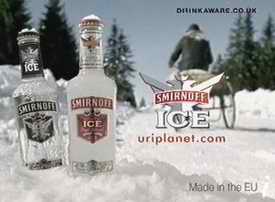 TV adverts for two alcopops have been the first to be banned under tighter rules aimed at protecting under-18s. One commercial for WKD showed a shopkeeper waving a pricing gun around, and another featured two men trying to grab a bottle in slow-motion.
Smirnoff Ice ads with characters called Uri and Gorb also broke the rules.
TV adverts for two alcopops have been the first to be banned under tighter rules aimed at protecting under-18s. One commercial for WKD showed a shopkeeper waving a pricing gun around, and another featured two men trying to grab a bottle in slow-motion.
Smirnoff Ice ads with characters called Uri and Gorb also broke the rules.
The Advertising Standards Authority (ASA) said the adverts breached regulations by being likely to have a strong appeal to minors. ASA has ordered that the commercials for
the vodka-based drinks should not be shown again.
They have been banned under rules introduced in January last year. Adverts for alcoholic drinks must not draw on youth culture in a way which is likely to "appeal strongly" to those
under 18.
ASA said the WKD adverts used "juvenile" humour and themes which would appeal to young people.
Of the Smirnoff Ice commercials, it said: We concluded that the characters were likely to become cult figures with strong
appeal to under-18s.
The advertising agency behind the WKD campaign, Big Communications, said the humour in the adverts was designed for adults.
Diageo GB, which makes Smirnoff Ice, disagreed with the decision and wants an independent
review.
|
|
26th August
|
|
|
|
|
From Canada.com
|
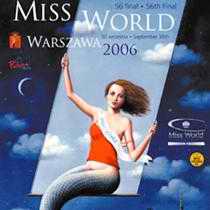 A white scarf was discretely added over an artist's depiction of a mermaid with an exposed breast on a poster advertising the 2006 Miss World contest, after officials in Warsaw's conservative administration deemed it too suggestive.
Rafal
Olbinski obligingly placed a white scarf with the Miss World inscription across the offending body part, said his agent, Piotr Reichel. He: agreed to make the change at the request from the Warsaw promotion office .
This year's Miss World
contest is to be held in the Polish capital on Sept. 30.
The city's symbol is a bare-breasted mermaid holding a sword and shield. Olbinski's poster originally showed a mermaid on a seesaw, the strap from her red top slipping over her shoulder to
reveal one of her breasts.
Tadeusz Deszkiewicz, head of Warsaw city hall's promotion bureau, told The Associated Press that there is no doubt that Olbinski's original version was strongly erotic and we did not want to attach such aspect to the
Miss World contest.
Warsaw's acting mayor is former Prime Minister Kazimierz Marcinkiewicz, whose Law and Justice party espouses conservative moral values such as no sex outside marriage and strict controls on abortion.
From The Independent
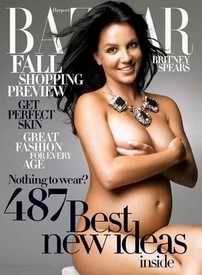 A semi nude but modest photo of pregnant US pop singer Britney Spears was given the green light Friday by a Tokyo subway censorship board after being rejected for being too 'stimulating.'
The advertisement for the October issue of Harper's Bazaar
features a nude and very pregnant Spears crossing her arms over her breasts was originally censored by subway operator Tokyo Metro Co.
After a revision to the 'stimulating' design that blacks out Spears from the waist down the subway operator
deemed the orinial advertisement as fit for commuters as it shows the joy of bearing a child.
We decided to accept the photo as it is because it expresses maternal love and joy of bearing a child, the Tokyo Metro spokesman said. By
revising the design, the initial intention to convey the message is not served.
The advertisements will be posted Monday at Tokyo's Omotesando station.
|
|
4th August
|
|
|
|
|
From The Register
|
 A complaint was submitted ti the ASA against Eidos Interactive for a magazine advert for Hitman: Blood Money . The picture showed a woman in her underwear with a bullet hole in her forehead and the headline: "Beautifully Executed".
People complained to the ASA about the juxtaposition of death and sexuality.
A complaint was submitted ti the ASA against Eidos Interactive for a magazine advert for Hitman: Blood Money . The picture showed a woman in her underwear with a bullet hole in her forehead and the headline: "Beautifully Executed".
People complained to the ASA about the juxtaposition of death and sexuality.
Eidos said the ad was not about violent sex but was intended as a parody of a perfume ad - presumably that horrible Opium poster. The Edge magazine, where the ad
appeared, said its readers were adult and hardcore gamers and none had complained.
The ASA said Beautifully Executed was a play on words and that it was unlikely to cause offense to adult gamers. The complaint was rejected.
|
|
25th June
|
|
|
|
|
Based on an article from The Guardian
|
 45 complaints that one of Sony's campaigns encouraged violent and anti- social behaviour among young people and objectified women have been dismissed.
The nationwide poster campaign, for the PlayStation Portable gaming device, used four lines:
"Strong language and scenes of a sexual nature here", "Your girlfriend's white bits here", "Take a running jump here" and "Saucy emails won't get you fired here".
Nutters thought that the reference to sex
and bad language was offensive, irresponsible and unsuitable for children. Many of them predictably pointed out that the ads were near schools or bus stops and believed the campaign targeted young male teenagers.
Sony Computer Entertainment
Europe's ad agency, TBWA/London, said that each of the campaign lines aimed to communicate different features of the PSP, including the ability to watch movies, view photos, play platform games and browse the internet wirelessly.
The agency added
that each function was made prominent by an icon at the foot of each ad and that the irreverent tongue-in-cheek tone has always been part of PlayStation's strategy.
The Advertising Standards Authority said that while some complainants thought
that the locations of the ads were unacceptable, they contained no explicit language or images likely to cause widespread offence or harm to children.
However, Sony did remove the ads from certain locations.
|
|
3rd April
|
|
|
|
|
From The Times
|
 Playboy Enterprises, the New York-listed adult publisher and broadcaster, wants to use Britain as its base to move into the gay market for the first time.
The company wants to launch a new gay brand as it tries to boost revenues beyond last
year’s $329 million (£189 million). Christie Hefner, the chief executive, said: “ We’ve extended the Playboy brand to women, and where there is a meaningful gay market, launching under a different brand is something we are very comfortable doing. In
the UK, our television people are very interested, and I wouldn’t be surprised if we launched something this year, given the importance of the market in Britain.
Playboy’s plans to focus on the gay market are part of a strategy of
diversification away from the company’s Playboy magazine which, despite its 3 million circulation, is only just profitable. The company has developed a more lucrative product-licensing division that targets women with clothing and accessories. It also
wants to maintain growth by supplying adult mobile phone clips.
Soft-core pornography on television is its most profitable activity, although Hefner prefers to describe the company’s activities as “valuing sexiness and style” and giving
“entertainment for grown-ups”.
|
|
15th January
|
|
|
|
|
From the BBC
|
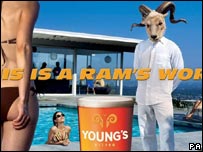 A beer advert has become the first to fall foul of rules banning any link between alcohol and sexual success.
The Young's Bitter billboard poster of a man with a ram's head surrounded by scantily clad women, had the strap line "This is a Ram's
World".
The Advertising Standards Authority said it and a second Young's poster breached rules introduced on October 1 last year and they should be withdrawn. The Advertising Standards Authority (ASA) said the strap line on the poster
featuring the women implied Young's drinkers were personified by the ram, who was the focal point of female attention. We were concerned viewers would be misled into thinking the advertiser offered a treatment that was more effective than it actually
was.
ASA spokesman Matt Wilson described the Young's ruling as a "benchmark" for others in the industry to work from.
Young's denied the images suggested its beer led to sexual or social success. The brewery said the ram in the adverts
related to one which had appeared on the brewery's logo for more than 150 years. It said the idea of a ram being in the social situations shown in the posters was so preposterous that people would understand it was not real. Spokesman Michael Hardman
said: These advertisements were introduced as part of a light-hearted campaign in 2004, well before the rules on the advertising of alcohol were tightened. They were repeated last year but we had already taken the decision not to run them again when
our case went before the ASA.
Another "Ram's World" poster showed the same figure dressed in a suit and surrounded by well dressed men at a gentleman's club.
The tighter rules affecting broadcast and non-broadcast adverts
came into force in response to political concerns about under-age and irresponsible drinking.
|
|
|