|
|
Advert censor bans gollywog character from adverts for the Ginger Pop Shop
|
|
|

|
22nd September 2016
|
|
|
See article from asa.org.uk
|
A press ad for the Ginger Pop Shop seen in the Purbeck Gazette in June 2016 included text which stated Visit our shop and get the tea-towel! and featured an illustration of a golly character holding a pint of ginger beer with text
underneath stating ENGLISH FREEDOM . Two complainants, who believed the depiction of the golly character was racist, objected that the ad was offensive. Ginger Pop Ltd said they did not accept
that the golliwog represented negative racial stereotypes. They provided information about the history of the golliwog character, including his origins in a children's book in the late nineteenth century. They provided a copy of that book and a sequel,
with quotes about his origin from the author. They also provided a modern edition of a Noddy Book and The Golly , a collectors' handbook, which showed the variety of golly memorabilia available. They also provided a letter from a supporter and a
comments book from their shop, which they said showed that the vast majority of passers-by were positive about the fact they sold golliwogs in their shop. They referred to two online videos they had uploaded about golliwogs. They believed the character
as depicted in the original books and on Robertson's marmalade badges was heroic and was an aspirational role model. They acknowledged the character had become stereotyped over time which they said had led some to believe the character was negative. They
also said that he was not intended to be seen as a human character but as a magical being, and that many people of all backgrounds had golly toys as children. They supplied a tea-towel which they had produced to celebrate 120 years of golliwogs, which
included many adjectives to describe the character and which they were said were far removed from the minstrel doll stereotype. ASA Assessment: Complaint upheld The ASA understood that there had been some
local controversy around the tea-towel produced by Ginger Pop for display and sale in their shop, and that the ad was a reference to that. However, we did not consider that all readers would be aware of that background, or that such awareness would
necessarily impact on their reaction to the ad. The Code required marketers to ensure that ads did not contain anything that was likely to cause serious or widespread offence, and particular care must be taken to avoid causing
offence on various grounds, including race. We noted that the ad featured an image which was recognisably a golly character. We considered that many people were likely to view the character as representing negative racial stereotypes, and its prominent
inclusion in a press ad was likely to cause serious or widespread offence. We also considered that the inclusion of the words ENGLISH FREEDOM in the ad was likely to contribute to that offence, because in combination with the image it could be
read as a negative reference to immigration or race. We therefore concluded that the ad was likely to cause serious or widespread offence. The ad must not appear again in the form complained of.
|
|
|
Feminist campaigners 'outraged' that the advert censor doesn't ban sex adverts from inside the Sunday Sport
|
|
|
|
|
21st September 2016
|
|
|
See article from asa.org.uk
|
Two national press ads for Luv2Chat, seen in the Sunday Sport on 14 June 2016, promoted adult chat lines:
a. The first ad appeared on an inside page of the paper and featured several images of naked and partially naked women in sexualised poses with their breasts visible. The images were accompanied by phrases such as They're Huge!
Shoot Your Load on my Massive Tits!! and Filthy Old Pensioner! Give Quick 30 Second Relief . b. The second ad appeared on the back page of the paper and featured several images of women, who appeared to be removing
their clothing, with their breasts partially visible. The images were accompanied by phrases such as XXX Sex Stories and Filthy Sex Chat with Hot TGirls! .
Not Buying It! [a feminist campaign group], who were concerned that the ads could be seen by children, challenged whether the ads had been irresponsibly placed. Worldwide Digital Media said that to
prohibit the ads from being placed in the newspaper, would be highly selective and restrictive, and would amount to censorship on the UK's free press. The Sunday Sport said they regularly ran similar ads in their newspaper, but
had never received a complaint directly about their content, and were not aware of any previous complaints to the ASA about children viewing such ads. They believed that their customers would all be aware of the regular sexual content within the
newspaper, and therefore believed that the newspaper was a suitable media to display the ads. They said there was nothing within the ads that could reasonably be perceived to target children. ASA Assessment: Complaint upheld in
relation to ad (b) only. The ASA noted that the ads contained sexually explicit imagery and text, and therefore required careful placement to ensure that they were not viewed by children. We understood that the Sunday Sport was a
paid-for newspaper targeted at adult males, which regularly contained similar ads for adult services alongside editorial content which was comparably sexually explicit. Because the newspaper was not targeted at children, we considered that it was
unlikely that ad (a) would be seen by them, and therefore concluded that the ad had not been irresponsibly placed on the inside of the Sunday Sport. However, because ad (b) appeared on the back page of the publication, we
considered that, if the paper was left in public places or around the house, the ad could be seen by children. We also understood that the Sunday Sport was usually displayed in retail stores alongside other newspapers in a readily visible position (as
opposed to appearing on the top shelf), and therefore the back page was more likely to be seen inadvertently by children. As such, we were concerned that there was a risk that children would be able to view ad (b), and concluded that the decision to
place it on the back page of the Sunday Sport was irresponsible. Ad (b) must not appear again on the back page of the Sunday Sport. We told Worldwide Digital Media not to place sexually explicit ads on the back page of
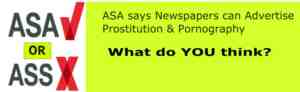
publications where they could be seen by children. Reaction Needless to say, the ban on the back page was not enough for the feminist campaign group Not Buying It! who were 'outraged' that the censors did not also ban
sex adverts inside the publication. The group countered with a few angry banners on its website. Eg
|
|
|
Advert censor finds that Three's Blair Witch Project spoof is too scary for children
|
|
|
|
|
27th July 2016
|
|
|
From asa.org.uk
See video from YouTube
|
Four ads for the mobile phone operator Three and the LG G4 handset: A YouTube video; a banner ad appearing on YouTube; and two pre-roll ads on YouTube.
a. A five minute YouTube video ad, seen in August 2015, opened with the following text Warning the following film contains scenes of a disturbing nature. Viewer discretion advised. Restricted. Suitable for viewers aged 15 and
over . It featured the 15 classification. The ad featured a purple puppet, Jackson, in a car with his human companion, Steve, driving into the woods. The ad cut to a black screen with white writing which said In 2015, Three went into the woods to
test the new LG G4. This is what they found . The ad continued to follow Steve into the woods where he saw a mysterious rusting vehicle in the overgrowth. As he approached the vehicle, a doll jumped up at the window, which in turn, made Steve jump.
The doll was brandished by Jackson who laughed and said Gotcha Steve! and it's only a bit of fun . Next, Jackson was highlighting the features of the camera and viewers saw a small voodoo style doll hanging down amongst the trees to the
right of the shot. Steve pointed this out to Jackson who immediately approached it with the words I love it! Ooooo! . Jackson pulled its leg in delight and said Look, it's a skellington Steve!... b. A banner ad
which appeared on 4 August 2015 at the top of the YouTube home page and was a shorter version of ad (a) featured Jackson and Steve. Text at the beginning of the ad stated Three went into the woods. This is what they found . The ad ended and on the
left-hand side, it stated Click to watch (if you dare) and on the right-hand side, it included an embedded video link to ad (a). c. & d. Two pre-roll ads on YouTube for the same product featured brief clips of ad (a)
and at the end of each ad, it stated Click to watch if you dare , which was a hyperlink to ad (a).
The ASA received three complaints.
One complainant, whose 12-year-old child saw either ad (c) or (d) before a YouTube video, and clicked on the link and was taken to ad (a) and subsequently became distressed by it, challenged whether ad (a) was irresponsible and
likely to cause fear and distress to children who saw it. One complainant, whose 10-year-old child saw ad (b) and clicked on the link and was taken to ad (a), challenged whether ad (b) had been responsibly targeted because it
was accessible to children. One complainant, whose 5-year-old child saw ad (c) before a Minecraft video and became distressed by the ad, challenged whether it had been responsibly targeted because it appeared before a video
which was likely to appeal to children.
ASA Assessment: Complaints upheld 1. Upheld The ASA noted the complainant's concerns and understood that their child had been distressed by the ad. We also acknowledged the ad included
a warning that stated clearly that it was suitable for viewers aged 15 and over and that text underneath the video on the YouTube page highlighted that the content was scary. Although we considered the ad did not show any acts of
violence towards Jackson or Steve, it did create and maintain a heightened sense of suspense throughout. We considered Steve was presented as apprehensive and hyper-vigilant during the ad as to what Jackson and he might find in the woods. The suspense
climaxed on several occasions during the ad such as when Steve reeled back from the mysterious rusting vehicle in the overgrowth when the doll jumped up at the window; the voodoo style doll dangling from a tree; the shadowy figure crossing in front of
them while they were in the tent; and the girl in the bed who leapt towards the camera and then scurried away across the ceiling. We considered Steve's fear at being in the woods culminated in the final scenes of the ad when he was shown screaming while
running through the woods trying to escape. We considered the ad's content was not excessively shocking for viewers who were 15 years old and above and therefore, it was unlikely to cause distress to them. However, we considered
younger viewers were likely to be distressed by some of the scenes, most notably where the girl leapt towards the camera and had blood pouring out of her mouth. The ad included a warning to state that it contained scenes of a
disturbing nature and that viewer discretion was advised. Given this, we considered that Three needed to take steps to reduce the likelihood of the ad being served and shown to younger viewers (i.e. under 15s) when they were using YouTube.
We understood that the ad had been kept away from YouTube content which was suitable for children and videos with gaming content unless they were relevant to the target audience. However, we understood from Three that the ad was
subject to inferred targeting, which meant it would have been served to YouTube users whose viewing history suggested they fitted within the intended demographic: over 18s, even if they were not signed into their account. We noted the intended audience
and that targeting was based on the viewing histories of YouTube users. Nevertheless, we considered there was the possibility the ad could still be served to children. By featuring the warning in the ad, we considered Three
recognised it might cause distress to younger viewers. We considered also that there could, however, be a risk that younger viewers would continue to watch the ad regardless of the warning. Moreover, we considered the ad's prolonged and heightened sense
of suspense was likely to cause undue fear and distress to children. We concluded the combination of the ad's content, and the possibility that the warning would be ignored, meant that ad (a) was likely to cause distress to those younger viewers who saw
it. We acknowledged the steps Three had taken to reduce the likelihood of children seeing the ad and we recognised that it was unlikely that they could take steps to prevent all under 15s from seeing the ad. However, we understood that it would have been
possible for Three to limit the targeting of the ad so that it was only served to YouTube users signed into accounts belonging to those who had declared themselves to be over the age of 15. In that respect, we considered applying that additional option
would have further reduced the likelihood of children being served and watching the ad. While Three had taken steps to target the ad, we concluded nevertheless that it had not been targeted appropriately. 2. Upheld
We understood the complainant's 10-year-old child had become distressed by ad (a), having watched ad (b) and clicking through to ad (a. It was our understanding from Three that ad (b) could not be subjected to any means of targeting
and was served to all YouTube users (regardless of whether or not they had signed into their account) on the day it appeared. Therefore, we understood that ad (a), which had been embedded at the end of ad (b), was also available to all YouTube users.
While the content of ad (b) included scenes from ad (a), we considered that its content was milder. However, ad (b) included an invitation for viewers to click here - if you dare and an embedded version of ad (a), which played
if clicked on. From the information and content presented in ad (b), we considered children were unlikely to understand that ad (a) might be unsuitable for them, given that they had been able to access and watch ad (b). Ad (a)'s warning appeared after
the user had clicked on the embedded video and as noted above, we considered that made clear that its contents were not suitable for under-15s. Notwithstanding that, ad (b) was available to all YouTube users, including those who were not signed into
their account. In those particular circumstances -- where all YouTube users were served ad (b) and could click through to ad (a) -- we considered the phrase click here if you dare and the warning which appeared after users clicked through to ad
(a) were insufficient to prevent YouTube users under the age of 15 from continuing to watch ad (a). For those reasons, we concluded that ad (b) had not been responsibly targeted and therefore, it breached the Code. 3. Upheld
One complainant's child saw ad (c) before a YouTube video featuring the Minecraft character I am Goldenpants . We noted Three's comments that YouTube did not regard Minecraft to be children's content and we understood that
depending on the edition of the game, PEGI (Pan European Gaming Information) had given it various age ratings from 7 to 12. Although it was our understanding that the game Minecraft did not have an audience that comprised exclusively of children, we also
understood that it was, nevertheless, very popular among them. Given that, we considered YouTube videos that featured Minecraft gaming content were likely to be of particular interest to children. We noted ad (a) could be accessed
via ad (c) by way of hyperlinked text that stated click to watch if you dare . As stated above in point 2, we considered young children were unlikely to interpret that statement as a warning about ad (a)'s content or properly acknowledge it, given
they had been served and had been able to watch ad (c), which featured much milder content. While we recognised Three had identified and restricted content before which ad (c) should not be shown, the ad still appeared before a
video that we considered went beyond broad appeal to YouTube users and was highly likely to be of appeal or interest to children. In that context, we considered that ad (c) had not been targeted appropriately and therefore, it was in breach of the Code.
Action We told Three to ensure that future ads which were unsuitable for viewing by children were appropriately targeted.
|
|
|
|
|
|
|
|
6th July 2016
|
|
|
Guy Parker, ASA Chief Executive, opines that there is absolutely no chance that his advertising censorship code can be made to apply to politicians and political advertising See
article from asa.org.uk
|
|
|