| 31st December | |
| British missionary couple jailed for calling Gambian president a madman
| Based on article from timesonline.co.uk |
A missionary couple from Britain have been sentenced to a year's hard labour in an African prison for calling the Gambian President a madman.
David Fulton and his wife, Fiona, were convicted of sedition after sending critical e-mails about Yahya
Jammeh, who seized power in the predominantly Muslim country in a bloodless coup in 1994.
Fulton and his wife were also fined £6,250 each. Their lawyer said that they did not plan to appeal but were hoping for a pardon.
The couple,
who were arrested on November 29, pleaded guilty and issued a public apology in the hope of a lenient sentence but were shocked when the judge handed down the maximum penalty for the shocking offences . The presiding magistrate, said: They have
shown no respect for the country, the Government and the President of the republic. I will send a clear message to the offenders.
Antouman Gaye, the couple's lawyer, said that their troubles began after they sent e-mails to friends and church
contacts in Britain: Some of it was to do with religion, some was to do with the state of affairs in this country. Some e-mails said the President is a madman. It was very risky.
Unfortunately for them, a Gambian person in England who
has a connection with one of these churches got hold of these e-mails and sent them back to the police here.
|
| 29th December | | |
Repressive India cyber law nodded through after Mumbai killings
| From dailytimes.com.pk |
A new law introduced in India has made Internet pornography a serious crime.
Browsing or downloading pornographic pictures or films will now attract a punishment of five years with a fine of up to Rs 1 million (£14,000). The term may be
raised to seven years on second offence.
The Information Technology (Amendment) Bill that was passed without debate by parliament this week with 45 amendments in the original law treats both purveyors of pornography and recipients in the same
manner. It gives wide powers to the authorities that a computer user may realise only when he is hauled up. The worst is that an inspector can raid and arrest an accused without a warrant.
In the original law enacted in 2000, this power was
vested in officers of the rank of deputy superintendent of police and above.
To satisfy the activists who campaign against child abuse, the bill provides a full section subtitled punishment for publishing or transmitting of material depicting
children in sexually explicit act, etc in electronic form. If any of these are found on a computer, the onus is on the owner to establish that the depicted are not children or will be punished. Another section of the bill provides for any
government agency to interrupt, monitor or decrypt any information generated, transmitted, received or stored in any computer.
Ambiguity has been kept in the provision that empowers the cyber security to monitor the Internet traffic.
Introducing any
contaminant in a computer or network is covered in the new category of cyber terrorism in the bill that would attract imprisonment and might extend to life term since it claims such conduct causes or is likely to cause death or injuries
to persons or damages to or destruction of property .
Cyber terrorism also seeks to cover other acts of terrorism committed electronically like threatening the unity, integrity, security or sovereignty of India or to strike terror on the
people or to access computer sources that are restricted for reasons of security of the state or foreign relations.
The bill also provides for punishment with a jail term of up to three years and a fine for sending any information — that is
grossly offensive or has menacing character or is known to be false — for the purpose of causing annoyance, inconvenience, danger, obstruction, insult, injury, criminal intimidation, enmity, hatred or ill will, or any electronic mail or message meant to
cause annoyance or inconvenience or to deceive or mislead the addressee or recipient.
Identity theft to misuse a person's electronic signature, password or any other unique identification feature or impersonation in electronic activity are
punishable with a three-year imprisonment and a fine of up to Rs 0.1 million.
Thefts of computer source codes and programmes have also been dealt with in the bill.
|
| 25th December | | |
Philippines to introduce ratings and a watershed for cable TV
| Based on article from
gmanews.tv |
Philippines authorities may soon set up a rating code for violence in television and cable programs, if a bill in the House of Representatives is passed into law.
House Bill 5625 also seeks to impose ban on violent and sexually themed
non-educational programming on TV during most of the day.
CIBAC Party-list Reps. Cinchona Cruz-Gonzales and Emmanuel Joel Villanueva said their bill is in line with the State policy to protect the welfare of children. The two said there are no
laws allowing the Movie and Television Review and Classification Board (MTRCB) and the National Telecommunications to block violent and sexually themed non-educational programming.
Under the bill, the MTRCB and NTC shall jointly prescribe, in
consultation with the television broadcasters, cable operators, concerned non-government organizations for children, and interested individuals from the private sector, the rules for rating the level of violence and non-educational sexual themes in
television programming.
This includes rules for the transmission by television broadcast systems and cables of signals containing specifications for blocking violent and sexually themed non-educational programming.
It also assigns the
MTRCB and NTC to jointly pass rules and regulations which shall prohibit the broadcast on commercial television and public telecommunications entities of programming that contain violent and obscene scenes for children based on the established ratings
code, including the broadcast by cable operators, from the hours of 6 a.m. to 10 p.m
|
| 25th December | | |
Philippines bans Aurora movie
| Based on article from
gmanews.tv |
The comeback movie of Rosanna Roces still cannot be shown to the public because the film has received another ban (X rating) from the Movie Television Review and Classification Board's (MTRCB).
The reviewers wrote in their report that controversial scenes are not fit for public viewing.
Aurora, directed by Adolfo Alix, Jr., tells the plight of a social worker who tries to escape in the middle of the forest after being kidnapped by members of the Lost Command.
The lead female character, played by Rosanna, will be
raped by Kristofer King in the middle of a forest. Members of the MTRCB want to shorten the said rape scene.
Philippine Entertainment Portal reported earlier that the said scene was deemed too explicit, resulting in a ban during the
first review of the film.
The director did not change anything in the film for the second review of Aurora. I stand by my cut of the film, he adds. He will appeal the decision at Malacañang and request for a final review.
|
| 24th December | | |
| Bali to challenge Indonesia's new sharia dress code bill
| From thejakartapost.com |
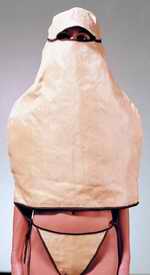 | Indonesian bikini
compromise |
The Bali People's Component (KRB) organization has finished its draft judicial review of the recently signed anti-pornography law, the first legal challenge to the controversial measure.
We have decided to submit this legal motion on Jan. 7
asking the Constitutional Court to conduct a judicial review of the law, said KRB Coordinator I Gusti Ngurah Harta.
He said the move was part of the KRB's ongoing commitment to fight the law, which many Balinese regard as a threat to their
cultural legacy and the integrity of the nation.
This highly-anticipated draft is the first legal challenge to the contentious porn law, which critics have slammed as an allowance for extremists to force one-sided morality against pluralist
Indonesia.
The law vaguely defines pornography as any material that incites sexual desire, a clause that has triggered debate nationally.
The 50-page draft outlines the legal arguments around whether or not the law violates key
constitutional rights, and looks at the issue from social, economic, artistic and cultural perspectives.
This law has trampled on at least five constitutional rights granted to all Indonesian citizens," said KRB's chief legal adviser,
Palguna.
The integral constitutional rights arguably under threat are the right to be treated equally in any legal process, the right to demand a legal certainty from and during legal prosecution, the right to be free from fear and intimidation,
the right to acquire beneficial gains from arts and culture and the right to pursue legal vocations. Anti Bikini, Anti Alcohol Indonesia puts off Western Tourists From in.reuters.com Indonesia's
tourism ministry said on Tuesday it expects a decline in tourist spending next year because of the global economic crisis. Some tourist areas, including the resort island of Bali, are heavily dependent on tourism for jobs and growth. A recent
shortage of alcohol in Jakarta and Bali, and concerns over Indonesia's new anti-porn law -- seen by some as a threat to artistic, religious and cultural freedom in the diverse archipelago -- have led some tourists to complain or even threaten to stay
away.
I understand that for foreigners alcohol is like tea or coffee for us, if there's no alcohol then tourists are reluctant to come here, Culture and Tourism Minister Jero Wacik told a press briefing, adding that the issue was being
resolved, particularly in top-tier hotels. Update: Trampling on Rights 3rd January 2008. See
article from xbiz.com The Bali People's Component, known as the KRB, has finalized a judicial
review challenging the recently ratified anti-pornography law and plans to present the review to the Constitutional Court on Jan. 9.
In its 50-page legal challenge, the KRB argues that the law has trampled upon at least five constitutional
rights granted to all Indonesian citizens, said I Dewa Gde Palguna, chief legal advisor of the KRB, in that it denies Indonesian people in 21 separate professions their basic right to the freedom of expression, among other things. Some of the at-risk
professions include dancers, playwrights, reporters, composers and gymnastics instructors, among others.
The KRB has estimated that the court will need about four months to come to a decision. |
| 22nd December | | |
Saudi may be preparing to end ban on cinemas
| From bi-me.com |
The Saudi film industry took another step forward last week with the public screening of a locally produced movie, suggesting the government could be moving towards lifting a three-decade old ban on cinemas.
The premiere of Mnahi , which
was produced by Saudi-owned Rotana studios, marks the second public screening of a Saudi film in a little more than a year, after Sabah al Lail was opened to the public on a commercial release in October 2007 during the Eid al Fitir holiday.
Rotana Studios is owned by Prince Waleed bin Talal, a Saudi billionaire, and it is believed his connections with the royal family played a major role in the movie's public showing.
I am correcting a big mistake, that is all, Prince al
Waleed had told the New York Times in a 2006 interview prior to the launch of Rotana Studios' first movie, Keif al Hal : I want to tell Arab youth you deserve to be entertained, you have the right to watch movies, you have the right to listen
to music. There is nothing in Islam – and I've researched this thoroughly – not one iota that says you can't have movies. So what I am doing right now is causing change.
Movie theatres existed in Saudi in the 1960s and 1970s, but they were
banned in the early 1980s after conservatives consolidated their support.
Ayman Halawani, General Manager of Rotana Studios, said in a press statement that Saudi cinema will not only produce but it will market its movies in its home country
and among its viewers, and here lay the significance of this event. Update: Cinema is Evil 22nd December 2008. See
article from guardian.co.uk A locally-produced comedy,
Menahi , premiered in two cultural centres in Jeddah and Taif this month before mixed-gender audiences, a taboo in Saudi Arabia whose strict Islamic rules ban unrelated men and women from mixing.
Turnout for the movie, produced by
billionaire Prince Alwaleed bin Talal's media company Rotana, was so big the film had to be played eight times a day over a 10-day period. While the kingdom's Grand Mufti Sheikh Abdul Aziz al-Shaikh has not commented on the issue, the head of
Saudi Arabia's religious police condemned cinemas as a pernicious influence.
Our position on this is clear - ban it. That is because cinema is evil and we do not need it. We have enough evil already, said Ibrahim al-Ghaith, the head of the
religious police, whose official title is the Commission for Promotion of Virtue and Prevention of Vice. He later toned down his remarks, saying that cinema could be tolerated if it does not violate Islamic law.
|
| 20th December | |
| Another UN vote supports the criminalisation of defamation of religion
| From cnsnews.com |
A defamation of religion resolution stating that Islam is frequently and wrongly associated with human rights violations and terrorism passed in the U.N. General Assembly – but with fewer votes than in previous years.
Over the past
year opponents ranging to media watchdogs and free speech advocates to Christian and humanist groups have stepped up lobbying against the Organization of the Islamic Conference (OIC)-driven campaign.
Thursday's vote passed by a margin of 86-53,
with 42 countries abstaining. The result showed a significant erosion of support since a similar resolution passed in the General Assembly last December by a vote of 108-51, with 25 abstentions.
For the first time, the number of countries
supporting the resolution fell behind the number of those voting against or abstaining.
Defenders of free speech take some consolation in the increased votes for our cause, Hillel Neuer, executive director of the human rights watchdog UN
Watch, said: But the adoption of yet another totalitarian text is a stark reminder that human rights at the U.N. is under assault.
He also noted that Islamic states were using a major U.N. conference on racism, scheduled for next spring,
to advance their campaign. Proponents are arguing that the defamation of Islam and Islamophobia are contemporary forms of racism, and should thus fall under purview of the racism conference, commonly known as Durban II.
The most
dire threat is coming from Geneva where a Durban II committee headed by Algeria has this week been seeking to amend international human rights treaty law to ban ‘defamation of religion,' especially Islam, Neuer said.
The shift in voting from
last year to this came primarily from 16 developing countries which voted in favor in 2007 but chose to abstain on Thursday. Two of them, Benin and Burkina Faso, are OIC members. (The others are Central African Republic, Congo, Costa Rica, Dominican
Republic, East Timor, Grenada, Haiti, Mauritius, Saint Lucia, Trinidad and Tobago, Tuvalu, Uruguay, Vanuatu and Zambia.)
Three countries which voted in favor in 2007 – Belize, Cape Verde and Liberia – moved to opposing the resolution this year.
And one country, OIC member Nigeria, abstained last year but voted in favor this year.
|
| 14th December | | |
Playboy apologises to the easily offended over Maria cover
| Based on article from telegraph.co.uk
|
Playboy magazine issued an apology after it put a nude model supposedly resembling the Virgin Mary on the cover of the Mexican edition of the publication at the time of a festival dedicated to the mother of Jesus.
The magazine, which hit
newsstands on Dec 1 as ceremonies began leading to the pilgrimage to the Mexico City shrine of the Virgin of Guadalupe, showed a model wearing nothing but a white cloth over her head and breasts.
The model, Maria Florencia Onori, is pictured
standing in front of a stained glass window with the cover line, We Love You, Maria in Spanish.
In a statement, Chicago-based Playboy Enterprises Inc said the Mexican edition of the magazine is published by a licensee, and the company did
not approve or endorse the cover: While Playboy Mexico never meant for the cover or images to offend anyone, we recognise that it has created offence, and we as well as Playboy Mexico offer our sincerest apologies .
Playboy Mexico printed
100,000 copies of the issue. |
| 14th December | | |
Russia withdraws internet censorship bill
| Based on article from
en.rian.ru
|
A draft law to toughen control over electronic media, including in the Internet, as part of efforts against extremism has been withdrawn from Russia's lower house of parliament for further discussion.
The Russian Vedomosti daily suggested that it
may have been pulled at the request of the government.
In November, during his state-of-the-nation address, Russian President Dmitry Medvedev pledged a commitment to free speech, saying that, No government officials will be able to hamper
discussions in the Internet.
The bill proposed by the dominant, Kremlin-backed United Russia party allows the closure of websites for publishing for a second time materials promoting extremism. It would also order Internet providers to
block access to the website.
|
| 14th December | |
| Author arrested for publishing inflammatory material
| Based on article from
indianexpress.com
|
He wrote the book, he says to condemn the recent violence between Hindus and Christians in Kandhamal, but Lenin Kumar was arrested by the Orissa police on charges of writing and publishing inflammatory material that could cause communal unrest.
A day later, his bail plea was rejected and he was remanded to judicial custody. Lenin's wife, Rumita Kundu, has also alleged that the police tortured her husband. Now, civil right activists, writers and journalists are up in arms
against the state Government and are planning a protest march to Raj Bhawan.
Lenin Kumar, editor of a quarterly Oriya magazine, Nishan, was arrested under sections 295 and 1539(A) of the Indian Penal Code for his book Dharma Nare Kandhamalare
Raktara Banya (Bloodletting in Kandhamal in the name of religion). Two others who helped him print and circulate the book have also been arrested and their bail pleas rejected as well. At least 700 copies of the book were seized from the
printing press and the press sealed.
|
| 13th December | | |
Iran whinges at Hollywood film with Iranian baddy
| Based on article from
guardian.co.uk
|
A new target in Iran's long-running grievance about its negative portrayal in popular western cinema is, The Wrestler , a film directed by Darren Aronofsky and starring Mickey Rourke, due for release in the US on December 17.
Newspapers and websites have alerted readers to the
anti-Iranian film by highlighting a scene in which Rourke's character, Randy "the Ram" Robinson, violently breaks a pole bearing an Iranian flag across his knee, after his opponent tries to use it to put him in a stranglehold.
Perhaps to avoid offending Iran's clerical rulers, no mention has been made of the screen name of Rourke's antagonist, the Ayatollah, played by Ernest Miller.
But the Miller character's wrestling attire, a skimpy leotard in the pattern of an Iranian flag with the alef character - representing the first letter of the word Allah - emblazoned front and back on his loins, has been condemned by Borna News,
a state-run website.
The pole-breaking scene occurs against the explicitly nationalistic backdrop of an animated crowd chanting, USA, USA. It is intended to represent the final triumph for Rourke's character, who comes out of retirement
following a heart attack for one last confrontation with the Ayatollah, a rival from his wrestling heyday.
While there is virtually no chance of The Wrestler being given official screening permission in Iran, many Iranians have become familiar
with it through promotional trailers shown on broadcaster, Voice of America's Persian-language satellite television channel.
|
| 13th December | | |
Vietnam looks to repressing bloggers
| Based on article from
rfa.org
|
With blogging on the rise in Vietnam, authorities plan tighter curbs and tougher monitoring.
Vietnamese authorities plan to police the content of dissident blogs through random checks and self-policing by the country's blogging community, a
senior Vietnamese Internet security expert has said.
There should be a legal corridor to assure better operation of the blogs, the director of the state-run Bach Khoa Internet Security Center, Nguyen Tu Quang, told RFA's Vietnamese
service. We'll manage them by randomly checking—we don't need to control all the blogs.
Earlier this month, Information and Communication Deputy Minister Do Quy Doan was quoted as saying Hanoi would seek cooperation from Internet giants
Google and Yahoo! to help regulate the country's flourishing blogging scene.
The government will announce new rules this month, stressing that Weblogs should serve as personal online diaries, not as organs to disseminate opinions about
politics, religion, and society, senior officials were quoted as saying.
Quang said under the draft rules being debated violators could face up to U.S. $12,000 in fines and up to 12 years of jail time.
Authorities currently block some Web
sites run by overseas Vietnamese that espouse views critical of the government, and they often seek to shut down anything seen as encouraging public protest.
In September, blogger Dieu Cay was jailed for 2.5 years on tax evasion charges after he
tried to persuade people to protest at the Olympic torch ceremonies in Ho Chi Minh City last summer. Depraved Vietnam Based on
article from thanhniennews.com Police in Ho Chi Minh City
Thursday arrested 10 suspects allegedly involved in the operation of a pornographic website and charged them with distribution of depraved material.
Police plan to press similar charges against two other suspects.
|
| 12th December | | |
Indonesia president signs repressive sharia anti-pornography law
| Based on article from
google.com
|
Indonesian President Susilo Bambang Yudhoyono was strongly criticised after signing a repressive anti-pornography law which opponents have said threatens national unity.
The law, backed by Islamic parties in the capital Jakarta, criminalises all
works and bodily movements deemed obscene and capable of violating public morality, and offers heavy penalties.
It prompted protests across Indonesia, with critics saying it could threaten art and traditional culture from temple statues on
Bali to penis sheaths on tribesmen in Christian and animist Papua province.
The president's signing of the law late last month was made public last Tuesday.
Yudhoyono could have chosen not to sign it because there are still several
provinces which strongly oppose the law, lawmaker Eva Sundari of the Indonesian Democratic Party of Struggle (PDIP) told AFP. The opposing provinces, such as Papua, Bali, Yogyakarta, North Sulawesi and East Nusa Tenggara, say that the law
threatened their culture and national unity.
I Gusti Ngurah Harta, head of the Bali People's Component, an organisation of local intellectuals and artists, said: We are disappointed that President Susilo Bambang Yudhoyono has signed the
law. We will not vote for him in the elections next year.
Bantarto Bandoro, political analyst from the Centre for Strategic and International Studies, said: Yudhoyono's decision could shake the foundation of his presidential campaign for
next year's election.
The law contains provisions for between six months and 12 years' jail for producers and distributors of pornography and up to four years in prison for downloading pornography.
|
| 9th December | | |
TV Censor finds Harry Enfield's Filipina sketch not in breach
| Based on article from
ofcom.org.uk
|
Harry and Paul
BBC1, 26 September 2008, 21:00
Ofcom received 42 complaints regarding a sketch in the Harry and Paul show which depicted a so-called upper class character, played by Harry Enfield, encouraging a Northern man - whom he treats as his dog - to
mate with his neighbour's Filipina maid. The scene showed the Northerner , known as Clive, failing to show interest in the maid and the Harry Enfield character shouting encouragement and urging Clive to mount her before sending the
maid back to the neighbour's home.
The complainants expressed concern that the sketch was offensive to the Filipino community and women in general, by presenting the Filipina as an object of sexual gratification.
Ofcom Decision
Ofcom recognises the sensitivities involved when comedy makes reference to or represents any particular ethnic community in the United Kingdom . In this case it was a Filipino who featured in the broadcast. We therefore considered this
material in the light of Rule 2.3 (generally accepted standards) which says that …broadcasters must ensure that material which may cause offence is justified by the context…
This particular sketch was one of a number which ran throughout
the series in which Harry Enfield plays an extreme comedy stereotype of an upper class toff living in the South of England. This caricature has little sensitivity to those outside of his social class. Consequently, he treats Clive like his dog. It
is in this context that the sketch showed the Harry Enfield character encouraging Clive to mate with his neighbour's domestic help, for whom he also has little or no respect.
Whilst Harry and Paul is a new series, Harry Enfield and Paul
Whitehouse are long established comedians whose style of humour often focuses on presenting characters in an exaggerated and stereotyped way for comic effect. The comedy frequently comes from the absurdity of the situation.
In terms of the degree
of offence and the likely expectation of the audience, we considered whether the material was justified by the context of the sketch as a whole.
As noted above, this item featured established comedians and the sketch was typical of the material
presented by Harry Enfield and Paul Whitehouse in this, and other series. Therefore it is Ofcom's view that the material would not have exceeded the likely expectation of the vast majority of the audience.
Further, in Ofcom's view, there was no
intention to ridicule women or the Filipino community in this sketch. The target of the humour was very clearly the upper class character played by Harry Enfield who holds such a deluded view of his social superiority that he treats individuals with
lower social status with ridiculous disdain. The Filipina domestic help was featured as a character in the sketch to highlight this extreme and ridiculous behaviour.
Comedy often, and rightly, engages with challenging and sensitive subjects such
as social class. In this respect Ofcom must regulate potentially offensive material in a manner that also respects freedom of expression – the broadcasters' right to transmit information and the viewers' right to receive it. Ofcom must therefore seek an
appropriate balance between protecting members of the public from harm and offence on the one hand and the broadcaster's right to freedom of expression on the other, taking into account such matters as context.
Although this sketch may have
caused offence to some individuals, it explored the issue of social class in an absurd way which was not intended to reflect real life. In our view this was the approach and effect of this sketch. On balance, it is Ofcom's view that the material did not
breach generally accepted standards because it was justified by the context.
Not in Breach
|
| 8th December | |
| Croatia police arrest Facebook activists
| Based on article from
news.bbc.co.uk
|
Croatia's prime minister has ordered an inquiry following arrests of several opposition activists who made plans via the social networking website Facebook.
This is not about this or that government or party, but about freedom, Croatian PM
Ivo Sanader said.
Police in Zagreb questioned a Facebook activist who had put up posters ahead of an anti-government protest planned for Friday, Croatian TV reported. In the Zagreb case, an opposition Facebook group with nearly 60,000
members included volunteers who had downloaded posters over the internet, Croatian TV reported.
The man arrested in the Croatian capital was charged with disturbing the peace, under an old law from 1990 which applied to the then-Yugoslavia, the
TV reported.
In a statement Sanader said he had asked Interior Minister Tomislav Karamarko and Police Director Vladimir Faber to submit a report today on the latest events and arrests in Zagreb and Dubrovnik and to take appropriate steps if
police did not respect regulations. No-one should be detained or arrested in Croatia for expressing different views.
The activist in Dubrovnik had set up a Facebook group called I bet I can find 5,000 people who dislike Sanader. Police
argued that his group had illegally shown a photo montage of Sanader in a Nazi uniform.
Sanader said he deplored any use of Nazi symbols for the purposes of political satire.
|
| 6th December | |
| Turkey asks Google to identify insulting YouTube posters
| Based on article from
cyberlaw.org.uk
|
A Turkish prosecutor says the United States should identify the individuals responsible for posting YouTube videos.
Ankara public prosecutor Kursat Kayral has asked U.S. officials to identify whoever posted videos on the video-sharing Web site
that offered derogatory views of Mustafa Kemal Ataturk, the founder of the Republic of Turkey.
Kayral said the videos not only insult Ataturk, but also Turkey and its flag. He has asked U.S. officials to hand over the identities of the
responsible individuals once they are determined.
Hurriyet said if Turkey is able to ascertain the identities of those responsible, they will likely face arrest if they ever step foot on Turkish soil.
|
| 6th December | | |
Red lights to be extinguished at Ning social networking
| Based on article from
avn.com
|
The social networking site Ning has announced that it will discontinue hosting adult-oriented networks in its Red Light District as of January 1. Ning was designed to allow anyone to create a social network on its platform. Network creators
were allowed to do their own moderating. Ning claims the decision was informed by the practical, not the philosophical. CEO and co-founder Gina Bianchini described the move as a logical step, taking into account all the problems adult content has
caused for the site, including sub-par ad revenue, an increase in illegal adult social networks, and numerous DMCA take-down notices.
We're not discontinuing the Red Light District because we no longer believe in the freedom to create your own
social network for anything as long as it's legal. We do. Practically though, supporting adult networks no longer makes sense, Bianchini wrote on the Ning blog.
|
| 5th December | | |
Barmaid sacked after blogging about drunk politician
| Based on article from telegraph.co.uk
|
Nathalie Lubbe Bakker was fired from her job after government officials rang the bar owner to complain about the claims relating to Pieter De Crem.
Miss Lubbe Bakker, also a Belgian, said she was shocked when she recognised the defence minister
among a rowdy party of her countrymen who stumbled into the B-Café.
Writing on her Living in New York blog the next day, Miss Lubbe Bakker claimed the minister's sang bawdy songs and made persistent demands to take
over the serving of drinks behind the bar. She went on to claim one of de Crem's officials told her he was in the city to attend a United Nations meeting.
Four days later, after her posting had been picked by Belgium's De Standaard newspaper,
Miss Lubbe Bakker reported on her blog that she had been sacked after a defence ministry telephone call to her boss: I was astonished to learn from a well-informed source that the defence minister's spokesman had telephoned the bar's owner.
What the contents of that conversation were are unknown to me but when my next shift finished, he dismissed me on the spot without any explanation.
Now de Crem has faced questions over the barmaid affair in the Belgian parliament.
While admitting a call was made to Miss Lubbe Bakker's boss, the minister insisted there was never any insinuation that she should lose her job.
De Crem went on threaten legal action against bloggers and warned Belgian MPs every one of you is
a potential victim. I want to take this opportunity and use this non-event to signal a dangerous phenomenon in our society, said during a debate last Friday.
We live in a time where everybody is free to publish whatever he or she wants on
blogs at will without taking any responsibility. This exceeds mud-slinging. I find that it's nearly impossible to defend yourself against this.
Belgian bloggers are up in arms over what they perceive to be a threat to free speech and a
Facebook campaign has been set demanding Miss Lubbe Bakker is reinstated in her job.
Many people on Belgium's blogosphere have noted that de Crem appears to have changed his mind since he wrote on his own website that the internet helps close
the gap between the citizen and the politician. |
| 5th December | | |
|
Philippines court confirms ban on Joseph Estrada's biopic See article from philstar.com |
| 3rd December | | |
YouTube restrict suggestive material to adults and demote it in searches
| Based on article from
uk.youtube.com
|
Our goal is to help ensure that you're viewing content that's relevant to you, and not inadvertently coming across content that isn't. Here are a few things we came up with:
- Stricter standard for mature content - While videos featuring pornographic images or sex acts are always removed from the site when they're flagged, we're tightening the standard for what is considered sexually suggestive. Videos with sexually
suggestive (but not prohibited) content will be age-restricted, which means they'll be available only to viewers who are 18 or older.
- Demotion of sexually suggestive content and profanity - Videos that are considered sexually
suggestive, or that contain profanity, will be algorithmically demoted on our Most Viewed, Top Favourited, and other browse pages. The classification of these types of videos is based on a number of factors, including video content and
descriptions. In testing, we've found that out of the thousands of videos on these pages, only several each day are automatically demoted for being too graphic or explicit. However, those videos are often the ones which end up being repeatedly flagged by
the community as being inappropriate.
- Improved thumbnails - To make sure your thumbnail represents your video, your choices will now be selected algorithmically.
- More accurate video information - Our Community
Guidelines have always prohibited folks from attempting to game view counts by entering misleading information in video descriptions, tags, titles, and other metadata. We remain serious about enforcing these rules. Remember, violations of these
guidelines could result in removal of your video and repeated violations will lead to termination of your account.
|
| 3rd December | | |
Animated bare limbs covered for muslim gamers
| Based on article from
techradar.com
|
A Dubai company has made a version of an online role playing game tailored specially for Muslims.
The firm in question is Game Power 7 and it has made a few adjustments to Gala's role-player Rappelz to make it supposedly more appealing
to customers in Islamic countries.
As well as changing the background music, the noises monsters make and taking out non-Muslim religious symbols, such as crosses, Game Power 7 has given some characters a little more to wear.
We're told
that female players will be properly covered up so that they're no longer showing too many flesh-coloured pixels. Arms and legs get special attention, with chainmail and long stockings pasted on.
|
| 3rd December | | |
European Parliament delegation compare Turkey to pariah states
| Based on article from hurriyet.com.tr
|
A delegation from the European Parliament urged Turkish officials to make the necessary legal arrangements to enhance freedom of expression and eventually lift the ban on access to YouTube.
Banning YouTube, Google's blogging site, the websites
of a teachers' trade union, Richard Dawkins and even a Turkish dictionary stands alongside more than 40 cases against writers and journalists even since the reform of the so-called anti-Turkishness article of the penal code, Richard Howitt, the vice
president of the European Parliament's Human Rights Sub-Committee, said in a written statement on Friday.
The British Euro MP called for the ban to be overturned at a meeting with Turkish Justice Minister Mehmet Ali Sahin in Ankara on Thursday,
the statement added.
Howitt criticized the ban, saying that around 1,000 websites are blocked in Turkey and this places the country alongside some of the world's worst nations for cyber censorship. As a modern country looking forward to European
Union membership, Turkey should be embracing new communications rather than putting itself in the same bracket as some of the world's pariah states, Howitt added in the statement. |
| 3rd December | | |
89% of Egyptians supposedly in favour of internet censorship
| Based on article from
editorsweblog.org
|
A sampling by the Egyptian Information and Decision Support Center shows that 89% of Egyptians age 18 to 35 are in favor of an Internet censorship law.
A majority of those in the 1,338 person sampling distrust the Internet, with 72% seeing it as
a bad influence, and 71% finding it dangerous for children. Internet relationships and friendships are also seen as untrustworthy, and 43% have found it negatively impacting family ties.
|
| 30th November | | |
Pakistan to resolve its terrorism problem by banning vulgar dance
| From thepost.com.pk |
Commissioner Lahore Division Khusro Pervez Khan has banned vulgar dance, gestures and immoral dialogues in the stage dramas being played in the four districts.
The Commissioner Lahore Division issued directives to four districts Kasur, Nankana,
Sheikhupura and Lahore to impose a ban immediately on theaters which stage obscene dances and dialogues.
The directive added that time for theaters will be only from 8pm to 11pm and no theater will be allowed to continue show after this
stipulated time. In addition, the commissioner directed the producers not to cast the actors who use vulgar dialogues. The details of the members of the committee that has been constituted to censor dramas on stage be also submitted in three days,
the commissioner said in the letter. The commissioner ordered producers to accommodate the senior actors who had been popular for family shows but they were ousted due to dirty stage dramas in the recent years.
|
| 29th November | | |
Indonesia president advised to make gesture and not sign porn bill
| From thejakartapost.com |
Presidential Advisor Adnan Buyung Nasution recommended President Susilo Bambang Yudhoyono not sign or ratify the recently passed pornography bill, as its enforcement could threaten the country's plurality.
I have recommended the President not
sign or ratify the porn bill. He has the right to do so and it is not against the Constitution, he told The Jakarta Post. Buyung said that by not signing the bill, the public would see that the President considers maintaining the unity of the
nation a priority.
The House of Representatives passed the controversial porn bill last month despite opposition from the Indonesian Democratic Party of Struggle (PDI-P) and the Prosperous Peace Party (PDS). The bill has endured strong protest
from human rights activists and pluralist organizations, as some articles in the bill were deemed contentious enough to spark disintegration.
The Constitution says a bill passed by the House is supposed to be signed by the president within 30
days. If not, the bill will still become a legitimate law. However, by not signing it, the president rejects the mainstream ideas and political interests of the House," Buyung said.
|
| 26th November | | |
China whinges about the new Guns n' Roses album
| Based on article from
news.bbc.co.uk
|
China has dismissed the new Guns N' Roses album, Chinese Democracy , as a venomous attack on the nation.
An article in the Global Times, published by the ruling communist party, says the album, launched this week, turns its
spear point on China.
The title track of the album, which has not been released in China because of the sensitive material, refers to the banned Falun Gong spiritual group.
On the title track, lead singer Axl Rose sings: If your
great wall rocks, blame yourself.
Artwork for the album includes the oil painting Red Star by Beijing artist Shi Lifeng - which depicts Chinese people as powerless.
The album's official website has been blocked in China.
|
| 25th November | | |
UN votes in favour of blasphemy laws backed by islamic countries
| From canada.com |
Islamic countries won United Nations backing for an anti-blasphemy measure Western critics say risks being used to limit freedom of speech.
Combating Defamation of Religions passed 85-50 with 42 abstentions in a key UN General Assembly committee,
and will enter into the international record after an expected rubber stamp by the plenary later in the year.
It provides international cover for domestic anti-blasphemy laws, and there are a number of people who are in prison today because
they have been accused of committing blasphemy, said Bennett Graham, international program director with the Becket Fund, a think tank aimed at promoting religious liberty: Those arrests are made legitimate by the UN body's (effective) stamp of
approval.
While the current resolution is non-binding, Pakistan's Ambassador Masood Khan reminded the UN's Human Rights Council this year that the OIC ultimately seeks a new instrument or convention on the issue. Such a measure would
impose its terms on signatory states.
Western democracies argue that a religion can't enjoy protection from criticism because that would require a judicial ruling that its teachings are the truth.
Defamation carries a particular
legal meaning and application in domestic systems that makes the term wholly unsuitable in the context of religions, says the U.S. government in a response on the issue to the UN High Commissioner for Human Rights: A defamatory statement . . . is
more than just an offensive one. It is also a statement that is false.
|
| 23rd November | | |
Australian author still held in Thai prison for lèse majesté
| Based on article from
theage.com.au
|
Harry Nicolaides is languishing in Bangkok Remand Centre, yet to face trial, over a few sentences in an unread novel.
On August 31 this year, Nicolaides was at Bangkok airport waiting to board a flight to Melbourne when he was detained by Thai
police on charges of lese majeste, the crime of insulting the monarchy. The arrest warrant alleged Nicolaides had insulted the Thai royal family in his second book, Verisimilitude , a novel Nicolaides self-published in Thailand in 2005.
For the past 82 days, Nicolaides has been held at the Bangkok Remand Prison, where he shares one toilet with up to 60 other prisoners, including men accused of violent and sexual crimes. He was only formally charged yesterday.
He has retracted the book and publicly apologised to the royal family and the Thai people for any offence caused by his reckless choice of words, but bail has been denied three times.
Few novels as commercially unsuccessful as
Verisimilitude — only seven copies were sold — can have caused so much strife for their authors. The alleged offence is believed to concern three sentences in the book in which the narrator refers to rumours concerning the romantic life of an unspecified
crown prince. It is simply one of the most bizarre cases I've ever come across, says Arnold Zable, author and president of the Melbourne branch of International PEN, an organisation that campaigns on behalf of writers in detention around
the world.
Nicolaides' case is more unusual than the average unusual case, says Dr David Streckfuss, a historian from the University of Wisconsin who lives in Thailand and specialises in the country's lese majeste laws: It's not clear
that any Thai ever read the book in the first place. When he published Verisimilitude three years ago, Nicolaides took the precaution of sending his book to the National Library, the Thai Ministry of Culture, the Thai Ministry of Foreign
Affairs and the Bureau of the Royal Household to check that its contents were acceptable. He received no response. When his book was released no one reviewed it and hardly anyone read it. Only 50 copies were printed. There was nothing to suggest that the
novel, which was only published in English, hadn't sunk directly into deep obscurity.
But Thai authorities issued a warrant for Nicolaides' arrest on March 17 this year. He was not told he was under investigation. Between March and August,
Nicolaides left and re-entered Thailand five times with no sign of trouble. When he was pulled aside by police at passport control on the night of August 31 he was, his brother, Forde Nicolaides, says, alarmed. When Australian embassy staff arrived and
explained the allegations, he was absolutely astonished. Update: Bail Refused Again 11th December 2008. From
prachatai.com Reporters Without Borders repeated its call for the release of Australian author Harry Nicolaides, facing a charge of the crime of lese-majesty, after he was
yesterday refused bail by the Bangkok criminal court for the fourth time.
Nicolaides, aged 41, who was formally charged on 21 November 2008, has been held at the capital's remand prison since 31 August. The charge relates to his book,
Verisimilitude, which came out in 2005 in which he referred to the way an unamed Crown Prince treated one of his mistresses. Only 50 copies were ever printed.
|
| 19th November | | |
Opposition party propose an extension of lese majeste laws
| Based on article from
nationmultimedia.com
|
A group of MPs from the opposition Democrat Party have proposed a draft legislation that would penalise people making defamatory remarks or contemptuous tones against the monarchy on the Internet or via computers.
The proposed law would also
punish those who wrongly accuse or attempt to frame up others of such a wrongdoing.
Under the proposed law, anyone putting inaccurate content about the monarchy on the Internet or a computer system faces a jail term of between three to 20 years
or a fine ranging from Bt200,000 (£3800) to Bt800,000 (£15,400).
Those uploading defamatory or contemptuous content about the monarchy face an imprisonment of five to 20 years or a fine of between Bt300,000 to Bt800,000.
The
law will also punish anyone falsely accusing others of such wrongdoings, with imprisonment of three to 20 years and a fine ranging from Bt200,000 to Bt800,000.
The law also seeks to punish people hiring others to do the job for them, the Internet
service provider or computer system administrator who fails to cooperate, as well as repeat offenders. Based on article from
bangkokpost.com Critics have blasted the Democrat proposal.
Boonsong Chaisinghananon, a Silapakorn University philosophy lecturer, said the amendments were more
likely to serve or be exploited by the Democrats and the People's Alliance for Democracy (PAD), which has often accused others of insulting the monarchy.
The proposers rejected a political movitation behind the amendments and said the ICT
minister appoint military personnel to help track internet violators.
|
| 19th November | | |
Brazilian internet users protest against Digital Crimes Bill
| Based on article
from advocacy.globalvoicesonline.org
|
Brazilian bloggers and netizens took to the streets of São Paulo to protest against the Digital Crimes Bill, which typifies the cyber-crimes punishable by law and stipulates penalties accordingly. They claim the law has so many flaws that,
instead of punishing real criminals, it might end up deeming as crime trivial conduct when surfing the Internet. Proposed by senator Eduardo Azeredo, the bill has passed through the Senate, has proceeded to the House of Representatives and has
been labelled as urgent, which means that voting might happen at any time.
|
| 18th November | | |
West Papua promises to secede from Indonesia over sharia bill.
| Based on article from thejakartapost.com
|
The head of the West Papua Provincial Legislative Council (DPRD) repeated the province's intention to secede from Indonesia if the anti-pornography bill passed into law, during a rally in front of the Bali governor office in Denpasar, on Saturday.
Jimmy Demianus Ijie told Balinese protesters that West Papua would galvanize international support for secession if the government enforces the anti-pornography bill in West Papua.
Jimmy said the West Papuans could not accept the bill because
it smelled of Sharia law and it had no respect for the constitution, which, he said, embraces Indonesia's five major religions and its hundreds of cultures.
He said the bill was an insult to church congregations in West Papua, who had
expressed their stand against the bill: The church played a major part in assisting the government in returning West Papua to Indonesia, and because the church is West Papua's representative, this is a stab in the back, too.
He further
supported the Bali People's Component's (KRB) attempt to file a judicial review at the Constitutional Court: If the judicial review fails, we will secede . KRB coordinator Ngurah Harta said the judicial review would be filed next week,
pledging to hold a civil disobedience campaign if the review fails.
|
| 18th November | | |
Indian state of Maharashtra bans film Deshdrohi
| Based on article from
hindu.com
|
With Deshdrohi is a film based on north Indians migrating to Mumbai which has been creating a controversy in the Indian state of Maharashtra, Lok Janshakti Party leader and Union Minister Ram Vilas Paswan questioned the banning of the
film in the State despite getting Censor Board clearance: What is the harm in screening the film? It has got clearance from the Censor Board. No other State has banned it.
The Maharashtra government has imposed a two-month ban on the film
fearing backlash from the Raj Thackeray-led Maharashtra Navnirman Sena (MNS) and others if it was allowed to be released in the present format.
The Maharashtra police had asked the film's writer, producer and actor Kamaal Khan for a separate
screening before the film's release.
The MNS has welcomed the ban on the film saying the movie had the potential for to create a law and order problem. Update: Still
Banned 18th November 2008. See article from dnaindia.com The Bombay high court on Monday refused to interfere with the state's order suspending the screening of the film. There was, however, a silver lining for
Khan as a division bench of Chief Justice Swatanter Kumar and Justice Sharad Bobde asked principal secretary (home) to give a hearing to the film's producer and pass a fresh order by November 20.
|
| 18th November | | |
Chinese blogger Guo Quan arrested
| Based on article from
rsf.org
|
Reporters Without Borders condemns the arrest of blogger Guo Quan, for posting blog entries deemed to be too radical . He is currently being held in a Nanjing police station on a charge of inciting subversion of state authority.
What the authorities regard as ‘too radical' is open letters to the government calling for democratic change,
Reporters Without Borders said. Guo's arrest is further evidence, if any were needed, that the Chinese dictatorship systematically punishes those who express views different from the Party's. We unfortunately fear that Guo could be jailed for a
long time, like the 49 other cyber-dissidents currently held in China.
Guo had been under house arrest since February after calling for the creation of a Chinese Netizen Party to combat online censorship. He also announced on 4 February that
he intended to sue the US company Google for ensuring - at the Chinese government's request after he created the Chinese New People's Party - that searches for his name on its Chinese-language search engine (http://www.google.cn) yielded no results.
Guo has been posting open letters on his blog calling for pro-democracy reforms ever since he was fired from his post as philosophy professor at Nanjing university.
|
| 17th November | |
| City authorities dismantle satellite dishes
| Based on article from
rapidtvnews.com
|
Officials in Ashgabat in Turkmenistan are continuing to dismantle satellite dishes. In place of the dismantled equipment their owners are offered a chance to sign up for cable television with a fixed choice of channels.
Along
with that, authorities are introducing payment for setting up and running cable networks. According to BBC Monitoring which carried the report, citizens are alarmed that the set of channels can be changed arbitrarily by authorities, and authorities also
have the possibility of turning off broadcasts.
The satellite dish dismantling campaign was triggered by the Turkmen president's remark at the beginning of this year that satellite dishes make the city look ugly. Rights activists have even
more cause to be concerned about authorities' actions aimed at suppressing human rights, in particular, denying the right for free information access.
|
| 16th November | |
| Another Bali protest against sharia dress code law
| Based on article from
google.com
|
Hundreds of people rallied Saturday in the Hindu-majority holiday island of Bali against a tough anti-pornography law branded by critics a threat to religious freedom.
About 400 people marched through the Balinese capital Denpasar in defiance
of the law passed by mainly Muslim lawmakers in Jakarta last month.
Protesters denounced as too broad the law's definition of pornography, saying it was a threat to Indonesia's diverse non-Muslim minorities and could shatter national unity.
High-spirited protesters in traditional sarongs and translucent temple blouses marched toward the provincial governor's office, cheering wildly at traditional dances and performances by local pop singers in curve-hugging pants.
The chair of
the West Papua provincial parliament, Jimmy Demianus Ijie, said the law passed after years of deliberation in Jakarta criminalised Papuan culture, where many people go semi-naked.
A challenge to the law would be launched in Indonesia's
Constitutional Court next week, activist Ngurah Harta told the protest: We have to win this judicial review or we will hold a massive civil disobedience campaign .
|
| 16th November | | |
Canadian customs publish list of banned titles
| Based on article from
xtra.ca
See latest list of films banned by Canadian Customs [pdf]
|
The Canada Border Services Agency (CBSA) has released its third quarter listing of videos it won't allow into the country because it has decided they are obscene.
Agents carefully screened 119 porn DVDs between July and September for what the
CBSA calls obscene content. Seventy nine of those titles were turned back at the border.
The CBSA publishes a lengthy list of qualifiers that determine its definition of obscenity. Along with the usual chestnuts of bestiality, necrophilia and
sexual assault, agents are instructed to ban films that include things like watersports, bondage and domination and what it oddly calls sex with pain.
Apparently attitudes at the CBSA have become more liberal over the last few years.
Before Nov 2005, any film that included watersports action netted an instant ban at the border. But in a CBSA internal memo released to Xtra through an access to information request, screeners were told, The Canadian community will now tolerate
consensual urination onto another person. [onto but not into!]
Here's a list of some of the more interesting banned films that were arbitrarily deemed obscene:
Europeein Vol 1, Europeein Vol 2
Frat Piss: The Hazing of Kaleb Scott
Kaleb Scott's Piss Party Weekend
San Francisco Lesbian Bondage Club 1 & 2
Triga's Piss Tapes Vol 1
Yellow! Triga's Piss Tapes, Vol 2
Amazing Lactations #2: Bondage
Mutterficker
Sex Slaves of Satan
Femmes De Sade
The
Jackbooth Job
|
| 15th November | | |
Uganda bans porn
| I can hardly believe it was legal before Based on article from
xbiz.com
|
The Media Council of Uganda has banned the publication and circulation of pornographic and obscene material.
The Chairperson of Uganda's Media Council, Dr. Goretti Nassanga, said the ban follows widespread concerns by Ugandans on the increase of
pornographic and obscene materials in Uganda's media.
The functions of the Media Council include censoring films, videotapes, plays and other related apparatuses for public consumption. Dr. Nassanga said the ban is backed by Uganda's Press and
Journalist Act and Penal Code Act, and also Article 17 of the United Nations Convention on the rights of the child.
Dr. Nassanga has warned newspaper publishers, editors, broadcasters, journalists, video hall operators and media practitioners to
stop publication and/or circulation of pornographic and obscene material — or risk closure and arrest. The order shall stay in force until the government passes a law on publication and circulation of pornographic and obscene matter.
|
| 15th November | | |
Saudi religious police arrest and beat poet blogger
| Based on article from
menassat.com
|
The Arabic Network for Human Rights Information (ANHRI) has reported that blogger Roshdi Algadir was arrested by religious police in Saudi Arabia on 4th November. He was taken from his place of work in Al-Dammam city, held for three hours, beaten
up and forced to sign an agreement never again to publish his work on the internet. The reason behind the attack is a poem that Algadir has posted on his blog (in Arabic) .
Roshdi Algadir, winner of an international award for his collections of poetry, had posted some of them on his blog. Following this he was surprised by members of the Hisba apparatus who snatched him from his work, beat him and accused him of
apostasy.
Algadir is insistent that poetry should only be subject to the critiques of literature, but the way he was arrested confirms the insistence of the apparatus to act against the interests of freedom of expression in the name of religious
repression.
Gamal Eid, executive director of ANHRI stated: The members of the Hisba apparatus threaten the legal system and all the citizen's rights in the name of protecting the Islamic religion. The existence of this apparatus is an insult
to Islam, depicting it as it does, as anti freedom of speech and anti freedom of expression.
|
| 13th November | | |
New Zealand complaints about Jono's New Show
| Based on
article from 3news.co.nz
See also Jono's New Show
|
New Zealand's C4 has received a number of viewer complaints after a raunchy episode of Jono's New Show .
The show featured uncensored footage from boobs on bikes parades, a dwarf involved in bondage & discipline and an explicit
interview with porn stars that involved simulated sex.
One nutter, who called the show terrible and pornographic , stated that young people were still up at the time it screened and that programmes were getting worse and worse.
Jono's New Show executive producer Angela Mann says: There were clear warnings at the beginning of the show saying it would contain sexual material. We covered a topic that was of great interest to the majority of our audience.
|
| 13th November | | |
Pakistan passes law with a death sentence for cyber crime
| Based on article from
blog.wired.com
|
Pakistani president Asif Ali Zardari has signed a law making cyber terror a crime punishable with death.
Executions will only be allowed if the hack attack causes [the] death of any person, the Prevention of Electronic Crimes law
states.
But the definition of what is considered cyber terror is alarmingly broad in the law, proposed last year and signed Thursday by the Pakistani president. Not only does it apply to any person, group or organization who, with
terroristic intent utilizes, accesses or causes to be accessed a computer or computer network or electronic system or electronic device or by any available means, and thereby knowingly engages in or attempts to engage in a terroristic act. The
ordinance also considers cyber terrorism to be:
- altering by addition, deletion, or change or attempting to alter information that may result in the imminent injury, sickness, or death to any segment of the population
- transmission or attempted transmission of a harmful program with the
purpose of substantially disrupting or disabling any computer network operated by the Government or any public entity
- aiding the commission of or attempting to aid the commission of an act of violence against the sovereignty of Pakistan, whether
or not the commission of such act of violence is actually completed
- stealing or copying, or attempting to steal or copy, or secure classified information or data necessary to manufacture any form of chemical, biological or nuclear weapon, or any
other weapon of mass destruction.
|
| 12th November | | |
Japanese gamers unimpressed by PC censorship of Fallout 3
| Based on article from
g4tv.com
The cut version of the game is available at
UK Amazon
|
Fallout 3 is scheduled for release in Japan next month and developer Bethesda has decided to make some PC changes to the Japanese version.
For starters, the possible detonation of an unexplored nuclear bomb has been
edited out, along with Mr. Burke, the non-playable character.
Bethesda also noted that one weapon title was changed because it was inappropriate and this is most likely the Fat Man, as it was the code name for the atomic bomb that
was detonated over Nagasaki, Japan, by the US during WWII.
The irony is that despite Bethesda's best intentions to be culturally sensitive to a country and their history, online reactions from Japanese users, however, indicate complete
irreverence and disappointment regarding the censorship.
|
| 12th November | | |
Argentina search engines ordered to remove celebrity searches
| Based on article from
news.cnet.com
|
Both Yahoo and Google are locked in a legal battle with dozens of fashion models and other public figures like Maradona over whether the Internet companies should have to censor search results relating to those persons' names.
Since last
year, Internet users have been left with abbreviated search results from Yahoo Argentina and Google Argentina, as a result of temporary restraining orders handed down by Argentine judges.
The move effectively holds the search companies
responsible for content on other Web sites, a legal maneuver that would not be possible in the United States or the European Union, according to a Google representative. In the United States, federal law generally says that search engines are not
responsible for the content of pages they index.
Google first received an injunction to block references to the individuals on its Argentina search engine in mid-2007. A group of about 70 fashion models, represented by the same lawyer, initially
asked the Internet company to block all search results with their names with the intent of blocking pornographic sites that used the models' pictures. Google responded that it would only block specific problematic links, provided it could notify users.
The matter was taken to court, and judges in Argentina have so far sided with the models. Other public figures--including Maradona and Judge María Servini de Cubría--have in recent months sought out the same lawyer to successfully
block search results about them on Google and Yahoo as well.
The lawyer representing all the plaintiffs, Martin Leguizamon Peña, has sought damages between 100,000 and 400,000 pesos for his clients (about $30,000 to more than $121,000.
Both Google and Yahoo have unsuccessfully appealed the restraining orders and are now complying with them while the underlying lawsuits filed by Peña's clients are pending.
|
| 12th November | | |
Sri Lankan broadcasting restrictions criticised
| Based on article from
lankabusinessonline.com
|
Reporters Without Borders condemns the government pressure that led to the debate programme Ira Anduru Pata being cut short as it was being broadcast live on the evening of 4 November on state TV station Rupavahini.
The abrupt censorship,
which has become a talking point among TV viewers, ended a discussion of a new broadcasting law by three guests, including Uvindu Kurukulasuriya, convener of the Free Media Movement, a local media rights group.
The presenter announced a break for
advertisements after 45 minutes, but the rest of the programme, which normally lasts two hours, was suppressed, the RWB statement said Kurukulasuriya had been criticising the government's media policies before he was censored, it said.
This
censorship came as widespread criticism forced the government to retreat on its newly-introduced Private Television Broadcasting Station Regulations, the RWB statement said.
The new rules would restrict development of privately-owned TV by
increasing the government's control over the issuing and withdrawal of broadcasting licences, which would have to be renewed annually.
After receiving representatives of journalists' organisations and media owners, media and information minister
Anura Priyadharshana Yapa announced that implementation of the new regulations would be suspended for a month.
Noting the government's decision to suspend the regulations, Reporters Without Borders said: This law is extremely dangerous for
media freedom. Delaying its implementation is not enough. Its content needs to be changed radically.
|
| 11th November | | |
Police will enforce the new sharia dress code law
| Based on article from thejakartapost.com
|
Bali Police chief Insp. Gen. Teuku Ashikin Husein said his institution had no option but to enforce the new pornography law in the province.
I have no option. The police must enforce every positive law in the country, he said in
Denpasar, as quoted by Tempointeraktif.com.
Ashikin said the law would be implemented through a government regulation which had yet to be established.
Last week, Bali's governor and speaker of the provincial legislature announced that the
province would not be able to enforce the newly passed law, saying it was not in line with Balinese philosophical and sociological values.
Bali leaders and members of the public have united in an organization named the Bali People's Component to
challenge the new law through the Constitutional Court. |
| 11th November | | |
| New media censor created in Armenia
| Based on article
from armenialiberty.org
|
The Armenian government has set up a new agency tasked with monitoring and regulating the work of the local media outlets, prompting serious concern from some of them.
The Center for Public Relations and Information (CPRI) was set up during a
weekly cabinet session upon the recommendation of President Serzh Sarkisian's administration.
A government statement said that the body will be tasked with conducting, among other things, a monitoring and analysis of activities of the
Armenian media, including newspaper circulations and the size of TV and radio audiences. It will also come up with initiatives relating to the legal regulation of media outlets' activities.
Some independent outlets expressed concern at the
development on Friday, saying that it could herald government restrictions on press freedom and even censorship.
Mesrop Movsesian, owner and chief executive of Independent TV channel A1+, claimed that the CPRI's main mission is to censor
independent news reporting: It looks like the idea is to have one center from which information will be controlled and delivered to the public .
|
| 10th November | | |
Erotic dancers arrested in Jakarta under new sharia morality law
| Based on article from
time.com
|
Indonesia watched its new anti-pornography law leap into action last weekend, as police raided a Jakarta nightclub and arrested three employees. The officers detained three erotic dancers in the raid. The women now face up to 10 years in prison.
The new law retains a broad definition of pornography that many fear could be abused by law enforcers and radical organizations. The law is wide open to interpretation and could even apply to voice, sound, poetry, works of art or literature, says Kadek Krishna Adidharma, one of many Balinese who see the law as an attempt by the Indonesian Muslim majority to impose their will on the rest of the country:
Anything that supposedly raises the libido could be prosecutable.
The law has a long list of possible offenses. Anyone displaying nudity could be fined up to $500,000 and jailed for up to 10 years. Public performances that could incite sexual desire
have been banned, and civil society groups will be allowed to help enforce the legislation. While it is true that pornographic magazines and pirated DVDs are easily available in Indonesia, advocates for the rights of religious and
ethnic minorities say the problem will not be righted by the new legislation. They point to existing provisions in the criminal law as sufficient to deal with the problem, and complain that the new law poses a threat to non-Muslim Indonesians. The law
imposes the will of the majority that embrace Islam, is a form of religious discrimination and against the spirit of tolerance taught by the country's founders, says Theophilus Bela, chairman of the Christian Communication Forum.
Four
provinces with sizeable non-Muslim populations — Bali, Yogyakarta, Papua and North Sulawesi — have already rejected the law and said it will not be enforced in their regions. It remains to be seen how and if that will be tolerated by Jakarta. Major
protests are planned for this month in Bali, where the governor has been a vocal opponent of the law and pledged that it will not be implemented. Many Balinese are now calling for greater autonomy and say dire consequences lie ahead if their demands are
not met. There is even a possibility that Bali will ask to separate from Indonesia, says Rudolf Dethu, a Balinese who has helped organize protests against the law: It's that serious. |
| 9th November | | |
Malaysian christians waiting to see of they can use the word 'Allah'
| Based on
article from christiantoday.com
|
A Malaysian court hearing the appeal by an evangelical church to use the word "Allah" in its Sunday School materials has been adjourned to next month.
The Evangelical Church of Borneo, otherwise known as SIB (Sidang Injil Borneo), and
its president Pastor Jerry Dusing filed the appeal at the High Court against the Internal Security Ministry and the Malaysian Government.
The hearing will resume on November 12.
On August 15 last year, SIB was preparing to bring in three
cartons containing six different publications from Indonesia to be used as Sunday School materials when they were withheld by a customs officer and later handed over to the Internal Security Ministry (ISM. Nearly a month later, Dusing received a
letter from the ISM stating that the import of the publications had been denied, that Christian publications containing the word “Allah” cannot be distributed in Malaysia. The letter also stated that the publications can raise confusion and
controversy in Malaysian society.
In response the church sent an appeal letter dated September 24 to the minister, stating that the previous prime minister had allowed the use of the word “Allah” in their publications.
|
| 8th November | | |
Turkey censors Swiss film festival
| Based on article from
europenews.dk
|
Alleged Turkish interference in a culture festival in Switzerland results in the removal of a movie and five articles written by leading journalists from the printed program.
I shouldn't have followed the pressure but the pressure was so
strong, says the director of CultureScapes
Claims of a censorship attempt by Turkey on a movie featuring a love affair between a Turkish woman and a Kurdish man from northern Iraq have overshadowed the Swiss festival CultureScapes.
The artistic director of the festival said yesterday that the movie
Gitmek was taken out of the printed program after a threat from the Turkish Culture and Tourism Ministry.
The Culture Ministry threatened to withdraw money if the movie was not removed from the program. And they did it very offensively,
Jurriaan Cooiman told the Hrriyet Daily News.
Starring Turkey as guest of 'honor' this year, the annual festival's 800,000 euro budget is equally financed by the Turkish and Swiss governments.
|
| 6th November | |
| No plans to follow Australia's internet censorship lead
| Based on article from
computerworld.co.nz
|
The New Zealand government has no current plan to follow Australia into compulsory filtering of internet connections by ISPs, says ICT minister David Cunliffe.
New Zealand's response to undesirable online material emphasises education, says
Cunliffe, referring to NetSafe's educational programme aimed at parents and children.
There is currently no legislative authority in the Films, Videos and Publications Classification Act for website filtering, Cunliffe notes.
The
Australian proposal, first mooted by the Howard government, has attracted criticism. The extent of the planned filtering is still unclear. Australian civil liberties campaigners have called it the Great Firewall of Australia, in allusion to China's
strict state online censorship.
In New Zealand a trial web filtering programme is being conducted by the DIA in association with a number of ISPs, who have volunteered. The trial currently blocks access to about 7,000 websites that are known to
deal exclusively with child sexual abuse imagery, Cunliffe says: There are no plans for the programme to be expanded to other types of illegal material.
|
| 5th November | | |
Japanese police target internet sites with suicide gas instructions
| Based on article from telegraph.co.uk
|
More than 870 people have killed themselves this year by mixing particular brands of toilet cleaner & bath salts and then inhaling the hydrogen sulphide gas produced.
The method has sparked a series of mass-evacuations in homes and hotels
because the gas forms noxious clouds that can also poison those nearby.
The internet has long been studied by suicide fads in Japan, which is home to the one of the highest rates in the industrialised world.
Police are now clamping down
on the most popular sites, including those that provide instructions on how to commit suicide by gassing.
The move follows the release of government figures that show that 876 people killed themselves between January and September this year by
inhaling gas in this way. In 2007 the number was just 29.
There are fears that the suicide rate in Japan will increase even more sharply over the coming months amid the nation's deepening economic crisis. In the past, recessions have always gone
hand in hand with a spike in the number of suicides in Japan.
In a bid to curb the nation's soaring suicide rates, the government is running an anti-suicide programme to help those suffering from mental health problems.
|
| 5th November | | |
Two Arabic channels removed from Egypt's Nilesat
| Based on article from
rapidtvnews.com
|
BBC Monitoring stated that local reports suggest that two controversial Arabic channels had been removed from Nilesat's platform of services.
One report emanated from the Muslim Brotherhood website in Cairo and said that the Egyptian
government has suspended the transmission of the space channel, al-Hikmah, on Nilesat without giving any reasons for the action.
The website's reason for the suspension was that the al-Hikmah channel launched a campaign to lift the blockade
imposed on the Gaza Strip, adding: however, the public relations officer of the space channel denied that the reason was the campaign launched to lift the Gaza blockade and said that the real reason was the financial difficulty which the [satellite]
channel was undergoing and which precluded payment of its debts to Nilesat.
The second problem channel is the al-Barakah satellite channel, also transmitting on Nilesat. The report, carried by BBC Monitoring, said that Egyptian security
services had suspended transmissions of the al-Barakah space channel on Nilesat, claiming that the channel was transmitting programmes that threatened the Egyptian national security.
|
| 3rd November | |
| Censorship causes games piracy in Saudi
| Based on article from gamepolitics.com
|
Spin coming from the Arabian Anti-Piracy Alliance (AAA) suggests that piracy is ruining the video game market in Saudi Arabia. But the GameCulture website explains, it is actually game censorship by the Saudi government which pushes gamers into
pirating the titles they want.
AAA official Scott Butler claims that Saudi officials aren't doing enough to combat piracy: In the UAE they are sending pirates to prison a lot, whereas in Saudi Arabia there has never been a judgment like that
for any kind of pirate. When they mete out the judgement of imprisonment, that's when the market will finally crack.
But, as GameCulture editor Aaron Ruby points out:
That might be the first time the Saudi legal
system was chastised for being too lenient. And therein lies the absurdity of Butler's proposal... Censorship in that country has effectively driven the videogame industry underground. The kingdom's fear of media that challenges its cultural values has
created a thriving entertainment black market, of which games are a key segment...
Iran, whose entertainment is also heavily regulated by the state, is also a hotbed of piracy. According to Mehrdad Agah, chariman of Puya Arts Software, 99% of all
games sold in Iran are pirated...
It's no coincidence that the countries with the highest piracy rates (Saudi, Iran, China) have some of the most draconian censorship policies on the planet. The true counter to piracy is more freedom, not less.
|
| 3rd November | | |
|
A Chilling New Anti-Obscenity Law in Indonesia See article from asiasentinel.com |
| 2nd November | | |
Azerbaijan to shut out foreign broadcasters
| Based on article from
austinnews.net
|
Authorities in Azerbaijan say they plan to halt local broadcasts by foreign stations by the end of the year.
The chairman of Azerbaijan's National Television and Radio Council, Nushiravan Maharramli, says his country is not interested in granting
local frequencies to foreign broadcasters. He says the change will affect the BBC and U.S. financed Voice of America and Radio Liberty.
The official says his country has been gradually implementing changes, having previously eliminated broadcasts
by Russian, French and Turkish stations.
|
| 2nd November | | |
Unimpressed by Indonesia's new sharia dress code bill
| Based on article from thejakartapost.com
|
| Indonesian bikini
compromise |
In a move of defiance against the controversial Indonesia pornography bill, Bali's governor and speaker of the provincial legislative council declared Friday the province would not be able to enforce the newly passed law.
In a two-point
written statement, signed by Governor Made Mangku Pastika and Speaker Ida Bagus Putu Wesnawa, Bali made its historic mark as the first region ever to publicly declare an inability to implement a law passed by the House of Representatives.
With
the passing of the porn bill on Thursday, we hereby declare that we cannot carry it out because it is not in line with Balinese philosophical and sociological values, Pastika said at the council building here.
We further implore every
element of the Balinese public to keep calm, stay alert, not be easily provoked and maintain the appropriate atmosphere to maintain the integrity of the Unitary State of the Republic of Indonesia.
However, the legal force of the declaration
remains unclear. Pastika did not elaborate on how the declaration would affect the island, calling it simply a statement from the people of Bali. Asked whether the provincial administration would pursue a Constitutional challenge, Pastika
said he and other leaders were still considering it, adding a legal challenge was the next most viable option.
The previous governor, Made Dewa Beratha, even stated during the bill's first introduction to the public in 2006 that Bali might as
well declare independence if the bill was passed. Update: Support 6th November 2008. Based on article from thejakartapost.com Members of
Bali's tourism industry declared their support Tuesday for efforts to legally challenge the recently passed pornography bill, calling the bill a violation of individual rights and an egregious monopoly on cultural values.
Head of Bali Tourism
Board (BTB) Ida Bagus Ngurah Wijaya said the industry was ready to support any legal challenge made to the pornography bill, including the plan by the Bali People's Component (KRB) to file a judicial review with the Constitutional Court.
He
regretted the passing of the bill, saying it was a violation of personal rights and a blatant attempt to standardize public values: Thus we are in full support of KRB's attempt to have a judicial review of the bill .
He further applauded
the island's leaders, Bali Governor Made Mangku Pastika and Speaker of the Bali Provincial Legislative Council (DPRD) Ida Bagus Putu Wesnawa, who last Friday had declared that the province would not carry out the law because it was not in line with the
island's philosophical and social values: That was indeed representative of our Balinese feelings as a community. We salute and support the governor and DPRD speaker. |
| 31st October | | |
Indonesia retreats from the civilised world
| Based on article from
news.bbc.co.uk |
| Indonesian bikini
compromise |
Indonesia's parliament has passed an anti-pornography law despite furious opposition to it.
Islamic parties said the law was needed to protect women and children against exploitation and to curb increasing immorality in Indonesian society.
The law would ban images, gestures or talk deemed to be pornographic.
Artists, women's groups and non-Muslim minorities said they could be victimised under the law and that traditional practices could be banned.
The law has prompted
protests across Indonesia, but particularly on the predominantly Hindu island of Bali - a favourite destination for tourists.
Critics particularly do not like a provision in the bill that would allow members of the public to participate in
preventing the spread of obscenity. We're worried it will be used by hard-liners who say they want to control morality, Baby Jim Aditya, a women's rights activist, told Associated Press news agency.
This law will ensure that Islam is
preserved and guaranteed, said Hakim Sori Muda Borhan, a member of parliament from President Susilo Bambang Yudhoyono's Democratic Party.
The bill must be signed by the president before it comes into effect.
Violators face up to 12
years in prison and hefty fines. |
| 31st October | | |
Reporters Without Borders condemns Turkey's censorship of Google's blog services
| From rsf.org
See also
Turkish creationist threatens to sue website for an article about the
approach to blocking websites in Turkey from cyberlaw.org.uk
|
Reporters Without Borders condemns Turkey's censorship of Google's blog services, Blogger and Blogspot, by a magistrate's court in the southeastern city of Diyarbakir as a result of a complaint by the Turkish TV station Digitrk. The station
claims that video footage over which it has exclusive rights has been posted on blogs hosted by these services.
The blogs on these services were suddenly closed without any warning to users and without any court summonses being issued, Reporters Without Borders said:
This is not just about copyright and piracy. This is yet another example of how, in Turkey, entire websites are closed just because of problematic content on a single page or blog. We call for Blogger and Blogspot to be reopened. Their closure has
handicapped thousands of Internet users in Turkey.
Access to some 10 websites, including very popular ones such as YouTube, Dailymotion and Google Groups, have been blocked in the course of this year in Turkey as a result of court decisions.
In most cases, access was blocked under Law 5651 on the Prevention of Crime Committed in the Information Technology Domain, which was adopted by parliament in May 2007 and took effect the following November.
Reporters Without Borders warned of
the danger this law represents for online free expression when it was approved by President Ahmet Necdet Sezer on 22 May 2007.
Commenting on the latest developments, Reporters Without Borders said: All this arbitrary blocking of websites has
demonstrated that this law is the main source for the deterioration in online free expression. Furthermore, ISPs are forced to do the blocking of access to sites that break this law. This makes them accomplices to censorship.
The press
freedom organisation added: We call for Law 5651 to be amended as quickly as possible. Rather than block an entire website, only the content regarded as 'sensitive' should be the challenged before the courts.
List of websites currently
blocked in Turkey
- www.blogger.com
- www.blogspot.com
- www.youtube.com
- www.slide.com
- www.googlegroups.com
- www.antoloji.com
- www.gundemonline.com
- www.wordpress.com
- www.geocities.com
-
www.kliptube.com
- istanbul.indymedia.org
- www.eksisozluk.com
- www.gazetevatan.com
- ateizm.org
- superonline.com
- richarddawkins.net
|
| 31st October | | |
China orders the closure of 10 online video sites
| Based on article from
itworld.com
|
China's Internet censor has ordered 10 online video sites to shut down and warned another 17, resuming an aggressive policy on such sites that had been relaxed during the summer.
The State Administration of Radio, Film and Television (SARFT) said
in a notice on its Web site that under the Internet Audio Video Program Service Management Regulations, there are still some Web sites posting audio and video programs containing pornography, violence and terror, endangering national security.
The 10 sites ordered to shut down include minor local sites, such as TVSou.com, TSXZ.com and Feesee.com.
Another 17 sites were officially warned to comply with SARFT regulations, including 371dvd.com, which on Tuesday prominently displayed
director Gu Changwei's banned film Spring Begins (Li Chun) as one of its offerings, VeryCD.com and JPSeek.com.
|
| 31st October | | |
Canadian court that hyperlinks to defamatory material are not themselves defamatory
| Based on article from out-law.com
|
The publisher of a link to defamatory material does not have any liability for that defamation, a Canadian court has ruled. Liability could only exist if the link publisher made any statement relating to the defamatory material itself, the court said.
Mr Justice Kelleher in the Supreme Court of British Columbia in Canada ruled that a hyperlink was like a footnote in that it led to material produced by a third party which the reader did not have to follow. The publisher of the link could not be
liable for someone else's content, he said.
Although a hyperlink provides immediate access to material published on another website, this does not amount to republication of the content on the originating site. This is especially so as a
reader may or may not follow the hyperlinks provided, he said.
|
| 30th October | | |
Reversing the social decay in Indonesia
| From pr-inside.com |
| Indonesian bikini
compromise
|
Hundreds of demonstrators in the Indonesian capital called on the government Wednesday to push through a controversial anti-pornography bill, saying it was the only way to reverse signs of social decay in the world's most populous Muslim nation.
The nearly 300 protesters in Jakarta pointed to everything from racy television ads and movies to touts selling Playboy magazine at stoplights as reasons the bill must pass.
I don't want my children to go to hell because we allow
pornography, said Siti, a demonstrator. More than 100 lawmakers stormed out of Parliament on Thursday to protest an anti-pornography bill. But a vote on the legislation was expected to go ahead later in the afternoon. The
bill, which outlaws pornographic acts and images, is opposed by members of two parties, the Indonesian Democratic Party of Struggle (PDIP) and the Christian-based Prosperous Peace Party, which together have 122 seats in the 550-seat Parliament. They showed their displeasure by walking out, but the speaker of the house said a quorum had been reached, so the vote could go ahead.
|
| 26th October | | |
South Korea restricts soldier's reading matter
| Based on article from
koreatimes.co.kr
|
In an unprecedented move, a group of military law officers filed a petition with the South Korean Constitutional Court, demanding the Ministry of National Defense's ban on dozens of bad influence books be lifted.
Seven officers
submitted the petition, arguing the censorship infringes on soldiers' basic rights.
It is a basic right guaranteed by the Constitution to read books for gaining knowledge and pursuing happiness,' said Choi Kang-wook, a lawyer representing
the petitioners: There is no argument for limiting their rights just because they are in the military, or that they must accept unfairness because they are soldiers.'
Their action angered the ministry. It's not appropriate as the
officers are tasked with enforcing law within the military, Defense Minister Lee Sang-hee said during a parliamentary audit of his ministry. I will order the Army Chief of Staff to take steps after reviewing whether their act violates work-related
discipline.
In July, the ministry announced 23 books that soldiers should not read.
The seditious books include Bad Samaritans , by Chang Ha-joon, a professor at Cambridge University, Year 501: The Conquest Continues
by Noam Chomsky, a U.S. author and linguist and Hyeon Gi-yeong's novel, A Spoon on Earth.
Those books were categorized by the ministry into three categories and claimed the books could have a bad influence on soldiers.
- pro-North Korea
- anti-government
- anti-U.S. or anti-capitalism
Ironically, many of the books banned by the ministry have drawn public interest and made the best sellers list at large bookstores in recent months.
|
| 25th October | | |
Apologies all round for Enfield's Filipina maid gag
| From newsflash.org |
The BBC has apologized to the Philippines for the skit in the comedy show Harry and Paul that was said to have portrayed Filipino women as sex objects.
BBC director general Mark Thompson apologized, in a letter dated Oct. 10, 2008, to
Philippine Ambassador to the Court of St. James Edgardo Espiritu, for the offense caused by the episode of Harry and Paul.
The apology came following a letter sent last Oct. 3 by Espiritu to BBC Trust Chairman Sir Michael Lyons expressing
the ambassador's dismay.
The episode angered some of the 200,000-strong Filipino community in the United Kingdom and prompted some leaders of the community to put up an online petition where Filipinos could lodge their protest against BBC and the
show's producer, Tiger Aspect Productions. The online petition gathered more than 2,000 supporters within three days.
Simultaneous silent vigils were also held on Oct. 17 in front of the BBC office in White City, just outside central London, and
Tiger Aspect Productions in Soho in central London.
Tiger Aspect Productions Chief Executive Andrew Zane issued an apology before the members of the Filipino community who joined the Soho vigil: We're sorry to anyone who was in any way
offended by the programme. This certainly was not our intention .
|
| 25th October | |
| PUSPAL: Official body dedicated to censoring foreign performers
| From thenutgraph.com
|
Indonesian Inul Daratista is only one example in an extensive list of popular foreign artists who have had their Malaysian performances frustrated or banned altogether on apparently moral grounds.
In 2003, American rap-rock band Linkin Park was
allowed to play in Bukit Kiara, on the condition that they did not go bare-chested, wear shorts or jump. Iin early 2004, then-PAS Youth wing leader Ahmad Sabki Yusof criticised a concert by Mariah Carey as condoning values that are totally
contrary to our way of life and our culture.
The Malaysian leg of pop burlesque group the Pussycat Dolls' 2006 World Tour saw their promoters, Absolute Entertainment, slapped with an RM10,000 fine. Culture, Arts and Heritage Minister Datuk
Seri Dr Rais Yatim was quoted as saying: I believe the way the Pussycat Dolls behaved onstage amounted to gross indecency.
Such reactions, and well as attendant official actions, have intensified in recent years. So much so that Malaysia
has set up censors specifically to deal with foreign performers. The main agency concerned with processing approvals for foreign performers is the Central Agency of Application for Filming and Performance by Foreign Artists (Puspal).
It
was set up by the Malaysian cabinet in 2001, under what is now the Ministry of Culture, Arts, Heritage and National Unity. Its function is to receive and process approvals for foreign artistes to participate in film shoots and performances.
In
Puspal's criteria for approving applications is a six-point code of ethics for performers. These guidelines range from "behaving improperly" (jumping about, shouting) to "sexual innuendoes".
Clearing the Puspal hurdle is
merely the first step. Immigration matters aside, what follows is delicate negotiation between the production company and a byzantine web of local authorities — such as the local police and municipal authorities — from whom it must obtain entertainment
permits.
This is often the most difficult step, as documents of consent arrive at the eleventh hour — if they do at all.
The repercussions over an unpredictable process for approving foreign artists reach beyond performance organisers.
Two high-profile artistes have already given Malaysia a miss. They have opted for more hospitable venues in the region, where the enforcement of entertainment licenses are relatively clearer and less easily manipulated by moral outcry.
Christina
Aguilera's 2007 Back To Basics tour included stops in neighbour Singapore, Thailand and the Philippines, but she refused to perform here; Beyonce Knowles, also in 2007, swapped her Kuala Lumpur concert for one in Jakarta.
Whither then Malaysia,
with its aspirations towards an international performing arts platform? Abdul Nasir put it tersely: We are really the backwaters.
|
| 25th October | | |
Author censored by Algerian police
| From ifex.org
|
The Arabic Network for Human Rights Information (ANHRI) has condemned a recent Algerian police order which prevents the publication of respected Algerian journalist Mohamed Benchicou's book, The Free Man's Journal (Journal d'un homme libre).
The injunction has prevented the journalist from presenting his book at the 13th International Book Fair in Algiers.
This is the second time that Algerian police have used such brutal censorship against the author. At the same time last year,
police issued an order to stop the production of Benchicou's book, The Jails of Algiers . This is a blatant intervention in publishing affairs, which are legally protected by the Algerian constitution, which outlaws censorship unless it happens as
a result of a judicial order.
The refusal to print Benchicou's new book is part of a systematic campaign of harassment against him by the Algerian government. He was held in prison from 2004 to 2006 and his newspaper Le Matin was closed
down two years ago in retaliation for releasing a book called Bouteflika: The Algerian Trick in 2004. In this book, Benchicou courageously criticised the prevailing corruption in Algeria under current president Abdelaziz Bouteflika.
|
| 23rd October | | |
Gears of War 2 banned in Germany and maybe Japan
| From edge-online.com
A vailable at
UK Amazon
|
A Microsoft spokesperson has told Edge that Epic's long-awaited Gears of War 2 game will not be released in Japan.
We can confirm that Gears of War 2 will not be available in Germany or Japan indefinitely said the spokesperson.
The reasons why the game will not be released remain unclear. In May this year Germany's ratings organization declined to issue the game an age certificate. The BBFC passed Gears of War 2, 18 uncut.
Update:
Evidently this story is causing waves within Microsoft. A spokesperson has contacted us to clarify that no announcement has been made about plans for Gears of War 2 in Japan.
|
| 23rd October | | |
Fallout 3 banned in India
| From gamingindians.com
The cut version of the game is available at
UK Amazon
|
Microsoft India has announced that it has cancelled its plans to release Fallout 3 for the Xbox 360 in India. A press statement issued by Microsoft states that the game included certain content that could potentially hurt
Indian sensibilities.
Here's the statement from Microsoft India:
Microsoft constantly endeavors to bring the best games to Indian consumers in sync with their international release. However, in light of cultural sensitivities in India, we
have made the business decision to not bring Fallout 3 into the country.
Games fail to release in India for various reasons - high prices, lack of distribution - but cultural sensitivities is a first.
Perhaps something to do with the ever more unstable country next door with nuclear weapons.
|
| 21st October | | |
British couple caught kissing on the beach appeal
| Based on article from
thescotsman.scotsman.com
|
Two Britons found guilty of having sex on a Dubai beach have lodged an appeal against their conviction. Hassan Matter, who represents them, said the appeal hearing would take place in Dubai on 18 November.
I made the appeal today, said Mr Matter.
We say they are not guilty.
Michelle Palmer and Vince Acors remain on bail ahead of next month's hearing.
|
| 20th October | | |
Turkish military to 'teach' journalists about terrorism reporting
| Based on article from
turkishdailynews.com.tr
|
A proposal by the head of the television and radio watchdog to enlist the military to 'teach' reporters about writing articles on terrorism has raised fear among journalists who believe this may lead to censorship or self-censorship
The first
striking thing about the proposal is that it covers only terrorism news, said Ercan Ipekçi, the chairman of the Turkish Journalists' Union: and secondly, it is run by an institution that has authority over the public. It is not a vocational
training. It will tell journalists how to censor news on terrorism rather than how to write it objectively.
Zahid Akman, president of the Supreme Board of Radio and Television, or RTK, proposed several days ago that reporters be given
'education' seminars on terrorism at the National Security Academy: We are doing this to prevent coverage that does not help combat terrorism .
|
| 20th October | | |
Indonesia dress code bill to exempt tourist bikinis
| Based on article from
old.thejakartapost.com
|
| Indonesian bikini
compromise
|
The Indonesian House of Representatives' special committee debating the controversial 'pornography' bill will allow tourists to wear bikinis at tourist resorts in a bid to ensure tourism is not negatively affected by the controversial legislation.
Tourists are allowed to wear bikinis in tourism resorts like Bali and Parang Tritis beach (in Yogyakarta). The porn bill will treat recreational and leisure areas differently, lawmaker Husein Abdul Azis of the Democratic Party said.
There have been fears among domestic tourism operators that the bill would deter tourists from visiting because it would recquire them to wear
appropriate covering.
Head of the House's special committee deliberating the morality bill, Balkan Kaplale, said his team had made some changes to contentious articles in the bill, finalizing the terms before lawmakers begin their recess
period starting on Oct. 30.
I can say there have been drastic changes in the bill, said Balkan of the Golkar Party. The changes act as a compromise to the growing opposition movements to the bill.
Lawmakers are still discussing the
much criticized definition of pornography which includes anything in life even remotely sexy. Article 1 of the bill defines pornography as any man-made work that includes sexual material in the form of drawings, sketches, illustrations, photographs,
text, sound, moving pictures, animation, cartoons, poetry, conversations or any other form of communicative message. |
| 20th October | | |
Filmakers detained over interviews with Tibetan residents
| Based on article from
cpj.org
|
The Committee to Protect Journalists condemns the detention in western China of a filmmaker and his assistant, who have been held for nearly seven months after taping interviews with Tibetan residents about their lives under Chinese government rule.
Police in the western province of Qinghai arrested filmmaker Dhondup Wangchen and assistant Jigme Gyatso, a Buddhist monk, in March, their production company, Filming for Tibet, recently disclosed.
The arrests came shortly after they sent footage
filmed in Tibet to the production company, which is headed by a relative of Wangchen in Switzerland. A 25-minute film titled Jigdrel , or Leaving Fear Behind , was produced from the footage and is available online. The film was intended to
shed light on the lives of Tibetans in China in the run-up to the 2008 Olympic Games in Beijing.
|
| 20th October | | |
Indian Supreme Court petitioned to censor TV
| Based on article from
itexaminer.com
|
The Supreme Court of India is displeased with the quality of television programmes shown these days, and after hearing a Public Interest Litigation by an NGO, is considering regulating TV programmes to curb obscenity.
The NGO raised the question,
Can there be a day in 365 days a family can sit together and watch TV without an assault on basic values?.
On receiving the petition, the court immediately issued a notice, in response to which TV channels have formed a separate body,
headed by former Chief Justice of India JS Varma, for self regulation. State government is now being consulted on the proposed bill to regulate TV channels.
The petition so far has received mixed reactions from Judges on the bench. Justice Aftab
Alam said, It is a delicate issue. I cannot be deciding what people want to see and appoint myself a guardian.
Justice GS Singhvi's reaction seemed to be in favour of regulation. He referred to two unforgettable incidents shown on TV: a
person in Patiala immolating himself , and a man in Hyderabad who threw himself from the fifth floor of a building.
The judges have three weeks to consider the case, but it is hard to see how strict rules can be applied. Indian epics such as the
Mahabharata contain a considerable amount of bloodshed and violence. Will such shows disappear from television?
|
| 19th October | | |
Beijing to demand photos of internet cafe users
| Based on article from
technology.timesonline.co.uk
|
All visitors to internet cafés in Beijing are to be required to have their photographs taken in a stringent new control on the public use of cyberspace.
According to the latest rules, by mid-December all internet cafés in the main
14 city districts must install cameras to record the identities of their web surfers, who must by law be 18 or over. It has been several years since internet cafés were required to register users to ensure that customers were not under-age.
All photographs and scanned identity cards will be entered into a city-wide database run by the Cultural Law Enforcement Taskforce. The details will be available in any internet café.
The Times searched for online comments on the rules but
was unable to find any — often a sign that most commentary has been critical and has therefore been erased. However, a survey by the internet version of the People's Daily showed that 72% of respondents were opposed to the measure, calling it an
infringement of their rights. Just over 26% supported the photographing because it would benefit children.
|
| 18th October | | |
Foreign press interviews will continue to not need Chinese government consent
| Based on article from
news.bbc.co.uk
|
China has extended some of the rules that gave foreign reporters greater freedom during the Beijing Olympics.
State news agency Xinhua said the temporary arrangement for the games, due to expire on Friday, would become standard practice.
It means journalists can continue to conduct interviews without applying to the authorities for permission.
Correspondents say the move to extend the rules has been eagerly awaited and is a sign of China's commitment to allow foreign journalists more freedom to report on a permanent basis.
But it is not clear whether other measures will remain
in place, such as those which allowed journalists to travel freely around the country without the supervision of a foreign ministry official.
They were introduced in January last year and covered foreign journalists who wanted to report on
Olympic-related issues.
|
| 17th October | | |
Turkey blocks major newspaper website after complaints from creationist nutter
| Based on article
from guardian.co.uk
|
The website of Turkey's third largest-selling newspaper has been blocked after a complaint by an Islamic creationist.
Turkish internet users are now denied access to the Vatan newspaper's website,
gazetevatan.com , after a court decided it had insulted Adnan Oktar, a prolific nutter writer who disputes the theory of evolution. It is believed to be the first major
newspaper site to be blocked. About 850 sites are already blocked.
Oktar, who last month successfully had the website of the British evolutionist Richard Dawkins blocked in Turkey, complained that he had been defamed in readers' comments to
stories on the online edition of Vatan, a liberal publication.
His spokeswoman, Seda Aral, claimed the comments included obscenities and said the newspaper had ignored requests to remove them. We are trying to protect ourselves, she said:
Vatan is always propagating against Mr Oktar and constantly publishes allegations about him. When people read these they are provoked into using these insults against him.
Critics say Turkey's penal code makes it too easy to obtain
blocking orders, although in practice prohibitions are often easily overcome through proxy servers.
|
| 17th October | | |
| Dubai kisses goodbye to its popularity as a tourist destination
| Based on article from telegraph.co.uk
|
Two Britons who have been jailed for three months for a sexual liaison on a beach in Dubai insist they are "innocent" and will appeal against their sentence.
Michelle Palmer and Vince Acors met at a £60 all-you-can-drink champagne
brunch in July and were arrested hours later by police who claimed they had been having sex on the public Jumeirah beach.
Judge Hamdi Abul Khair, who has presided over their case at Dubai's Court of First Instance, sentenced them to three months
imprisonment, fined them 1,000 dirhams (£155) each for drinking alcohol and ordered their deportation after their sentence.
But he did not make clear whether the sentence related purely to the charge of indecent behaviour or the charge of
sex outside marriage.
The unfortunate couple will remain on bail in Dubai pending the appeal, which will be lodged after the judge issues a formal explanation of his verdict, in two weeks.
Hassan Mattar, defence lawyer for the pair, said:
"The verdict shows that the judge was convinced that they did not have sexual intercourse but he punished them for the indecent act of kissing (in public). Senior persecutor Faisal Abdelmalek Ahli said: The sentence is rather light. I
expect the prosecution to appeal.
Under the law of the United Arab Emirates, of which Dubai is part, the maximum sentence for sexual intercourse outside of marriage is one year imprisonment and the minimum is three months, he said. The same
applies for committing an indecent act in public.
Ahli said he expected Acors and Palmer to serve their full three-month term in Dubai: Sometimes people serve half their sentence, but this is so short I expect they will serve it all .
|
| 14th October | | |
Balinese protest again against pornography bill
| Based on article from
afp.google.com
|
Thousands of protesters rallied on the Indonesian holiday island of Bali on Saturday to demonstrate against an anti-pornography bill denounced by critics as a threat to national unity.
More than 5,000 protesters surged through the streets of the
mostly Hindu island's capital in opposition to the bill under deliberation in Jakarta.
The bill, which looked set to be passed several weeks ago but has been pushed back amid a public outcry, criminalises all public acts and material capable of
raising sexual desires or violating community morality.
Protesters denounced the proposed law as too broad and a threat to local customs on the island, where naked temple statues proliferate and skimpily dressed foreign tourists relax on
beaches.
Demonstrators turned up to the rally in traditional Balinese clothes including semi-see-through temple blouses, saying such clothes could be deemed too suggestive if the law was passed.
|
| 12th October | | |
Another Canadian rights tribunal clears Maclean's magazine
| Based on article from
ca.reuters.com
|
Another rights tribunal has dismissed a case against Canada's Maclean's magazine, which was accused of spreading hatred against Muslims in an article by conservative writer Mark Steyn.
The 2006 article The New Word Order may
have caused some to fear Muslims as a threat to western society, but that did not mean that it promoted religious hatred, the British Columbia Human Rights Tribunal ruled.
The article, with all of its inaccuracies and hyperbole, has resulted
in political debate which in our view (the human rights code) was never intended to suppress, the three-member panel ruled.
Media and civil rights groups had opposed the complaint against Maclean's by the Canadian Islamic Congress, fearing
that a ruling against the national newsweekly would lead to restrictions on freedom of the press.
The Canadian Islamic Congress lost similar complaints against the Maclean's article in Ontario and before the Canadian Human Rights Commission.
|
| 12th October | | |
Extreme version promises for No More Heroes 2
| Based on article from
bit-tech.net
|
Grasshopper Manufacture has confirmed that the sequel to last year's slash 'em up No More Heroes will be getting two different UK releases to help please fans who want an extra-gory version.
The original version of No More Heroes was an extra-gory and in-your-face game that had buckets of blood, harsh language and men on toilets - though a lot of this was toned down for the UK version after pressure about the needless violence.
Suda 51 is now hoping that by offering two versions of the game the sequel will be able to keep all the fans happy.
We won't be able to make the same game for all territories, Suda 51 said in interview with Eurogamer at the Tokyo
Game Show: For Europe, we're going to release two versions. One extreme version, and one with less violence.
The sequel will be called No More Heroes: Desperate Struggle Comment:
No More Censors 12th October from Alan Just a small correction. It's stated that after pressure the UK got a toned down version of the first game.
In fact, here in
the UK we got the proper, original, directors cut version.
It was only for the American release that extra blood etc was added in an attempt to appeal to a certain market segment. So we didn't lose stuff from our proper version - they got
extra stuff that the designers really didn't want to have there.
|
| 10th October | | |
Turkey will block and ban until internet is child safe
| Based on article from hurriyet.com.tr
|
Websites will continue to be banned as long as they post content inappropriate for Turkish families, a Turkish minister has said.
Practices are needed to protect young people and the public at large from harmful material online, the
Turkish Daily News (TDN) quoted Transportation Minister Binali Yildirim as speaking at the international CeBit Information Technology Summit.
Law 5651 sees as appropriate the establishment of precautions against material that might hurt
children, youth and families. If these precautions are not enough, then the law sees a Website ban as necessary, he said.
Turkey is listed together with Tunisia, North Korea, Saudi Arabia, Turkmenistan, Iran and Vietnam, as the “black listed”
countries that implement government censorship controls.
The purpose of the law was not to actually shut down Websites ...BUT... was to encourage the appropriate use of the Internet for the betterment of society, he added.
|
| 8th October | | |
Hong Kong review their obscenity laws
| Based on article from
xbiz.com
|
Hong Kong's government has begun reviewing its laws governing obscene material in a public process that is expected to continue through January.
Public opinion surveys and an online discussion forum will be used to gather opinion for the review,
and area representatives will be invited to participate in focus group discussions.
The current Control of Obscene and Indecent Articles Ordinance was enacted in the late 1980s.
The topics for consideration and possible revision in the
law review include the definitions of obscenity and indecency, the adjudicating system, the classification system, regulation of new forms of media, enforcement and penalties, and publicity and public education.
The Hong Kong government plans to
use information from the review process to prepare proposals for a second round of public consultation in 2009. |
| 7th October | | |
Thai newspapers addicted to nonsense surveys
| See editorial from
nationmultimedia.com
|
A survey from the Thai Culture Ministry revealed that children spent around 2 hours a day playing computer games. About 80% of them choose the combat-style, action-packed games, some of which come with graphic and violent images. The addiction can
affect their personality as they become more prone to bursts of anger and violence. Without proper guidance, some are unable to distinguish between fantasy and the real world.
But why do children prefer to spend hours and hours playing these
games? A survey conducted last year showed that:
- 79% of youngsters said they became addicted to computer games to relieve stress
- 68% said they were lonely
- 21% cent said that they wanted to improve the computer skills
- 18% said they wanted to meet new friends in cyberspace.
[So 80% of Thai youngsters suffer from stress? Strange that no youngsters play games simply because they are fun] Now that the youngsters have told us about their problems, it's time for the adults to step in
to help them. The adults should provide them with better and constructive recreation activities to help them deal with stress. Constructive activities such as sports or music for instance can also help them develop their thinking and personalities during
their formative years.
|
| 7th October | | |
Actress suicide spurs further repression of Korean forum posters
| Based on article from
koreatimes.co.kr
|
The suicide of iconic actress Choi Jin-sil has policymakers moving quickly to strengthen identity verification at South Korean websites supposedly to discourage cyber bullying and malicious online messages.
The 40-year-old Choi, one of the
country's most popular entertainers of the past two decades, was found dead at her home in southern Seoul in an apparent suicide, and family members and friends claim she had been distressed from harassment on the Internet.
The Korea
Communications Commission (KCC), the country's broadcasting and telecommunications regulator, said Internet users will be required to confirm their identity to post comments or participate in online discussions at popular Web sties starting next month.
This means that users will have to type in their resident registration numbers, a 13-digit code that indicates birth date, sex and registration site, or I-PIN numbers, a personal identification code for online use, to leave messages.
The identity verification system is already mandated to 37 of the biggest Internet portals and online news sites that have more than 200,000 visitors in daily traffic. The KCC is looking to expand the rules to sites with more than 100,000 visitors,
whose number currently reaches 178 sites.
The operators of the Web sites will be required to disclose the identities of bloggers accused of cyber attacks on request of police or victims seeking legal action, government officials said.
It could be said that the system will be expanded to virtually all, commonly used Web sites that have message boards,'
said Kim Yeong-joo, an official from KCC's network ethics team. Granting approval by the Cabinet, the new regulations will kick in sometime in November, Kim said.
And the KCC plans to rewrite the telecommunications law to mandate Web sites to
immediately pull any articles deemed as slanderous for a minimum 30 days before arbitration were subjected to heated debate among lawmakers.
|
| 6th October | | |
Psychiatrists look to ban Dementium: The Ward game
| Based on
article from multiplayerblog.mtv.com
Dementium: The Ward is a vailable at UK Amazon
|
Japanese newspaper Sankei Shimbun reported that the Japanese Association of Psychiatric Hospitals has asked the distributor Interchannel to pull DS game Dementium: The Ward from store shelves.
Released in Japan in June, Dementium
is survival horror first-person shooter with a plot that has the protagonist in a dilapidated hospital filled with gruesome surgical experiments.
It seems that the organization was concerned that the game might encourage discrimination and
prejudice against those with psychiatric disorders.
Maker Gamecock's said that this story, like many before it, boils down to a lack of understanding or appreciation (and therefore fear of) games outside our little sub-culture. I'm sure
the people involved have only the best intentions. The co-publisher/distributor for the game in Japan, Interchannel, will deal with the situation appropriately. In the meantime, we're thrilled that this quick bout of paranoia has brought so much
attention to our first lovechild. The BBFC have kindly described the game in their decision to rate it 15 uncut
DEMENTIUM: THE WARD is a first-person shooter/survival-horror game for the Nintendo DS console in which the player takes on the role of a man who wakes up in a derelict hospital with no idea of his identity. In order to find out his
identity he must battle his way through the grotesque results of medical experiments carried out in the institution. The game was classified '15' for strong violence and moderate horror.
Although a significant part of progressing through the game
depends on the player finding clues and solving puzzles, there is a frequent requirement to fight and kill enemies in order to survive and move through to the game's conclusion. This results in the violence having a cumulatively strong impact over the
duration of the gameplay as the player takes on these enemies with a limited arsenal of guns, a club and a hand-held circular saw. The enemies themselves are fantastical in appearance (skeletal figures with open chest cavities), behave in a manner
reminiscent of 'zombies' and are not realistically human. Encounters with these figures see bullet impacts, blows with the club or 'cutting up' with the circular saw, containing no strong detail, and although there is some bloodshed in the first moments
of such attacks, it is neither realistic nor sustained. These enemies merely disappear to register that they have been killed. Although some close-range gunfire can take off a zombie's head this is without gory detail and there are no other opportunities
to dismember or decapitate such victims. In addition, because they vanish from view on being killed, there is also no opportunity to inflict post-mortem damage. Other obstacles that require fighting are giant slugs and larger 'boss' enemies of an equally
fantastical nature. The frequency of the violence in the game places it outside what may be allowed at the '12' category where the Guidelines state that 'There should be no emphasis on injuries or blood […] Occasional gory moments only.' However, it
meets with the requirements of the Guidelines at '15' where strong violence is allowed provided it does 'not dwell on the infliction of pain or injury'.
The nature of the enemies faced by the player both reinforces the fantasy elements of the
game and contributes a sense of moderate horror which is emphasised by the appearance of the environment in which the game is played: blood-soaked walls and floors around which bodies are strewn. However, the bloody images are lacking in strong realism
and do not amount to 'the strongest gory images [which] are unlikely to be acceptable' at the '15' category.
|
| 5th October | | |
Just like the UK Government propose to do
| Based on article from
online.wsj.com
|
A group of Canadian researchers said they found evidence suggesting that a Skype joint venture in China is monitoring its users' Internet text chats and storing messages that contain politically sensitive content on publicly-accessible servers.
In a report, the researchers allege that the monitoring-and-storage program led to the disclosure of millions of records containing personal information of users of the Chinese service, as well as who participated in voice calls using the service. It said the data was stored on eight servers operated by the service, which is a joint venture between Skype, a unit of eBay, and TOM Online, a unit of Hong Kong-based TOM Group Ltd.
The report was published by the Information Warfare Monitor and OpenNet Initiative–Asia, and written by Nart Villeneuve, a researcher at the University of Toronto who specializes in Internet censorship and evasion tactics used to bypass it.
Jennifer Caukin, a spokeswoman for Skype, said that the idea that China's government might be monitoring communications in and out of the country shouldn't surprise anyone. Caukin claimed that: once we informed TOM about the apparent
security issue, that they were able to fix the flaw.
In a separate statement, TOM Group said that as a Chinese company, we adhere to rules and regulations in China where we operate our businesses.
Some users believe that Skype
uses encryption that protects users from government monitoring, and the service has been widely used by dissidents in China for that reason.
The report leaves unclear what relationship, if any, the Chinese government may have had with the
monitoring and storage effort it describes. But it says the records it uncovered on unsecured TOM-Skype servers included an encryption key that could be used to decrypt the data, and therefore could easily have been accessed by the government.
The report said the messages stored on the servers contained keywords relating to sensitive political topics such as Taiwan independence, political opposition to the Communist Party, and Falun Gong, the outlawed spiritual group. The evidence
confirms that TOM-Skype is censoring and logging text chat messages that contain specific, sensitive keywords and may be engaged in more targeted surveillance, the report says.
|
| 4th October | | |
Censorial Japan, Germany and Australia may miss out on MadWorld
| Based on article from
shacknews.com
|
PlatinumGames' MadWorld , the action-adventure Wii game, is so violent that publisher Sega isn't optimistic about getting the game released in Japan.
Sega doesn't even plan to show the game at next week's Tokyo Game Show, according to
MTV Multiplayer. In fact, any Japanese release will be evaluated after MadWorld is released here.
The plan is undoubtedly in response to a recent spate of Japanese bannings for violence, the most recent being EA Redwood Shores' Dead Space
. But the other usual suspects in censorship cases--Germany and Australia--are being treated the same way. [The German and Australian] markets could see MadWorld, but it's not part of Sega's strategy right now, reads MTV's report.
|
| 4th October | |
| Syria gets more effective at controlling internet use
| Based on article from
thenational.ae
|
Syrian authorities are tightening their control over the internet and shutting loopholes that used to allow access to banned websites, according to a Damascus free-speech watchdog.
New research by the Syrian Centre for Media and Freedom of
Expression suggests that internet censorship is on the rise.
Mazen Darwich, director of the independent media centre, said Syria's efforts to muzzle the net have been successful: more sites are being blocked and more controversial articles are
taken offline than ever before: There are clear signs that the crackdown on the internet is increasing. More sites are being blocked; there are more restrictions on internet cafes and there is increasing pressure from the security apparatus with daily
interference about what articles are appearing online.
At least 161 separate sites cannot be accessed in Syria, a majority related to opposition political parties, Kurdish groups and media organisations deemed hostile to the Arab republic.
The actual number of blocked sites is much larger, including many blogs and comment sites.
Many English-language and international websites that can be critical of Syria are readily accessible. It is domestic and Arabic language sites that are
subjected to tighter scrutiny.
In its latest annual report, the media centre said Syrian website administrators were being personally telephoned by government officials and told to take down politically sensitive material – something that never
previously happened.
One website – called clean hands – set up to campaign against corruption, was shut down, apparently after a formal written banning order was issued. That decision became the subject of a legal challenge by the site
administrator, lawyer Abdullah Ali, who insisted the move was unconstitutional. He recently dropped the legal case because he was put under pressure , according to commentators familiar with proceedings.
To avoid any future legal
challenges to website bans, the Syrian authorities are now issuing verbal shutdown orders, the media centre said, rather than leaving a paper trail.
People running websites will get a phone call from someone saying: 'This is not good, what
you're doing is not good.' It's a threat, it's an implied threat, Darwich said.
Initially Syria blocked free web-based e-mail services, such as Yahoo and Hotmail, but few restrictions were placed on browsing, with sites belonging to radical
Islamic groups and the Kurdish opposition blocked. That situation has since reversed. E-mail is freely available – although the centre warns e-mail is in all likelihood heavily monitored – while browsing is more strictly limited.
A committee of
officials is tasked with drawing up a blacklist of banned sites, which during the summer numbered around 100 but has since grown by at least 25 per cent. Popular networking sites YouTube and Facebook are on the prohibited list. Internet censorship
is highly contested, with Syrian computer users looking for ways to hack past any limitations placed on their web browsing. While the controls used to be fairly crude, advanced new monitoring and restriction software provided by Platinum Inc has,
according to Darwich's centre, given the authorities here the upper hand.
And activists are concerned that conditions for web users will further worsen with the introduction of a new e-publishing law. Although still in draft form it is widely
expected the legislation will require all Syrians running any kind of website to apply in advance for a government licence.
All public internet centres need operating approval from the security services and are required to keep detailed records
of their customers' surfing habits. With Syria still in a state of war with neighbouring Israel and struggling with a domestic threat of Islamic extremism, the government justifies tight internet controls on grounds of 'national security'.
|
| 4th October | | |
China censors religious music
| Based on article from telegraph.co.uk
|
Musicians and tour organisers have told The Daily Telegraph that a series of significant performances have been affected amid a tightening of political control over the arts and Christianity.
Among the victims are the Academy of Ancient Music,
one of Britain's leading orchestral and choral groups, which was invited to sing The Messiah at the Beijing International Music Festival in October.
The performance will go ahead but has been made by invitation only to get round the
ban. Ironically, among the invitees are members of the Politburo and other senior government leaders.
The Sinfonica Orchestra di Roma has dropped plans to play Mozart's Requiem in the Sichuan earthquake zone in honour of the dead and to
raise money for survivors. It will play a programme of smaller, mostly non-religious works instead. Stefano Palamidessi, the Rome orchestra's general manager, said he had been advised to drop Mozart's Requiem from an open-air performance in the
main square in the city of Dujiangyan, part of a China-wide tour.
An official said: A smaller piece as part of a bigger programme might be OK, but a big work like Mozart's Requiem would definitely be out.
Attitudes in the top
leadership to religion and western culture in general are thought to be divided. Some regard an explosion in evangelical Christianity across the country as having social benefits, while others regard it as an alien threat to Communist Party control.
|
| 3rd October | | |
Turkey owns up to blocking 1112 web sites
| Based on article from
guardian.co.uk
See also richarddawkins.net
|
The head of Turkey's Telecommunications Board has stated that 1,112 Web sites have been banned in the country since November 2007 following complaints by individuals over content on these sites.
Speaking to the Anatolia news agency,
Telecommunications Board President Tayfun Acarer said a center was established within the Postal and Telecommunications Directorate (PTT) on Nov. 23, 2007, allowing people to report Web sites on which they have complaints. He said people also have the
option to report their complaints by email or telephone.
This center has received a total of 24,598 complaints since its establishment last year. Following these complaints, 1,112 Web sites, 861 automatically and 251 with judicial decisions,
were banned.
Acarer said: The duty of the state is to protect its citizens and warn them against harmful Internet content. He noted that Web site bans are necessary to prevent the public from falling victim to sites with criminal or
ignoble intent.
According to Acarer, 12 Web sites were banned because of prostitution, 51 for insulting Atatrk, 79 for gambling, 415 for exploitation of children and 390 for obscenity.
|
| 3rd October | |
| Heavy fine for Chinese man for possessing adult video
| Based on article from
xbiz.com
|
A Chinese man was fined $277 for a 30-minute adult video found on his hard drive.
Chinese authorities were looking for harmful information from a new business' IP address when they discovered the video on Ren Chaoqi's computer, according
to CNET.com.
Chaoqi told the authorities he obtained the video through BitTorrent.
The fine has apparently ignited a controversy on some Chinese-language websites, CNET details online opinion polls that are overwhelmingly in
Chaoqi's favor.
According to an Internet survey conducted by Sina.com, in which 55,259 persons voted, 96.52% thought that this person did not illegaly distribute and exhibit pornographic videos and that the negligible impact should not have
incurred such a heavy fine.
Ren told a reporter he is waiting for an administrative review that he hopes will lead to a lower fine — or no fine at all.
|
| 2nd October | | |
3rd Thai journalist murdered in 3 months
| Based on article from
cpj.org
|
The Committee to Protect Journalists calls on Thai authorities to launch an immediate investigation into the shooting death of Jaruek Rangcharoen, a journalist with the daily Thai-language newspaper Matichon.
Jaruek was shot and killed on
September 27 in a market in the Don Chedi district of Thailand's western Suphanburi province, according to the Thai Journalists Association, a local press freedom advocacy group.
The association said in a statement that the murder was believed to
be linked to Jaruek's reporting on corruption issues in a local administrative organization, and that he had previously expressed his fear to provincial Governor Somsak Phurisrisak that people were plotting against him.
Local police have not yet
commented publicly on the case. CPJ continues to investigate to determine if Jaruek's murder was clearly related to his work as a journalist.
The murder of Jaruek Rangcharoen is another disturbing indicator of the disintegration of law and
order and protection of press freedom in Thailand's provincial areas, said Bob Dietz, CPJ's Asia program coordinator: We call upon the relevant national Thai authorities to swiftly bring the perpetrators in this case to justice.
Jaruek
is the third Thai journalist to be killed in the past two months. Atiwat Chaiyanurat, also a reporter with Matichon, was shot to death in his home on August 1 in the southern Thai province of Nakorn Sri Thammarat. Shortly before his death, he had
reported on local corruption and a police manhunt for an alleged assassin who had arrived in the area in the run-up to a local election.
Chalee Boonsawat, a reporter with the country's largest Thai-language daily, Thai Rath, was killed on August
21 while covering an explosion in Thailand's violence-plagued southernmost provinces bordering Malaysia, where Muslim insurgents and government forces have been locked in a violent struggle over autonomy issues since 2004.
|
|
|