 Court judgement challenges freedom of expression
Based on an article from The Guardian see
full article
The courtroom struggles of two Canadian women - one an international folk star,
the other her former close friend - have far-reaching implications for press freedom
Loreena McKennitt is a Canadian folk star and Niema Ash is a travel writer who became a close friend of McKennitt until the friendship turned sour.
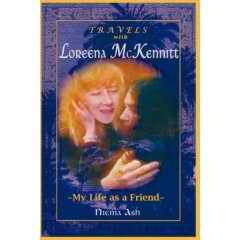
In order to try to come to terms with the collapse of their relationship - "a cathartic exercise" - Ash decided to write a biography which she entitled Travels With Loreena McKennitt: My Life as a Friend .
To ensure control, Ash also arranged to publish it herself.
Published in June 2005, the book is essentially about the nature of celebrity, though it clearly dwells on intimate personal matters too. McKennitt has given many interviews herself but
had previously stopped the publication of another book about her songs, citing her right to privacy. So Ash cannot have been too surprised when she launched a legal action to ban the book. She later reduced that to a demand that 38 separate sections be
deleted, some of them as small as five lines.
But it was the cause of action that was so surprising. She did not sue for libel, which is fairly normal in such circumstances, but claimed the book breached her privacy.
An affronted Ash
refused to accede to the demand and, having previously armed herself with insurance, decided to fight the case. Once the insurers' money ran out, its lawyers were forced to retire, and Ash represented herself in the high court. It is impossible to know
whether Mr Justice Eady's decision would have been different if Ash had had the benefit of an experienced barrister, but his ruling certainly astonished the legal community.
In finding for McKennitt, and insisting that eight of the 38 instances
should be expunged, the judge tipped the balance away from freedom of expression for the media, and towards the the legitimate expectation of citizens to have their private lives protected.
He drew heavily on the controversial European
court of human rights victory by Princess Caroline of Monaco over pictures of her taken in public. Eady decided that information does not forfeit its "private" quality simply because it concerns events that could have been witnessed in a public
place or because third parties are involved. In other words, authors cannot assert they have a right to freedom of expression if, in telling their own life stories, they reveal information about someone else's.
Now, following the refusal of the House of Lords to hear a further appeal, it is possible to get to grips with the issues. There is a possibility of a petition to the European Court of Human Rights, but that has not
deterred Ash from deciding to talk openly about the case for the first time.
Ash has now published a new version of the book, deleting the offending material but adding a chapter which deals with the trial. It was held in private and I think
that was grossly unfair, she says. As for the judgment itself, let me just say that I believe it was seriously flawed.
But it's hard to see, from the available evidence, that Ash was anything other than decent and fair and truthful.
It isn't a kiss-and-tell book , she says. It's about friendship and fame. It's my story, and I should be allowed to tell it.

 Trumped up charges against the Naked Rambler
 Scottish government call for 18 rated smoking
  of the word 'cock'
 BBC investigation raises concerns about Operation Ore
  David Lepper sets his sights on censoring YouTube

 BA ridiculed over censorship of Richard Branson cameo
  Operation Ore flawed by fraud
  for making Britain violent
  IWF publish their annual report