 Extreme Associates challenge the Miller
test
Extreme Associates challenge the Miller
test
From AVN
With the Extreme Associates obscenity trial
still months away, the company's defense team has filed another motion to dismiss the indictments against Extreme and its co-owners Rob Black and Lizzy Borden. This time they are challenging whether the all-too-familiar Miller test for obscenity
can be applied to the World Wide Web.
Their attorneys have asked Judge Gary Lancaster, whose brilliant analysis in granting an earlier Motion to Dismiss was later reversed by the
Third Circuit Court of Appeals, to consider new arguments for dismissal; among them:
• That the federal obscenity statutes are unconstitutional;
• That the Miller test's requirement that the charged material be "taken as a whole" is impossible to accomplish in the context of the World Wide Web;
• That the "community standards" prong of the Miller test used in determining whether a particular work is obscene cannot be applied to an online "community";
• That obscenity code Sections 1461 ("Mailing obscene or crime-inciting matter"), 1462 ("Importation or transportation of obscene matters") and 1465
("Transportation of obscene matters for sale or distribution") are impermissibly overbroad;
• That the digital video clips charged do not fall within the range of
tangible material eligible for prosecution under two sections of the obscenity law.
Should the Court decide that the above points are insufficient for a dismissal of the entire
indictment, the motion also asks that the Court clarify certain points of law before the case moves forward:
• That the "material to be taken as a whole" regarding the
charged video clips refers to the entire Extreme Associates website;
• That the applicable "community" within which the charges are to be considered, for the purposes
of the Miller test, is the entire World Wide Web; and,
• In the alternative, if the Court rules that the "community" has to be a geographic area, that that
community should be the Central District of California, where Extreme's headquarters are located, rather than the Western District of Pennsylvania, where the clips were originally viewed by postal inspectors.

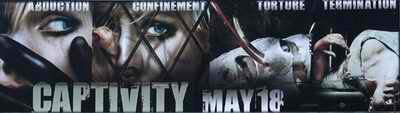 US Government to Take a Hard Look at Horror
  Contributing to the hype for Wristcutters
  WRISTCUTTERS – A LOVE STORY is a fantasy drama about a
young man who kills himself and then finds himself in a form of limbo occupied by other suicide victims. The film was classified ‘15’ for suicide theme and strong language.
WRISTCUTTERS – A LOVE STORY is a fantasy drama about a
young man who kills himself and then finds himself in a form of limbo occupied by other suicide victims. The film was classified ‘15’ for suicide theme and strong language.  Internet world protected from unconstitutional law
  Tennessee porn tax on hold
 Contributing to the hype for Transformers
  Contributing to the hype for Grindhouse
  Judge orders return of DVDs seized on basis of no rating symbol
  As long as we're cleaning up pornography, everything else will fall into place
 Journalist in jail for refusing to hand over protest video
  So just rename adult films as R rated and let the kids watch them anyway
  Arkansas to hike their level of fines
  Missouri nutter wants age limit set to 21 for adult entertainment
  Texas police raid a Chippendales show
  Sex industry restrictions in Virginia
 Law proposal to ensure that censors see all of a game's content
  Texas nutters eye adult industry for extra revenue
 Sex toys remain illegal to sell in Alabama
  FCC angling to regulate violent TV content
  Viewing porn in schools to be a crime
 Video featuring passages from Koran taken down
  Teenage Mutant ninja Turtles take a pounding
  Advert featuring accidental male kiss withdrawn
 Nutters call for investigation into filming of Hounddog
  MySpace sued on a claim of insufficient security
  US backs off from requiring political bloggers to register
  $1.6 million fine for minor infraction
  FBI raids porn producers to check record keeping
 A report issued today by the nutters of the Parents Television Council said TV
violence since 1998 has increased in every prime time slot, with violent incidents up 45% during the 8 pm hour, 92% during the 9 pm hour and 167% during the 10 pm hour. On average, the networks show 4.41 instances of violence per hour.
A report issued today by the nutters of the Parents Television Council said TV
violence since 1998 has increased in every prime time slot, with violent incidents up 45% during the 8 pm hour, 92% during the 9 pm hour and 167% during the 10 pm hour. On average, the networks show 4.41 instances of violence per hour.  Email porn facing new laws
  Censor beer labels