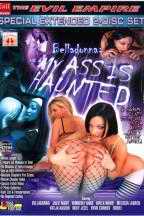
UK: Passed R18 for strong images of real sex after 28:46s of compulsory BBFC cuts:
2005 Harmony Limited video
2005 Harmony Limited VoD
The BBFC commented:
Cuts required to abusive and potentially harmful activity (in this case aggressive forcing of an oversized butt plug into woman's mouth and anus), a reference to underage sex, and to blasphemous activity (in this case insertion of
crucifix-shaped dildos into anus and vagina of women role-playing as nuns). Cuts made in accordance with BBFC policy and Guidelines and the common law of Blasphemy.
v The Big Bang - 1987 France / Belgium animation comedy fantasy by Picha.
The Big Bang is a 1987 France / Belgium animation comedy fantasy by Picha. Starring Luis Rego, Georges Aminel and Perrette Pradier.
Cut by the BBFC for blasphemy.
Summary Review: Like something off Flesh Gordon
In 1995, Italy annihilates Libya, which destroys Israel. Africa bombs Germany, which in turn
attacks France. Then it gets out of hand leaving only two continents on the verge of World War IV. In the north, a mutated strain of males in America and Russia merge. All that is left of womankind retreat to their territory of Vaginia.
Everything looks like something off Flesh Gordon. The weapons and characters, even the battle (of the sexes) that is going on here. There are loads, loads and loads of sexual reference and innuendo.
Bottom
line: not for everybody (like the politically correct and squeamish).
Catacombs is a 1988 Italy/US horror by David Schmoeller. With Timothy Van Patten, Ian Abercrombie and Jeremy West.
Cut by the BBFC for blasphemy. Uncut in the US
Summary Notes: A demon with cool moves
A demon is trapped in a monastery. 400 years later a young girl arrives at the monastery
to study.
Surprisingly, the characters throughout are well rounded, often humorous and quite believable. The demon that stalks the catacombs has some cool moves that unfortunately are not really exploited in the films conclusion.
Versions
uncut
run:
84m
pal:
81m
US: Uncut and MPAA R rated
2015 Shout! Factory [Double Feature with Cellar Dweller] RA Blu-ray at US Amazon
2013 Shout! Factory [Horror Marathon Volume 2] R1 DVD
at US Amazon
cut
cut:
12s
run:
84:15s
pal:
80:53s
UK: Passed 18 after 12s of BBFC cuts for:
1988 EIV VHS
From the BBFC. Cut for blasphemy:
Cuts to remove a sequence in which a priest is punished for his gluttony by Christ. In the sequence removed by the Board, a statue of Christ came alive and stabbed the priest to death with a nail he had pulled from his ankle.
The Devils is a 1971 UK drama by Ken Russell With Vanessa Redgrave and Oliver Reed.
Cut by Warner Brothers and the BBFC for X rated cinema release in 1971. The BBFC X rating was overruled and banned by 17 local councils.
In the US the film was further cut for an R rating. The UK cinema version was later
released in the US with an X rating and misleadingly labelled as a Director's Cut.
The best available version, with some cuts restored, is held by Warner Brothers, but has never been released except for a screening at the 100 years of the BBFC cinema
event.
Much to the irritation of genre fans Warner's are sitting on the Director's Cut and refuse to release it. The Director's Cut was shown at an event celebrating 100 years of the BBFC.
Thanks to Gary. The Director's Cut consists of the BBFC X rated
version with 2 extra scenes that were previously cut, including the pre-cut scene known as the Rape of Christ. There is other cut footage which is now lost.
best available
cut:
run:
111:08s
pal:
106:41s
cinema cuts
cuts
UK: The cut UK Cinema version/X Rated US Version was passed 18 without further cuts for:
This version restores the US cuts made for an R Rating and so is the cut/pre-cut UK Cinema Version. Note that this is misleadingly noted in the US as a Special Uncut Restored Version.
UK: A pre-cut version was passed X (18) after BBFC cuts
for:
The film was first seen by the BBFC in an unfinished rough cut on 27 January 1971. At around the same time, this rough cut was also shown to senior executives from
Warner Brothers, the film's distributor. Both the BBFC and Warners expressed strong reservations about the strong religious and sexual context of the film, which seemed likely to provoke significant controversy. Warners and the BBFC therefore drew up
separate lists of the cuts they would require before the film could be distributed in the UK. Warners were content with their own plus the additional cuts requested by the BBFC and a full list of required changes was forwarded to the director.
The cuts were intended to reduce:
(i) the explicitness and duration of certain sexual elements, including an orgy of nuns
(ii) elements of violence and gore during an interrogation scene and the final burning of the
character played by Oliver Reed
(iii) scenes that mixed sexual activity and religion in a potentially inflammatory fashion.
A modified - but still technically unfinished - version of the film was seen again by the BBFC on 8 April 1971, incorporating many (but not all) of the cuts requested by both the BBFC and by Warners. Ken Russell had toned down or
removed what had been regarded as the most difficult scenes, including the entire Rape of Christ sequence in which a group of nuns cavort on a crucifix, whilst hoping that the significant reductions he had already made would perhaps allow certain
other shots to remain. The BBFC requested further reductions in four sequences. Russell responded by complying fully with three of the cuts but insisted that the fourth additional cut could not be made properly because it would create continuity
problems.
On 18 May 1971 the BBFC awarded an X certificate to the cut version of the film. Because of the scale of the changes made to the film (including the deletion of one entire scene) it is difficult to
calculate accurately how much was removed from the film between January and May 1971. However, it is safe to say that several minutes were removed.
The resultant version suffered cuts as follows:
A scene showing nuns assaulting an effigy of the cross was deleted (approximately 30s)
An enema scene loses some details
The crushing of Grandier's legs
loses details.
Grandier's tongue torture loses details
Shots of a priest being assaulted by nuns after the King's visit are missing
Jeanne
masturbating with a chard bone was cut
Whippings scenes throughout were removed
cinema cuts
cuts
cuts
cut:
run:
107:59s
pal:
103:40s
UK: The extensively cut US R Rated Version was passed 18 without further BBFC cuts for:
1988 Warner VHS
US: The cut UK Cinema Version was passed X for its US release but was further cut for an R Rating. This R Rated version was cut as follows:
Grandier (Oliver Reed) drives doctors away from dying woman loses some of hers screams and a little nudity.
Sister Jeanne (Vanessa Redgrave) dream of Grandier as Christ does not show her
licking Christ's wounds, clasped hands by a crown of thorns and some of the lovemaking scene.
Shots of Jeanne masturbating and two shots of her whipping herself have been removed.
A nude Phillipe (Georgina Hale) brought before Laubardemont (Dudley Sutton) has lost the pubic hair.
An enema of Jeanna on the altar does not show the insertion of a syringe between her legs.
Shots of nuns stripping and one vomiting have vanished
the King's visit to Loudon has lost vomit and pubic hair along with a nun masturbating with a candle and an enema.
A needle is Grandier's tongue has been cut.
Whilst Laubardem collects statements against Grandier, we miss naked nuns kissing and caressing.
The
shot of a nun's hanging body been taken down has been cut to remove nudity.
The torture of Grandier has lost 4 hammer blows and a shot of his bloody legs.
As Grandier crawls to
the stake, kicks by Barre (Michael Gothard) have been deleted
The burning of Grandier has been reduced
Jeanne inserting a purging device between her legs is no more.
UK: banned on by 17 local authorities who overruled the BBFC X rating, including Surrey, Blackpool, Sevenoaks, Plymouth and Nottingham.
In Tunbridge Wells, the film was in the middle of its run when it was subject to pickets from local church
bodies and, despite a petition signed by 2,500 people in support of the film, the decision was made to cease screenings.
Glasgow magistrates banned the film in 1971 on grounds it offended good taste and public decency.
World: The film was
banned at the time of release in Finland, Italy, Ireland, Chile and New Zealand.
A handful of local
authorities took the decision to ban the film, on the grounds of possible offence (in response to petitions against it) rather than blasphemy.
Pre-release press
hype suggested that the film would contain a blasphemous scene in which Christ fantasises on the cross about making love to Mary Magdelene. The Board received nearly two thousand letters and petitions from the public and pressure groups, a
majority anxious about what they regarded as potentially blasphemous content, and the minority supporting the film's uncut release in the UK. .
The BBFC took the unusual step of inviting twenty-eight representatives of the
major Christian churches to view the film at the Board, and also took legal advice from a QC before making a decision. All who saw the film at the BBFC agreed that the film was not blasphemous in the legal sense, although it might have the capacity to
offend some Christian viewers.
The film was duly passed 18 in 1988 without cuts and subsequently viewed by the Director of Public Prosecutions who supported the BBFC's decision that the film was not likely to be found
Guilty of blasphemy by a Jury.
Multiple Maniacs is a 1970 USA crime comedy horror by John Waters. Starring Divine, David Lochary and Mary Vivian Pearce.
Heavily cut by the BBFC on grounds of blasphemy for 1990 18 rated VHS. A restored version was passed 18 uncut with previous cuts waived for 2016 cinema release and Blu-ray the following year.
Summary Notes
The travelling sideshow 'Lady Divine's Cavalcade of Perversions' is actually a front for a group of psychotic kidnappers, with Lady Divine herself the most vicious and depraved of all - but her life changes after she gets
raped by a fifteen-foot lobster...
Versions
uncut
96:34s =92:42s
UK: A restored version was passed 18 uncut for strong sex references, sexual violence with previous BBFC cuts waived for:
UK: Passed 18 after 4:53s of BBFC compulsory cuts for:
1990 Castle Communications PLC VHS
The BBFC cuts were:
Cut to remove an entire supposedly blasphemous sequence set in a church in which a male transvestite buggered himself with a rosary. The shots of the transvestite were intercut with footage of Christ moving through the Stations of the
Cross.
Visions of Ecstasy is a 1989 UK short film by Nigel Wingrove. Starring Louise Downie, Elisha Scott and Dan Fox.
Banned by the BBFC for 1989 video release on grounds of blasphemy. the ban was challenged and upheld by the Video Appeals Committee and then the European Court of Human Rights. The blasphemy law was repealed in 2008 and the
BBFC ban was revoked for an uncut 18 rated DVD release in 2012.
Visions of Ecstasy, an innocuous (if rather silly) short film depicting 'the ecstatic and erotic visions of St Teresa of Avila. In the film, St Teresa is first seduced by her own sexual psyche, and then mounts and caresses
the crucified body of Christ. Technical shortcomings notwithstanding (hands which seem to move freely despite apparently being nailed down).
Versions
uncut
run:
19:44s
pal:
18:57s
UK: Passed 18 uncut for nudity and sex involving religious images for:
2012 4Digital/Redemption [Visions of Ecstasy + Sacred Flesh] R0 DVD
at UK Amazon
US: Uncut and MPAA Unrated for:
2012 Sacrament [Visions of Ecstasy + Sacred Flesh] R1 DVD at US Amazon
The BBFC explained its decision in a press release:
Visions of Ecstasy is a 19 minute short film, featuring a sequence in which a figure representing St Teresa of Avila interacts sexually with a figure
representing the crucified Christ. When the film was originally submitted to the BBFC in 1989, for video classification only, the Board refused to issue a classification certificate. This decision was taken on the grounds that the publication of the
film, which the issue of a BBFC certificate would permit, might constitute an offence under the common law test of blasphemous libel.
The Board is required, as part of the terms of its designation under the Video Recordings Act
1984, to seek to avoid classifying any work that might infringe the criminal law. Therefore, the Board had no alternative at the time but to refuse a classification. The Board's decision to refuse a classification to the film was subsequently upheld by
the independent Video Appeals Committee.
In 2008, section 79 of the Criminal Justice and Immigration Act abolished the common law offences of blasphemy and blasphemous libel. This means that the BBFC is no longer entitled to
consider whether the publication of the film might comprise a blasphemous libel.
The BBFC has carefully considered Visions of Ecstasy in terms of its current classification Guidelines. These reflect both the requirements of
UK law and the wishes of the UK public, as expressed through regular large scale consultation exercises. With the abolition of the offence of blasphemy, the Board does not consider that the film is in breach of any other UK law that is currently in
force. Nor does the Board regard the film as likely to cause harm to viewers in the terms envisioned by the Video Recordings Act.
The Board recognises that the content of the film may be deeply offensive to some viewers. However,
the Board's Guidelines reflect the clear view of the public that adults should have the right to choose their own viewing, provided that the material in question is neither illegal nor harmful. In the absence of any breach of UK law and the lack of any
credible risk of harm, as opposed to mere offensiveness, the Board has no sustainable grounds on which to refuse a classification to Visions of Ecstasy in 2012. Therefore the film has been classified for video release at 18 without cuts.
banned
UK: Banned by the BBFC for:
1989 Axel VHS
The BBFC decision was subsequently appealed to the Video Appeals Committee who upheld the ban.
Director Nigel Wingrove then took his case to the European Court of Human Rights, but again lost his case. Mark Kermode explained:
Visions of Ecstasy, an innocuous (if rather silly) short film depicting 'the ecstatic and erotic visions of St Teresa of Avila was banned in the UK in 1989. In the film, St Teresa is first seduced by her own sexual psyche, and then
mounts and caresses the crucified body of Christ. Technical shortcomings notwithstanding (hands which seem to move freely despite apparently being nailed down) the film raised a problem for the BBFC, which is forbidden from classifying material which may
infringe the laws of the land.
Despite support from the likes of Derek Jarman, the BBFC concluded that, if prosecuted, a 'reasonable jury' was likely to convict Visions of Ecstasy as blasphemous. Not to be defeated, director Nigel Wingrove took
his case to the European Court of Human Rights, arguing that the very existence of a blasphemy law contravened the freedoms of expression enshrined in the European Convention of Human Rights.
In a mealy-mouthed ruling, the Court
agreed that Freedom of expression constitutes one of the essential foundations of a democratic society , but with the caveat that freedom carries with it duties and responsibilities including a duty to avoid as far as possible an
expression that is, in regard to objects of veneration [i.e. religion], gratuitously offensive to others and profanatory . Which effectively meant that Wingrove was allowed his freedom of expression unless such freedom offended his Christian peers.
In which case, he wasn't...
Jean-Luc Godard's biblical retelling mixed too much nudity with religion for the Brits but ok in the US where the Blu-ray will be released on 7th January
Hail Mary is a 1985 France/Switzerland/UK drama by Jean-Luc Godard. With Myriem Roussel, Thierry Rode and Philippe Lacoste.
US: Uncut and MPAA Unrated for:
US 2013 Cohen Media Group (RA) Blu-ray at US Amazon released on 7th January 2014
Censorship History
Set in modern times with characters, Mary, Joseph and a virgin birth. Somehow wound up the nutters perhaps for its plentiful nudity. Kicked off a blasphemy storm in Australia and somehow never made it to UK
cinema/DVD
Summary Review : Illuminating
In this modern retelling of the Virgin birth, Mary is a student who plays basketball and works at her father's petrol station; Joseph is
an earnest dropout who drives a cab. The angel Gabriel must school Joseph to accept Mary's pregnancy, while Mary comes to terms with God's plan through meditations that are sometimes angry and usually punctuated by elemental images of the sun, moon,
clouds, flowers, and water.
Perhaps only Jean-Luc Godard would be arrogant or mad enough to make a film of the nativity recast in 1980s. He concentrates on the experience of Mary, who is a basketball playing teenager who has stuck
by her high moral standards by not sleeping with her boyfriend Joseph only to find herself pregnant by divine intervention. She struggles with the idea of a child growing inside her without having played a role in its conception or even enjoyed the
intimacy of its creation.
There is a lot of nudity and it is perhaps this which was considered most controversial, but this is always non-sexual and unlikely to be found offensive.
In 2008, section 79 of the Criminal Justice and Immigration Act abolished
the common law offences of blasphemy and blasphemous libel. And now the film has been passed 18 uncut for a 2012 4Digital home video release.
But don't expect too much. Director Nigel Wingrove was a bit defensive when
talking to the BBFC :
If I made the film now I would make it very differently, I was exploring areas of dark
eroticism, but I had worked chiefly in prints, not films.
People say I should put it out, but on a personal level I have reservations. If I did release it, I would need to put it into context and perhaps release a documentary to
accompany it.
The film has now been passed 18 uncut for nudity and sex involving religious images for:
UK 2012 4DigitalRedemption R2 DVD at UK Amazon for release
26th March 2012
The BBFC have explained their decision to unban the film in a press
release :
Visions of Ecstasy is a 19 minute short film, featuring a sequence in which a figure representing St Teresa of Avila interacts sexually with a figure representing the crucified Christ. When the film was
originally submitted to the BBFC in 1989, for video classification only, the Board refused to issue a classification certificate. This decision was taken on the grounds that the publication of the film, which the issue of a BBFC certificate would permit,
might constitute an offence under the common law test of blasphemous libel.
The Board is required, as part of the terms of its designation under the Video Recordings Act 1984, to seek to avoid classifying any work that might
infringe the criminal law. Therefore, the Board had no alternative at the time but to refuse a classification. The Board's decision to refuse a classification to the film was subsequently upheld by the independent Video Appeals Committee.
In 2008, section 79 of the Criminal Justice and Immigration Act abolished the common law offences of blasphemy and blasphemous libel. This means that the BBFC is no longer entitled to consider whether the publication of the film might
comprise a blasphemous libel.
The BBFC has carefully considered Visions of Ecstasy in terms of its current classification Guidelines. These reflect both the requirements of UK law and the wishes of the UK public, as
expressed through regular large scale consultation exercises. With the abolition of the offence of blasphemy, the Board does not consider that the film is in breach of any other UK law that is currently in force. Nor does the Board regard the film as
likely to cause harm to viewers in the terms envisioned by the Video Recordings Act.
The Board recognises that the content of the film may be deeply offensive to some viewers. However, the Board's Guidelines reflect the clear view
of the public that adults should have the right to choose their own viewing, provided that the material in question is neither illegal nor harmful. In the absence of any breach of UK law and the lack of any credible risk of harm, as opposed to mere
offensiveness, the Board has no sustainable grounds on which to refuse a classification to Visions of Ecstasy in 2012. Therefore the film has been classified for video release at 18 without cuts.
The outrage which cartoons of the Prophet Muhammad have provoked among Muslims has prompted much self-righteous blather about the sanctity of free speech. Yet Muslims are not the only ones who seem to find blasphemy beyond the pale, and who believe
that religion should take precedence over liberty. Here in the UK, Christians retain the protection of the law of 'blasphemous libel', a common law offence which forbids the publication of 'contemptuous, reviling, scurrilous or ludicrous matter relating
to God'. Although archaic, this law provides a striking counterpoint to the claim that freedom of expression is an integral part of the British way of life.
Take the case of Visions of Ecstasy , an innocuous (if rather silly) short film
depicting 'the ecstatic and erotic visions of St Teresa of Avila' which was banned in the UK in 1989. In the film, St Teresa is first seduced by her own sexual psyche (played, conveniently, by a photegenic 'babe'), and then mounts and caresses the
crucified body of Christ. Technical shortcomings notwithstanding (hands which seem to move freely despite apparently being nailed down) the film raised a problem for the BBFC, which is forbidden from classifying material which may infringe the laws of
the land.
Despite support from the likes of Derek Jarman, the BBFC concluded that, if prosecuted, a 'reasonable jury' was likely to convict Visions of Ecstasy as blasphemous. Not to be defeated, director Nigel Wingrove (who has since helmed the
cult nuns-on-heat romp Sacred Flesh ) took his case to the European Court of Human Rights , arguing that the very existence of a
blasphemy law contravened the freedoms of expression enshrined in the European Convention of Human Rights. In a mealy-mouthed ruling, the Court agreed that Freedom of expression constitutes one of the essential foundations of a democratic society , but with the caveat that
freedom carries with it duties and responsibilities including a duty to avoid as far as possible an expression that is, in regard to objects of veneration [i.e. religion], gratuitously offensive to others and profanatory . Which effectively
meant that Wingrove was allowed his freedom of expression unless such freedom offended his Christian peers. In which case, he wasn't...
Visions of Ecstasy remains the only film to be banned in the UK solely on grounds of blasphemy. Yet the
issues which the law raises remain a very real concern. Having successfully transformed itself from an autocratic censorship body into one of the most accountable regulators in the world, the BBFC now rightly prides itself on maintaining a fine balance
between the liberal principles of its own classification guidelines and the rigid inflexibilities of certain aspects of the law. In the case of Martin Scorsese's The Last Temptation of Christ (1988), for example, pre-release protests from
Christians alleging blasphemy resulted in the board screening the film to 28 representatives of the UK's major churches, who concluded that it 'was not blasphemous in the legal sense, although it may have the capacity to offend some Christian viewers'.
An 18 certificate was duly awarded.
Despite the clean bill of health, some local councils went ahead and banned The Last Temptation of Christ anyway. The furore followed the movie onto TV, where its transmission provoked a record number of
complaints. Similar protests attended the classification of Dogma (1999), a religious satire staring Matt Damon and Ben Affleck as fallen angels, which provoked a deluge of pre-printed mail shots from sections of the Catholic church demanding that
the BBFC ban the movie. The board refused, a decision in which it was supported by the office of the Archbishop of Westminster which went on the record to say that Dogma was not blasphemous. Still the protests continued.
Less
well-rehearsed are the rare cases of cult and 'special interest' movies which have been cut in order to comply with our blasphemy laws. Trash maestro John Waters may have entered the mainstream with multiplex-friendly fare such as Hairspray, Cry Baby and
Serial Mom, but his early underground film Multiple Maniacs (1970) is still considered legally unpassable in its complete form thanks to a scene in which Divine makes nefarious use of a rosary intercut with the Stations of the Cross. More bizarre
still is the case of a hardcore sex video which was submitted to the board last year, featuring sacrilegious dildos being placed where the sun doesn't shine by 'women role playing as nuns'. The video, which was duly cut 'in accordance with the Blasphemy
Act 1698', rejoices under the charming title Belladonna: My Ass is Haunted . And no, that's not 'Ass' in the biblical sense of the word.
While there's no doubt that such material is potentially extremely offensive (to me, at least), should
we really retain a law which privileges the sensitivities of Christians over those of others? The Last Temptation of Christ may have been reclassified in 2000 to a more lenient 15 certificate, but Visions of Ecstasy remains banned in the UK
to this day, a situation which the BBFC cannot rectify as long as the offence of blasphemy remains on the statute books. In the wake of the recent rebellion regarding proposed legislation on religious hatred, which, it was claimed, threatened artistic
and democratic freedoms, has the time not arrived to repeal Britain's outdated blasphemy law? Only then will we have an even playing field in which freedom of speech is genuinely sacrosanct, and all religions (and their critics) are granted the same
level of protection in the UK.