Mi-Porn.com logo DVDs, Blu-Ray, VOD,
Sex Toys & Lingerie
mi-porn.com

 World News

Online Shops
Adult DVDs and VoD
Online Shop Reviews
New Releases & Offers
Sex Machines
Sex Machines

 2006: April-June
 

  Home  UK Film Cuts  
  Index  World  Nutters  
  Forum  Media Liberty  
   Info   Cutting Edge  
   US   Shopping  
   
Sex News
Sex Shops List
Sex+Shopping

Melon Farmers


28th June   Disastrous Censorship

From The Times

Soldiers in masksUnder a draft law being reviewed by China’s top law-making body, the standing committee of the National People’s Congress, media outlets could face fines ranging from £3,500 to £7,000 if they do not seek permission from local authorities before reporting riots, disasters, strikes or outbreaks of disease.

Local governments will be required to disseminate information on emergencies in a timely manner, but it is an exception if the release of information may jeopardise the handling of emergencies.

The official Xinhua news agency said the decision to introduce the law was made because of errors in handling the outbreak of severe acute respiratory syndrome (Sars) in 2003. It said: The Government’s inexperience in dealing with the emerging crisis led to one of the country’s most serious health hazards. Sars originated in China and the nation was widely condemned for covering up the disease initially, enabling the virus to spread more easily.

It had been expected that China’s censors would relax their controls to prevent a recurrence of that embarrassing incident. On the contrary, officials charged with vetting information available to the public have tightened their grip in recent months.

China has a long history of covering up emergency incidents, and news blackouts are regularly imposed because of official nervousness that bad news could harm the image of the ruling Communist Party. For example, the deaths of 85,000 people in the central province of Henan in 1975, when dams burst during a typhoon, were revealed only in a book on China’s worst 20th-century disasters in 1998.


26th June   Hobbling Chinese Skype

From BoingBoing
See Also Nart Villeneuve's report
And Rebecca McKinnon's report

Chinese SkypeInternet censorship tech-expert Nart Villeneuve reports that Skype's Chinese client (distributed by China-based provider TOM Online) installs censorware on the user's computer without telling. An important point: the international version of Skype available at Skype.com does not include the censorware. Nart says:

Skype's partner in China, Tom Online, has implemented filtering of Skype's text chat for Chinese users. Skype is not being transparent about the filtering fucntionality that has been introduced. Here is my initial attempt at trying to figure out Tom-Skype's filtering. Tom-Skype can be downloaded from skype.tom.com and I installed in in Chinese and English. I also installed the 2.5 beta version, all appeared to function the same. The tests [that follow in this blog-post] are from Tom-Skype 2.0 installed in English. The first thing I noticed is that Tom-Skype is bundled with an executable called ContentFilter.exe. It is an application developed by Tom Online called Tom Word Review. It is digitally signed by Skype.

Rebecca McKinnon examined the app, too, and wrote:

The bottom line is: TOM-Skype doesn't censor much at all, but it is set up to censor whatever TOM Online employees plug into their "keyfile," at any time. And users (unless they have attained Nart's level of geekdom) have no way of knowing what is going on and why.

Let's hope that TOM Online and Skype do the right thing, which is:

  1. Inform users that censorware is being downloaded onto their computers along with the Skype-branded chat client, and inform users exactly which Chinese law requires that this must happen.
  2. Do not add any political or religious words to the "keyfile" unless forced to do so by written court order.
  3. Make a list of those words added to the "keyfile" available to users so that they can be informed that any messages containing those words will not be received.

So far the only term located in the banned word keyfile is 'fuck'.


26th June   Demanding Privacy for Public Images

Thanks to Alan

vidcap of French actressThe website www.brenus.net/indexfr2.htm contains vidcaps of mainly French actresses in nude scenes.

It seems that an attempt is being made in France to close the site by accusing the webmaster of infringing the privacy of certain actresses! (Err, how many people saw the flicks in the cinema?) The court case is on Monday 26th June, so if the site's disappeared the worst has happened.


25th June   Conviction without Conviction

From Modbee

A media watchdog group protested the conviction of an Italian blogger for defamation, warning that such a verdict could lead to censorship of blogs in Italy.

Blogger Roberto Mancini, 59, was convicted of defamation last month in Aosta, northern Italy, and sentenced to pay $16,900 in fines and damages.

Four people, including two journalists, had filed a complaint against him over the content of his blog, which reports on local news in sarcastic and sometimes crude terms.

It looks like the blogger is being punished for his bad language and not because he posted false information, which is unacceptable, Paris-based Reporters Without Borders said in a statement. The group also said Mancini wrongly was held responsible for comments posted by readers.

Mancini denies writing the incriminating comments, according to his defense lawyer, Caterina Malavenda. She said he would appeal the verdict.

According to court documents, messages posted on the blog made clear, unflattering references to the four who filed the complaint, in one case mentioning that one of them had taken part in a bank robbery.

Malavenda, Mancini's lawyer, argued that the author of the defaming pieces could not be identified with certainty. She said authorities had seized in a raid photographs that appear on the blog, books on blogging and passwords: All the material shows he can be someone who used the blog, but there's no evidence that he is the author of those defaming pieces

Reporters Without Borders added the complainants were not able to show (the reports) were untrue and warned that the verdict might induce people who manage blogs to censor messages posted by visitors.


25th June   Thailand Block Nightlife Forum Website

From BarLadies

Screen showing a blocked websiteThe Thai authorities have added www.barladies.com to their ever expanding list of websites being blocked. Those using the ISP, True, were first to notice the blocking but no doubt the other ISPs will follow suit.

Even though Thailand claims to censor only such obvious sites as porn and gambling it is very worrying when they start on discussion forums.

Also will probably cause more people to seek out proxy services than it will end up blocking. On the other hand, the expats oriented website, Thai Visa, very quickly updated their policies to block the discussion of proxy services.


23rd June   Mbeki in Congress with his TV Station

Based on an article from The Guardian

SABC logoSouth Africa's public broadcaster (SABC) has banned high-profile critics of the government from its programmes, demonstrating bias towards the ruling African National Congress.

At least six political analysts who have on occasion criticised the president, Thabo Mbeki, and his allies have been blacklisted on the grounds that they are ill-informed. The blacklist was drawn up by the head of news, Snuki Zikalala, an ANC member and former government spokesman who answers to a board appointed by an ANC-dominated parliamentary committee.

The decision followed several censorship rows that prompted accusations that the SABC had become a mouthpiece for the ANC. It ditched a documentary critical of the president and refused to show images of a cabinet minister being booed during a speech.


22nd June   Egypt Insult Human Rights

From The Independent

Egyptian authorities have ordered the release of an award-winning blogger and activist, imprisoned 45 days ago on charges including insulting the President.

Alaa Seif al-Islam who was arrested at a pro-reform demonstration on 7 May, had drawn the ire of the authorities for his provocative weblog and taking part in banned street protests. He is expected to be released from the Tora prison in Cairo today.

The release comes after a turbulent period of protest and violence in Egypt. Practically all groups opposed to President Hosni Mubarak, including the Muslim Brotherhood and secular groups such as Kifaya! (Enough!) and Youth for Change have had members beaten. Hundreds have been arrested.

Alaa's wife, Manal, with whom he runs the website Manalaa.net, which won an award from the media freedom group Reporters Without Borders, said after the decision: There's no going back now, we'll definitely be continuing our activities.

Supporters highlight Alaa's importance in pushing the boundaries for political dissent through the internet. Nora Younis, a fellow blogger and activist, said:
He raises the ceiling of what is possible. After others were arrested on charges of 'insulting the President', he arranged a petition on his site that said 'we, the undersigned, insult the President' - to be given to the Public Prosecutor.


17th June No Censorship Heroics

From the Bangkok Post

Vietnam's communist government has issued strict new press regulations that punish "denying revolutionary achievements" and require journalists to have articles reviewed before publication, officials and state media said Friday.

The new Decree on Cultural and Information Activities follows aggressive reporting in Vietnam's state-controlled press of a massive corruption scandal that forced the resignation of the transport minister and the arrest of his deputy over embezzlement of some 7 million dollars in state funds.

The press regulations came even as Prime Minister Phan Van Khai, in a speech to the National Assembly before his retirement, called for measures to ensure transparency and openness of state agencies. But added that the people's right to be informed must be clearly regulated.

Such regulations will be strengthened with the new degree that Khai signed in June and set to take effect July 1. Under the new rules, Vietnamese journalists can be fined 3 million dong (190 dollars) for publishing stories with anonymous sources and up to 7 million dong (450 dollars) for refusing to allow an interviewee to read an article before publication.

Disseminating reactionary ideology is banned, along with any articles that reveal Party secrets, state secrets, military secrets and economic secrets, which carry fines of up to 30 million dong ( 2,000 dollars).

Vietnam already has criminal laws on the books that punish "revealing state secrets" with up to 15 years in prison. Vietnamese journalists can also be fined for defaming national heroes, although the decree does not spell out who is a national hero.

Vu Xuan Thanh, head of the Ministry of Culture and Information Inspection Department, said the ministry would decide which national figures are considered heroes and said that the law would not be used to shield government officials from legitimate criticism.

A spokesman in Paris for the press freedom advocacy group Reporters Without Borders condemned the new press regulations as a step backward for Vietnam. In a period where we felt that something may be changing in this country, because a few journalists started investigating on corruption scandals, this is a very bad news, said RWB's Julien Pain.


13th June   Forced to Trial

From The Guardian

The Force of Reason book coverThe trial of Oriana Fallaci, a journalist and author accused of defaming Islam in a book, was opened and adjourned yesterday in an Italian court.

The charge stems from a recent book, The Force of Reason, one of a trilogy she has published since the September 11 attacks on the US. In the book, Fallaci is alleged to have made 18 blasphemous statements, including referring to Islam as "a pool that never purifies".

She has been charged with violating a law that forbids defamatory statements about a religion acknowledged by the Italian state. The offence is punishable with a fine of up to €6,000.

Fallaci has frequently stirred debate with her views, which are largely based on the notion that Muslims are engaged in a plot to conquer Europe by immigration. She has been accused of trying to incite racial hatred, but has also been applauded by rightwing factions and free speech activists.

Adel Smith, head of the Italian Muslim Union, brought the lawsuit against her.

The judge ordered another hearing on June 26.


8th June
updated to
17th June
  Searching for Censorship and Finding It

From BBC

Google.cnChinese authorities have blocked most domestic users from the main Google.com search engine. Internet users in major Chinese cities faced difficulties accessing Google's international site in the past week, Reporters Without Borders said.

But www.Google.cn, the controversial Chinese language version launched in January, has not been affected.
The site blocks politically sensitive material to comply with government censorship rules. [Melon Farmers appears ok]

It was only to be expected that Google.com would be gradually sidelined after the censored version was launched in January, Reporters Without Borders said in a statement: Google has just definitively joined the club of Western companies that comply with online censorship in China.

Google.com, the search engine's uncensored international site, had previously been available to Chinese web users, but problems accessing the site had been reported across the country recently. It was blocked nationwide on 31 May, the statement said. The blocking was also being extended to Google News and Google Mail, Reporters Without Borders said.

On Tuesday, Google co-founder Sergey Brin defended his company's decision to launch the censored Google.cn service, a move which drew heavy criticism. We felt that perhaps we could compromise our principles but provide ultimately more information for the Chinese and be a more effective service, he said:
Perhaps now the principled approach makes more sense.


10th June   Update: Anniversary Censorship Lifted

From Wired

Google.cnChina has lifted its online blockade of Google.com after a two-week crackdown that had prevented direct access to the site and temporarily thwarted popular workarounds.

Reporters Without Borders, or RSF, said that tests revealed the uncensored version of the search site was accessible again to internet users in Beijing and Shanghai. The crackdown overlapped with the June 4 anniversary of the bloody 1989 Tiananmen Square protests.

A Google spokesperson confirmed this, saying that we have heard no further reports from users in China of problems accessing Google.com.

On June 6, RSF reported that Google.com was blocked throughout much of China, and that programs like DynaPass and Ultrasurf, which allowed users in China access to censored web content, were also being blocked on a large scale successfully for the first time.

It's always the same thing that happens in China [at this time of year] -- they heavily censor the internet because they think people will be discussing the event, said Julien Pain, RSF Internet Freedom desk chief. This year, what's new is that they blocked Google at this period.

RSF's Pain criticized Google for creating the Google.cn site, saying it gives the Chinese government an option to fall back on if they decide block Google.com.
If you give them the option … in time of crisis they will block it. And in the long run, they will block it. If you leave the option open to the Chinese, you have to be really naïve to think that they won't use it.

17th June   Update: Yahoo Sucks

From CNET News

Google.cnReporters Without Borders has issued a report finding that of the major Internet search engines operating in China, Yahoo censored more terms in a limited test it conducted.

The group used six terms, including "Falungong," "Tibet Independence" and "Democracy," and noted what the first 10 results were on the Chinese sites of Google, Yahoo, Microsoft and the local Baidu.com. While there is no official published list of banned terms provided by the Chinese government, the companies are believed to follow the same general guidelines.

While yahoo.cn censors results as strictly as baidu.cn, search engines google.cn and the beta version of msn.cn (beta.search.msn.com.cn) let through more information from sources that are not authorized by the authorities, Reporters Without Borders said.

The press freedom organization is particularly shocked by the scale of censorship on yahoo.cn. first because the search results on 'subversive' key words are 97 percent pro-Beijing, the group said. It is therefore censoring more than its Chinese competitor Baidu.

Reporters Without Borders called on search engines operating in what it said were "repressive" countries to refuse to censor protected content, such as information about human rights and democracy.

25th June   Update: Seeking More Censorship

Based on an article from News.com.au

Google.cnThe search engines of two of China's most popular web portals are back in operation after they were upgraded to censor internet content even more repressively.

Authorities blocked the search engines of Sina.com and Sohu.com to try to increase their censorship facilities, website staff said.

Concerned government censors have been inspecting web portals including Sina and Sohu and others, a customer service employee at Sina said.

The Sina employee refused to specify what aspects of the search engine had been inspected. But on Tuesday Sina staff said the government was seeking to enhance the censorship capabilities to pre-empt supposedly "unhealthy" content.

Meanwhile Google has offloaded its minority stake in Baidu.com, China’s leading search engine. The sale of the stake comes two years after the Californian technology group bought a 2.6% holding in Baidu for about $60 million (£33 million), having paid $5 million for the holding in June 2004.


30th May   Thugs Ban Indian Film

From The Times

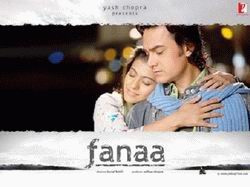
Fanaa posterThe latest blockbuster of Bollywood’s most fêted star, Aamir Khan, has been banned in cinemas across the state of Gujarat after he joined a street protest against the building of a dam that will displace 35,000 people from their homes.

The film, Fanaa (Annihilation), which was released yesterday, would not be screened in the western state until Khan took back his remarks, cinema owners and members of the opposition Bharatiya Janata Party said.

The actor took part in protests against the dam, which is regarded as essential for the state’s development, in Delhi last month, where he accused political parties responsible for its construction of being “thugs”. He said that farmers displaced by the dam had lost their livelihood and should be resettled.

BJP activists yesterday burned posters of the actor in the state’s capital, Ahmedabad, shouted slogans outside multiplexes and labelled Khan an enemy of Gujarat. Banning the film is a way of telling the world that we will not let anybody talk or act against the state’s development, said Amit Thakar, the national secretary of the party’s youth wing. He said that the dam was the lifeline of Gujarat and its opponents would be blacklisted.

Khan refused to apologise, saying that to do so would let down those people that the dam has displaced.

The controversy prompted Manmohan Singh, the Prime Minister, to defend the actor’s right to free speech:
Every citizen has the freedom of expression as long as he does not indulge in unconstitutional activities.


29th May   Irrepressible Info

From the BBC
See also Irrepressible.info

irrepressible.info logoInternet users are being urged to stand up for online freedoms by backing a new campaign launched by human rights group Amnesty International.

Amnesty is celebrating 45 years of activism by highlighting governments using the net to suppress dissent. The campaign will highlight abuses of rights the net is used for, and push for the release of those jailed for speaking out online.

It will also name hi-tech firms aiding governments that limit online protests.

Called Irrepressible.info, the campaign will revolve around a website with the same name. It aims to throw light on the many different ways that the freedom to use the net is limited by governments.

For instance, said a spokesman for Amnesty, around the globe net cafes are being closed down, home PCs are being confiscated, chat in discussion forums is being watched and blogs are being censored or removed.

The internet has become a new frontier in the struggle for human rights, said Kate Allen, UK director of Amnesty International. Its potential to empower and educate, to allow people to share and mobilise opinion has led to government crackdowns."

For instance, she said, Chinese journalist Shi Tao is serving a 10-year jail sentence for sending an e-mail overseas which detailed the restrictions the Chinese government wanted to impose on papers writing about the 15th anniversary of the Tiananmen Square massacre.

Amnesty wants to get people using an icon in e-mail signatures or on websites that contains text from censored sites as featured right

The Amnesty campaign will also seek to get net users to sign a pledge that opposes repressive use of the net. The pledges will be collated and presented to a meeting of the UN's Internet Governance Forum that is due to meet in Athens in November 2006.

The pledge reads: I believe the internet should be a force for political freedom, not repression. People have the right to seek and receive information and to express their peaceful beliefs online without fear or interference. I call on governments to stop the unwarranted restriction of freedom of expression on the internet and on companies to stop helping them do it .


29th May   France is a Bitch

From The Guardian

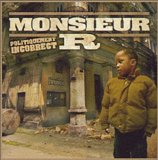
Politikment Incorrekt CD coverOne of France's most popular rappers will appear in court today charged with offending public decency with a song in which he referred to France as a "slut" and vowed to "piss" on Napoleon and Charles de Gaulle.

Monsieur R, whose real name is Richard Makela, could face three years in prison or a €75,000 (£51,000) fine after an MP from the ruling UMP party launched legal action against him over his album Politikment Incorrekt.

In the video for the song FranSSe, Makela appeared dressed as a gendarme with two naked women rubbing against the French flag as he rapped: France is a bitch, don't forget to fuck her till she's exhausted/You have to treat her like a slut, man.

When Daniel Mach, MP for Pyrénées-Orientales, heard the album last year, he proposed a law making it a criminal offence to insult the dignity of France and the French state. In November, when riots broke out in France's run-down suburbs, another UMP deputy, François Grosdidier, won the support of 152 MPs and 49 senators who demanded that parliament act against Makela's lyrics. But by then Mach had taken a personal action against Makela for making and disseminating "violent and pornographic messages" to which minors could get access.


27th May   3rd Generation of Repression

From the BBC

At Cambodia's prime minister has banned the use of videos on mobile phones over fears they might spread pornography - after a plea from his wife. Camera and video phones are growing in popularity in Cambodia, with a first 3G network planning to begin trading soon. But PM Hun Sen moved to outlaw the new phones after his wife, Bun Rany, said they could have negative consequences for social morality.

Hun Sen said Cambodia should wait 10 years before allowing video phones. Maybe we can wait for another 10 years or so until we have done enough to strengthen the morality of our society

In a petition submitted to her husband on 19 May, Bun Rany said the new phones could increase
sexual exploitation of women and children and other vices that would cast our society as a very dark one.


27th May   Ethiopia Blogged Off

Press Release from Sweet Entertainment Group

At least 10 opposition blogs have been inaccessible to Ethiopian internet users since last week, prompting suspicions the government has blocked them.

Reporters Without Borders (RSF) said the domestic Ethiopian viewing of the sites, all of which contain posts highly critical of Addis Ababa, had been impossible since Friday and asked for an explanation.

In an open letter to information minister Berhan Hailu, it said technical faults were unlikely to be the cause and warned that shutting down avenues of free expression would likely raise already heightened political tensions: We would like to know if your government has deliberately blocked access to online publications ... thus taking the course of filtering the Internet. Preventing debate and controlling news and information circulating online will only aggravate an already very tense political climate.

An AFP correspondent in Addis Ababa confirmed that blogs listed by RSF as being blocked were no longer accessible through Ethiopian internet service providers.

Several of them contain posts attacking Ethiopian Prime Minister Meles Zenawi and criticising the alleged government shutdown as "an act of desperation."


25th May   British Columbia Film Censorship does not Apply to Internet Download

Press Release from Sweet Entertainment Group

Sweet Entertainment Group (SEG) and Steve Sweet, will not be going to trial next month in Vancouver, British Columbia on charges of distributing films over the Internet in contravention of the British Columbia Motion Picture Act.

British Columbia Film Classification OfficeThe British Columbia Film Classification Office (BC FCO) had taken the position that SEG fell under its purview and therefore had to have a license to distribute content over the Internet, and, in addition, to submit any content to the Commission for its review, rating and censorship. SEG balked at that idea and took the position it did not have to do so.

No doubt smarting from the acquittal of Mr. Sweet and SEG on obscenity charges, on June 16, 2004 the BC FCO decided to launch its own raid on Sweet’s studios. Assisted by the Vancouver Police Department FCO Inspectors seized computer discs and other corporate materials and then charged SEG, and Steve Sweet personally, for breaches of the Motion Picture Act; specifically for carrying on the business of an adult film retailer and distributor without being licensed to do so.

The Crown abandoned charges against Steve Sweet of obstructing a Film Classification Officer last month. Today Crown Counsel directed a stay of proceedings against all SEG corporate defendants and Mr. Sweet personally, bringing this latest prosecution to an end. SEG would like to once again thank its legal counsel, Paul G. Kent-Snowsell, for the tremendous job he did in defending these charges and bring the case to a successful conclusion.

Max Sweet


24th May   Iranians Offended by Cartoons but Not by Violent Intimidation

From The Telegraph

Iran has suspended publication of its official state newspaper after it published a cartoon that sparked violent ethnic protests in the northwestern city of Tabriz, a senior judiciary official said today.

The cartoonist and the editor-in-chief of the “Iran” newspaper were arrested over the lampoon that was deemed to insult Iran’s Azeri minority, Tehran’s chief prosecutor Saeed Mortazavi said: Some charges were brought against both of them and they were transferred to Evin prison. He did not specify the charges.

The official Irna news agency said the cartoonist, Mana Neyestani, and the editor-in-chief, Mehrdad Qasemfar, were detained for “further investigation”.

Furious members of the Azeri minority pelted government buildings and banks with stones in Tabriz last night, enraged by the cartoon, eyewitnesses in the city said.

The cartoon, which appeared in Friday’s edition of Iran, showed a boy repeating the Persian word for cockroach in different ways while the uncomprehending bug in front of him says “What?” in Azeri.

The Azeris of northwestern Iran speak a language related to Turkish. Although Azeris have many luminaries among Iran’s commercial elite, Iran’s majority Persians mock them in jokes.


24th May   Searching for South Korean Censorship

From X Biz

Government officials are accusing search engine giant Google of failing to protect South Korean children from Internet pornography.

According to a report by the Korea Times, national search portals take the responsibility of confirming that users are at least 20 years old before allowing them to access sites containing pornographic material. In fact, Korean search portals go as far as to restrict display pages resulting from keyword searches that contain any sex-related words. However, according to the paper, Google, which Korean users can access, does not follow the local practice.

While Google technically hasn’t broken any local laws, its failure to comply with local custom could cost the company, which has had trouble breaking into the South Korean market.

Google is not legally required to check whether Internet users are over 20 years old before showing the search results for adult content, Han Meyong-ho, an official at the state-run Information Communication Ethics Committee, said.

But, as Meyong-ho pointed out, it would be “proper” for Google to verify the age of its users — something that Yahoo’s Korean portal does do.


22nd May   Contrary to Thai Culture

From the Bangkok Post

computer game LarryThe Ministry of Information and Communications Technology (ICT) yesterday announced a plan to introduce a rating system for online computer games to help parents screen the products to suit their children.

ICT deputy permanent secretary Maneerat Phalipat said the ministry had asked Thammasat University's Research and Consultancy Institute to study and develop a game rating model for Thailand.

The model was introduced at a workshop yesterday which was participated in by representatives from both the government and private sectors, including game producers and distributors, parents and teenagers.

The proposed model has two kinds of labels. The first is an age rating, which would categorise games for five age groups - all ages, 3+ years, 6+ years, 12+ years, and 18 years and over.

There is also a ''Rating pending'' for games that are in the process of being rated.

The other kind of label is a content description which consists of seven warning signs - Bad Language, Drugs, Gambling, Fear, Love, Sexual, and Violence.

For Thailand the study has added two more special signs, Contrary to Thai Culture and Endless Game for those that could cause addiction among players.

Games labelled Contrary to Thai Culture will be banned, while the Endless Game label would remind parents to limit their children's playing hours.

The ministry also plans to adopt marketing strategies to encourage game distributors and importers to voluntarily apply for ratings. They said the system is aimed at raising public awareness of the threats of online games, while calling for operators to show responsibility for consumers.

Maneerat said the proposed model would be reviewed before being officially submitted to the ministry and later to the cabinet. She expected the system to be implemented by the end of the year.


21st May   Seeing Red over Pornography

From Asian Sex Gazette

State Duma logoThe lower house of Russian parliament, the State Duma,  has rejected a draft bill offering a definition of legal pornography last week. The bill, submitted by the nationalist Rodina (Motherland) faction, received the support of only 91 deputies, while 226 votes were required.

The authors of the draft suggested amending the provisions of the penal code governing punishment for dissemination of pornography and offered a legal definition of pornography. The authors hoped that would help prevent ambiguities in interpretation. But most deputies rejected the draft, saying it was not likely to help improve the situation, on the contrary, it would make law enforcement even more complicated.

The current Russian law, Article 228, Russian Criminal Code(1), reads as follows: The production, circulation, or advertising of pornographic works, printed publications, pictures or any other articles of a pornographic character, and also the trading therein or the possession with the goal of sale or dissemination... shall be punished by deprivation of freedom for a term of up to three years, or a fine of up to three months' minimum pay, with the mandatory confiscation of the pornographic articles and the means of their production.

Anyone who has been to Russia in the past six years would probably be surprised to learn that there is an anti-pornography law on the books or that it is still enforced. Certainly, a casual survey of the wares of table merchants in urban underpasses would reveal that pornography (although its popularity has declined) is still in abundance on the streets.


19th May   Electing for Repression

From The Times

China sentenced a veteran dissident writer to 12 years in jail for subversion yesterday, after he posted essays on the internet supporting a movement by exiles to hold free elections.
The sentence on Yang Tianshui is one of the harshest to be handed down to a political dissident since the trials that came after the 1989 Tiananmen Square crackdown on students demanding greater democracy. It underscores the determination of the ruling Communist Party to brook no opposition and to maintain a tight grip on the internet.

Yang is one of several writers and dissidents to be tried over the content of internet postings. He has no plans to appeal because he regards his trial as illegal. Li Jianqiang, his lawyer, said: He is most dissatisfied but he had expected such a sentence. He refused to answer questions because he does not recognise the legality of the court.

Yang was detained after he posted essays on the internet in support of Velvet Action of China, a movement named after the Velvet Revolution that overthrew the Communist Government in the former Czechoslovakia. He was freely expressing his opinion and posed no threat to state security. We argue that his actions were entirely within the Constitution, Li said.

The court, in the eastern province of Jiangsu, also found Yang guilty of plotting to form provincial chapters of the outlawed China Democracy Party and of receiving financial assistance from overseas. He is a member of the China chapter of International PEN, the movement founded to defend freedom of expression.

His lawyer said that the sentence was particularly severe because the writer already had a record. Yang served a ten-year jail term on charges of counter-revolution from 1990 to 2000 after he voiced opposition to the military crackdown on the student protesters in Tiananmen Square. He had faced a maximum sentence of death on the charges against him. We think even a one-year sentence is too much. This is very unfair, Li said.


19th May   Football Film Declared Offside

Based on an article from the Bangkok Post

Lao football logoThe producer of Mak Te Lok Talueng (Lucky Loser), a comedy movie that pokes fun at a fictitious Lao football team, has cancelled the opening after complaints from the Vientiane.

We will not release the film on May 18 as scheduled in order to show good faith, said Wisut Pulworaluck, chief executive officer of GMM Tai Hub. We don't want to create any problems that may lead to conflicts between the two countries.

MWisut made his announcement at a press briefing after a meeting yesterday with Lao ambassador Hiem Phommachanh.

Lao officials complained the movie's jokes belittled Lao people and the film, about a Thai coach taking the Lao football team to the World Cup, contained inappropriate scenes. The film shows Lao footballers dyeing their hair and underarms to get a Western look, while the team practised in refrigerated containers to get used to the cold weather.

Wisut said the ambassador made several points that prompted the company to cancel the release.

There was no plan for film edits to make it more palatable.

Meanwhile, Foreign Minister Kantathi Suphamongkhon has advised Thai film producers to be more considerate and respectful of other nations. He said Thai films have high potential in the international arena but the industry needs to be more sensitive about other peoples' feelings.

It is the second Thai film in less than a month to offend a neighbouring country. Horror flick La-Tha-Pii (Ghost Game) brought protests from Cambodia, which complained it exploited the tragic history of its Khmer Rouge regime of the 1970s.


12th May   XXX Banned

From the BBC

ICANNInternet regulators have finally rejected plans to create a domain for pornography websites ending with the .xxx suffix. Internet regulator Icann's chief said the decision was not political.

Advocates of the exclusive domain had argued that it would make it easier for web users to locate - or avoid - pornography online.

Conservative opponents of the plan said it would legitimise pornography, while opponents in the porn industry warned it could lead to more state control.


5th May   Soviet Style Dictatorship

From Radio Free Europe/Radio Liberty

A report on media censorship around the world says Uzbekistan's President Islam Karimov has reestablished a Soviet-style dictatorship in his country that relies on brutal intimidation to silence journalists and human rights activists.

The report, issued today by the New York-based Committee to Protect Journalists, focuses on the 10 most censored countries. It says Karimov's regime uses an informal system of state censorship to prevent the media from reporting on widespread police torture, poverty, and an Islamic opposition movement.

The report also says Uzbekistan is the former Soviet republic with the most journalists in jail at the end of 2005.


3rd May   Censors Fund Terrorists

From Video Business

The Middle East film biz is facing some chaos as it grapples with inconsistent censorship and falling box office due rampant piracy and competition from satellite TV. And piracy has gone beyond simply leaving local distributors feeling lighter in the pocket.

There is evidence that terrorist groups are financing their activities through sales of these illegal DVDs. It's a market worth hundreds of millions of dollars, but it's probably the only illegal activity in the Gulf which isn't punishable by prison, says Hamad Atassi, president of Prime Pictures.

Illicit DVD vendors face only a fine or possible deportation for foreign pirates.

The irony, of course, is that religious extremists have inadvertently opened up their societies to the very Western values they claim to despise. Unfettered access to uncut films is having a positive effect, particularly in the more conservative Gulf territories. Whether through pirated DVDs sold door to door by street vendors in Saudi Arabia and the U.A.E, online downloads and file-sharing or simply through parallel imports from Internet outlets such as Amazon, audiences across the region can see whatever they want, whenever they want, regardless of the authorities' attempts to curb their enthusiasm.
The result is a generation of outward-looking youths hungry for uncut Western entertainment.

Nowhere is censorship, and indeed piracy, more prevalent than in Saudi Arabia. Cinemas have been prohibited for the past three decades, while up to 70% of DVDs are also banned from official releases.

There are signs, however, that authorities in the notoriously strict kingdom are loosening up. Last year saw the first limited public screenings of animated films, to which only women and children were allowed.

As for such censorship in other parts of the Arab world, sometimes the decisions can appear random. The censorship didn't stop people from seeing the film, of course. You can find copies everywhere in the market, said the film's Lebanon rep, Tony Chacra.

No matter what they do, they cannot stop the public, said Hiyam Salibi of Italia Films, the Mideast reps for Brokeback Mountain, who were told by censors there was no chance the film would be approved. All the people can see the complete version if they want.


3rd May   Big Brother has his Eye on Asia

From the Bangkok Post

Governments in Asia are considered among the world's worst ''enemies'' of internet freedom, as they increasingly censor websites and jail people who express views deemed dangerous online.

In comments marking World Press Freedom Day, today, experts said several countries including China, Vietnam and Nepal are feeling more threatened by cyberspace than ever as internet use booms among their populations.

Of 15 ''enemies of the internet'' named by Paris-based rights group Reporters Without Borders late last year, five were in East or South Asia - China, North Korea, Vietnam, Burma and Nepal. The 10 ''countries to watch'' included Thailand, Malaysia, Singapore and South Korea.

Experts warn that, with less freedom of information, Asian societies risk seeing more corruption and abuse of government power, while public discontent will grow, leading to more social instability. They fear the internet will spread Western ideas of freedom and democracy which will lead to an overthrow of their power, said formerly imprisoned Chinese journalist Gao Yu, who won Unesco's Guillermo Cano World Press Freedom award in 1997.

Employing sophisticated filtering technology, forcing internet cafes to register users and internet service providers to reveal user information, the governments were trying to rein in a medium they realise they must also embrace to spur modernisation and economic growth.

In China, the world's biggest jailer of journalists, the number of cyber dissidents imprisoned has exceeded the number of reporters locked up.

Vietnam, which lacks China's money and technology, has employed internet police to filter out ''subversive'' content and spy on cybercafes.

Burma blocks not only foreign news sites but also web-based email services and forces internet cafes to monitor their computer users.

North Korea only allows a few thousand privileged people to have access to a heavily-censored version of the internet.

Asian countries on the watch list, despite being perceived as more modern and open, also displayed worrying signs of trying to control the internet, the group said.

For example, in Thailand, the government extended its fight against internet pornography to censoring online news sites as part of Prime Minister Thaksin Shinawatra's effort to rein in the media. Defamation suits that once targeted newspapers now hit writers who publish online, the Southeast Asian Press Alliance said.


28th April
updated to
17th June
  Turkey Insulted by Journalistic Criticism

From Cyprus Weekly

Gagged Turkish protestorAnkara is set to drag a Turkish Cypriot columnist before a Turkish court in unprecedented legal action that signals a serious escalation in the persecution of dissenters in the occupied north.

No formal charges have yet been laid against London-based columnist Serhat Incirli who writes for independent daily Afrika. But Turkish Cypriot police have questioned Incirli’s parents at their home in the north, seeking the columnist’s London address and telephone numbers.

Turkish Cypriot ‘prime minister’ Ferdi Sabit Soyer confirmed to reporters Turkey’s Attorney General is preparing a case against Incirli.

He said Ankara wants to file charges against Incirli for two of his articles published in Afrika that were deemed as a “direct insult” to the Republic of Turkey.

If the trial does go ahead, it would be the first time that a Turkish Cypriot journalist is tried in a Turkish court – a development Incirli said would mark a “dangerous” turn in how Ankara suppresses dissent in the north.

Incirli suggested a precedent-setting trial would make Turkish Cypriots easier scapegoats for Ankara to vent its mounting frustration over Turkey’s increasingly troubled EU entry bid.

Incirli said he “had no idea” why Ankara is preparing to sue him, but he suspects it pertains to his harsh criticism of Turkey’s double standards over Cyprus and its own long-standing Kurdish problem. He said Ankara openly favours the partition of Cyprus, but it quashes any discussion over Kurdish demands for heightened autonomy within its own borders.

Incirli, who holds a Republic of Cyprus passport, pondered the legal ramifications of Turkey trying a citizen of an EU-member country it doesn’t recognise.


8th June   Update: Conscripting Journalists to Turkey's Battle Against Free Speech

From MSNBC

Gagged Turkish protestorA prominent Turkish journalist went on trial on Wednesday charged with undermining the authority of the armed forces by writing in support of a young man who refused to do military service.

Perihan Magden is one of several journalists and writers who face the courts this week as nationalist prosecutors inside the criminal justice system try to silence opinion and comment that, they argue, threaten Turkey's unity or the integrity of the state.

Magden's trial, which was adjourned until late next month, is being closely watched by the European Union. Brussels is taking an increasingly hard line with Turkey over restrictions on freedom of expression.

Separately, some staff at TRT, the state broadcasting network, demonstrated in Istanbul yesterday against alleged censorship and interference by the government, which has its roots in political Islam. Some 150 people, mostly employees of state-run Turkish Radio and Television Corporation (TRT), staged a demonstration on Wednesday to denounce the ruling Justice and Development Party (AKP) for what they called censorship, pressure, partisan appointments and increased religious broadcasts.

The group demonstrated outside TRT's radio building in downtown Istanbul, holding up posters that read: "No to censorship, end pressure" and "Allow us to do our jobs" and accused TRT of becoming a mouthpiece for Prime Minister Recep Tayyip Erdogan and his government.

The employees were members of a journalists' trade union. Representatives of journalists associations and other nongovernmental organizations were present in a show of solidarity.

Freedom of expression in Turkey, which has frequently clamped down on dissident views in the past for fear of stoking separatist or leftist strife, is one of the most contentious issues in Ankara's relations with the EU. It is expected to feature high on the agenda at a bilateral meeting on Monday aimed at making progress on Turkey's bid to join the Union.
 

17th June   Update: Turkey Insults EU

From The Times

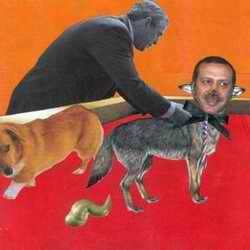
Gagged Turkish protestorA British artist is facing up to three years’ jail in Turkey for exhibiting a collage that depicts its Prime Minister as a dog being awarded a rosette by President Bush in a pet show.

Police in Istanbul seized Michael Dickinson’s Best in Show — in which he superimposed the head of Recep Tayyip Erdogan on to a dog’s body — from his exhibition in the city.

He has been told that he is likely to be charged with insulting the dignity of the Prime Minister. The show’s organiser, Erkan Kara, will go on trial on September 12 on the same charge.

ErdoganDickinson said: It’s such an Alice in Wonderland feeling. The law is so absurd . . . This law exists in Turkey about insulting ‘Turkishness’ or the State. You’re not allowed to state your opinion.

The case could greatly embarrass Turkey and Britain, for it raises questions about Turkey’s human rights record as it seeks EU membership, with Tony Blair’s backing.

Dickinson has lived in Turkey for 20 years, teaching English at Yeditepe University. His exhibition was staged in Istanbul by the Global Peace and Justice Coalition. The collage, hung with anti-war images, refers to the Prime Minister having taken legal action over cartoons depicting him as various animals.

Charles Thomson, of the Stuckist art movement, to which Dickinson belongs, has told Blair that it is intolerable for an EU applicant to censor political comment: I trust you will communicate your strongest condemnation and ask for this case to be abandoned, he wrote, urging Blair to oppose Turkey’s EU membership until it changes its stance on human rights.

Thomson has also written to Olli Rehn, the EU Enlargement Commissioner, saying that in the Union the collage would be considered acceptable free expression.

The Turkish Foreign Ministry said: Everybody will have to wait and see whether the court decides if this is about freedom of expression or not. A spokesman said that Turkey’s laws should be respected and suggested that the international community was too hasty in condemning it.


24th April   Courts Tell Hong Kong Government to Sod Off

From Asian Sex Gazette

In a landmark decision, the Hong Kong High Court ruled recently that current laws on the age of consent discriminate against homosexuals.

Justice Michael Hartmann acted in favor of William Leung, 20, who launched a Judicial Review against the government for what he considered unfair laws against gays.

Hartmann said existing laws were "demeaning of gay men," stereotype them as "deviant," and interfere with their private lives on the assumption that homosexuality was "morally reprehensible." Hartmann declared that four sections of the law covering homosexual acts, on the books since 1991, were unconstitutional.

Previously, sexual intimacy between two men below the age of 21 was a criminal offence even though sexual intimacy between heterosexuals and lesbians is allowed after the age of 16. Group sex between gay men, even though in private and conducted by consenting adults, was also criminal, while such activities between heterosexuals and lesbians above 16 was allowed. An act of sodomy, submitted as the natural sexual expression of gay men, below the age of 21 was a criminal offence with possible life imprisonment if it was conducted between two men.

During the trial in July, the government conceded that three of the four sections were in breach of the Bill of Rights and Article 25 of the Basic Law safeguarding equal rights because they unfairly distinguished between homosexuals and heterosexuals.

However, it maintained that the criminalization of sodomy between men under the age of 21 was not in breach of the constitution since sodomy between a man and a woman under 21 was equally a criminal offence.

Hartmann also declared that criminalizing sodomy for homosexuals below the age of 21 was indirectly discriminatory of gay men since it deprives them of their natural sexual expression. Put plainly, heterosexual couples may have sexual intercourse under the age of 21, homosexual couples may not, he said.

Law Yuk-lai, director of the Hong Kong Human Rights Monitor, said the ruling was long overdue:
The Hong Kong government should have reviewed its legislation in 1994 when the United Nations Human Rights Committee declared that discrimination on the basis of sexual orientation was a violation of human rights.


22nd April
Updated to
12th May
  Dancing Against Repression

From the Jakarta Post

Bali DancerArtists, public figures, and members of ethnic groups from throughout the country are planning to march through Central Jakarta on Saturday to show their cultural opposition to the pornography bill.

Organizers say the parade organizers will demonstrate Indonesia's cultural diversity as part of a national movement to reject the bill.

The legislation, supported by Muslim leaders and the Indonesian Ulema Council, contains articles which could make it illegal for women bare their thighs, breasts or navels in public.

Those opposed to the bill say it could also end up outlawing the traditional costumes of non-Muslim ethnic groups in the country, along with the traditional kebaya and kemben dresses used in ethnic dances throughout the country.

Artist, activist and march organizer Ratna Sarumpaet said Thursday in Jakarta that around 5,000 people were expected to join the parade, gathering at 11 a.m. at the National Monument.

Ratna said the parade would present traditional dances, including Aceh's Seudati and West Java's Jaipong, a series of Papuan performances and Central Java's mesmeric Kuda Lumping.

Activist Yeni Rosa Damayanti said that the parade was not about debating religious values. Instead it was about protecting Indonesia's cultural diversity, which the bill had put under threat.

23rd April   Update: Dancing Against Dress Censorship

From the China Post

Bali DancerDancers, musicians and models rallied in Indonesia on Saturday against a proposed anti-pornography bill that could impose jail terms for kissing in public or baring "sensual" body parts.

Most of the nearly 1,000 protesters were women dressed in colorful traditional costumes that showed off their shoulders, cleavage, calves and midriffs. This bill defies logic, said rally coordinator Yeni Rosa Damayanti as they marched through the streets of the capital, Jakarta, under a light drizzle. The state shouldn't try to dictate how women dress.

The protesters said they fear traditional dancing, skimpy clothes and even bathing in rivers could be declared illegal if it is passed.

Muslim groups should not be allowed to force their beliefs on the whole country, said the demonstrators, who included actors, writers, beauty pageant finalists, and a truck loaded with transvestites.

5th May  Update: Nutters in Black

From Asia Media

Bali DancerAround 1,000 supporters of a proposed anti-pornography bill that would ban kissing and sensual dancing in public rallied in the Indonesian capital on to demand the immediate adoption of the law.

The protesters, dressed in black, and some driving motorbikes, gathered at Jakarta's main downtown roundabout, about a week after the same number of people demonstrated against the bill.

Thursday's demonstrators called on leaders to impose the law sooner to prevent "public displays of women's sensuality." We support the bill because it could protect the moral of the people, said Sarkawi, a protest organiser.

The anti-pornography bill that was originally drafted in 1999. It is currently being considered by a special parliamentary committee.

12th May   Update: Network Contention

From the Jakarta Post

Bali DancerSome 5,000 people under the banner of The Nationalist Network will take to the streets Thursday in another protest against the Indonesian pornography bill. The protesters will comprise some 42 community groups,

They will start marching from the Hotel Indonesia traffic circle in Central Jakarta, passing through Semanggi flyover toward the House of Representatives in South Jakarta.

While the porn bill is still being deliberated at the House of Representatives, with some revisions made, many groups, particularly artists and people interested in the study of culture, are still trying to convince the House to drop the bill, saying it would deny the people freedom of expression.

Network coordinator Nur Aini said it was important to keep the cause alive because the porn bill only served the interests of politicians and not the general public.

22nd May   Update: Indonesia's Morality Destroyed by Intolerance

From the BBC

Bali DancerMore than 10,000 people have taken part in an anti-pornography rally in the Indonesian capital, Jakarta. They were supporting a bill before parliament which would include a ban on public kissing and erotic dancing.

The bill would make organising erotic dancing punishable by up to 10 years in prison and public kissing on the mouth punishable by five years or a fine.

Critics of the anti-pornography bill say it would curtail artistic freedom and violate women's rights. Anyone performing dances deemed erotic could also be punished by up to five years in prison.

Supporters of the hardline Islamic Defenders Front (FPI) and Hizbut Tahrir Indonesia were amongst those who marched on the parliament building.

Women and children joined the protesters, many of whom held banners reading "Pornography can destroy nation's morality" and "Indonesia should be civilised".

1st June   Update: Back to Square One

From the BBC

Bali DancerThe House special committee on the pornography bill will rework its draft to focus on curbing the prevalence of obscene materials, a development that brings the heated discussion about its contents back to square one.

The decision was made after committee members agreed that the current draft denied people's basic rights and also was rife with inconsistencies.

Lawmaker Eva Kusuma Sundari said: Proponents of the bill have repeatedly said that it was to protect women and children, but there was no mention in the bill about laws that protect women and children as its legal consideration.

She said that after taking into account the demonstrations for and against the bill, committee members also agreed to focus on measures to curb the production and distribution of pornographic materials, instead of restricting individual behaviour: Preparation of the new draft alone will take at least three months.

Special committee Chairman, Balkan Kaplale, insisted the deliberation of the bill to be completed by mid-June, with only a plenary session necessary for its endorsement.


20th April   No Human Rights to Abuse in Brunei

From Brunei Direct

Internet service and content providers have been told to watch content which goes against public interest, national harmony, decency and social morals.

The Permanent Secretary at the Prime Minister's Office said yesterday unhealthy and inaccurate content on the Internet could mar Brunei's image to the outside world and investor interest towards the country.

Pg Dato Paduka Hi Ismail also called on managers of cyber cafes to be extra vigilant in making sure that their users get registered in ensuring that the Internet is not abused.

Speaking on cyber cafes which have been told to use a logbook for users, he urged them to install a firewall to ensure that students do not abuse the facility at the cafes.

The Broadcasting Act requires that any licence holder that provides any broadcasting service must ensure that their service is not used or continued to be used for lottery purposes. It must also ensure that the service is not abused to advertise, supply or promote any religions besides Islam, any practice against the teachings of Islam or to attract customers for prostitution or any immoral acts.

Meanwhile, the Internet code of practice stipulates that a licence holder must ensure that content is not against the public interest or country's harmony. In particular, the content does not contain material-that brings hatred, insult or spark dissatisfaction towards His Majesty, the government or people in Brunei that attempts at reform unless through legitimate ways


18th April
Updated to
20th April
  Customs Censorship of Little Importance

Based on an article from CTV. See also Little Sisters Bookstore

Little Sisters book & art emporium
Little Sisters, the Vancouver gay and lesbian book store that has been fighting government censorship rules for 20 years, is back before the Supreme Court of Canada this week, asking for financial help to pay for its latest court challenge.

The cost of the store's fight against bureaucrats who label books and magazines obscene and block them at the border is far beyond its resources, says Jim Deva, co-owner of Little Sisters.

A lower-court judge in British Columbia ruled that the case was important enough to deserve federal financial aid, but the provincial court of appeal decided otherwise last year.

The store won a key Supreme Court ruling in 2000, with a decision that said Customs had a right to censor material, but had to change the way it did so.

Little Sisters, though, says Customs has not changed. Its latest censorship case involves four publications that were ruled obscene in 2001 and 2003, including two series of comic books and two books on bondage and sadomasochism.

But that fight is on hold while lawyers argue the financing. What we're after is some financial help so we can actually get the court case to court, Deva said. Precedents say that people can get government funding for court challenges deemed to be of major importance. Deva is upset that the appeal court didn't see his case as important.

The latest case has drawn a flock of intervenors, including the Canadian Bar Association, Egale Canada, the Canadian Aids Society, the Sierra Legal Defence Fund and Environmental Law Centre and the attorneys general of both Ontario and British Columbia.

20th April   Update: Reserved Little Sisters

From Iran Focus

Little Sisters book & art emporiumThe Supreme Court reserved judgment Wednesday in the case of a Vancouver gay and lesbian bookstore that wants Ottawa to pick up the legal tab for a lawsuit against Canada Customs.

The arguments drew pointed questions from the justices for both sides, which lawyer Joseph Avray saw as a good thing he said after the hearing: I think they understand that this is a complex question. As they are wont to do, they like to explore it from all sides. They like to have their questions answered, they like to be helped with what's troubling them. They posed tough questions to all counsel.

He said the suit would never have been filed if Customs had followed the last ruling and improved the way it makes obscenity decisions:
The court's order last time around simply didn't have enough teeth and we're here to get a court order with plenty of teeth.


9th April   Bellicose Bollox

From Iran Focus

The new Palestinian culture minister has set his sights on stamping out pornography — and belly dancing.

Atallah Abu Al Subbah, a senior official of Hamas, said belly dancing was “a form of striptease”: I do not regard forms of pornography and striptease as culture. They are destructive.

Abu Al Subbah blamed Israel for the spread of pornographic movies in Gaza and the West Bank. He vowed to confront the vice by boosting the “culture of resistance” and Islamic values. Israel spreads pornographic movies among our people as a means to recruit them, the minister said.


8th April   Adding to the Bands Bans

From the BBC

Rollinf Stones Bigger Bang CD
Chinese authorities have added Rough Justice from the Bigger Bang album to the Rolling Stone's banned list of  Brown Sugar, Honky Tonk Woman, Beast of Burden and Let's Spend the Night Together.

Lead singer Sir Mick Jagger said the band were not worried by the censorship and had fully expected it.

The Rolling Stones do not have such a devoted Chinese following and it is widely expected the majority of the audience will be non-Chinese. Sir Mick sarcastically added:
I'm pleased that the Ministry of Culture is protecting the morals of the expat bankers and their girlfriends that are going to be coming.


5th April   Space for Censors

Based on an article from Mac User

The online meeting place Myspace has been ejecting tens of thousands of profiles from its service. According to reports, it has removed some 200,000 'objectionable' profiles from its service on grounds ranging from racist comments to being too risqué.

The MySpace social networking service, which claims millions of regular users, was acquired by Rupert Murdoch's News Corp last year. It is now cracking down on those who do not abide by the rules of online behaviour as set by News Corp.

Under the safety tips on the site, Myspace states Harassment, hate speech and inappropriate content should be reported. If you feel someone's behaviour is inappropriate, react. Talk with a trusted adult, or report it to MySpace or the authorities. It also warns that people should think twice before posting a photo or info you wouldn't want your parents or boss to see, and that If you lie about your age, MySpace will delete your profile. MySpace users should be at least 14 years old.

News Corp, which also owns the noxious Fox News in the US, is particularly concerned by a possible backlash from parents and teachers who complain about objectionable content visible to the millions of American teenagers who use the service.


4th April   Political Bloggers to be Silenced for Singapore Elections

From the Bangkok Post

New Internet technologies such as podcasting and videocasting cannot be used for disseminating political information during the upcoming Singapore general election, the government said in a recent published statement.

Bloggers are allowed to discuss politics but will have to register their sites if they consistently espouse a political line.

Streaming of "explicit political content" by parties or individuals has been banned under election advertising rules set in 2001.

The latest clarifications are supposedly aimed at curtailing the scope of those who hoped to use the internet to influence the polls, said Dr Balaji Sadasivan, senior minister of state for information, communications and the arts, in a breakdown of the new rules in The Straits Times.

Increasingly popular is podcasting, an Internet audio feed. Podcasting is not among the "positive list" of regulations which spells out what political parties, candidates and election agents can do to promote themselves during the campaign, Balaji said.

In the November 2001 polls, online electioneering was limited mainly to political parties posting their candidates' biographies and rally information on websites. In elaborating, Balaji said that websites of political parties and those who take an avowedly political stance have to be registered by the Media Development Authority (MDA).

Bloggers who "persistently propagate, promote or circulate political issues relating to Singapore" are also required to register with the MDA. During the election period, these registered persons will not be permitted to provide material online that constitutes election advertising, he said.


4th April
Updated to
23rd June
  Murderous Bulldozers Relocate to London

From CBS News

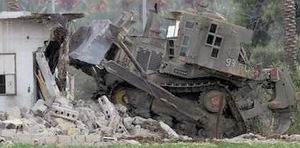
Military bulldozerA play about an American peace activist killed in the Gaza Strip has opened in London instead of the previously planned off-Broadway home.

My Name Is Rachel Corrie, a one-woman show starring Megan Dodds, began a six-week run this week at the Playhouse Theatre in London's West End.

The play had been due to open this month at New York Theatre Workshop, one of the city's leading off-Broadway spaces. But the production was suspended indefinitely in February.

The show's director, British actor Alan Rickman, said the theater had canceled the run, and accused it of "censorship born out of fear."

The Playhouse stepped in to stage the story of Corrie, who was killed by an Israeli bulldozer while trying to stop the destruction of a Palestinian home in the southern Gaza town of Rafah in March 2003. Corrie had traveled to the Middle East with the International Solidarity Movement, an activist group that tries to stop Israeli military operations in the Palestinian territories.

23rd June   Update: Murderous Bulldozers Descend on Broadway

From Reuters

Military bulldozerA play about an American human rights activist who died in the Gaza Strip will now open in New York in October, six months after it was pulled from the schedule at another theater amid charges of censorship.

My Name is Rachel Corrie is a one-woman show based on the U.S. human rights campaigner killed by an Israeli bulldozer in 2003, trying to prevent demolition of a Palestinian building.

Producers Dena Hammerstein and Pam Pariseau said in a statement on Thursday the play would open at the off-Broadway Minetta Lane Theatre on Oct. 15, for a limited run to Nov. 19.


4th April   Operation Anti-Censorship

Press release from www.anonymizer.com

Anonymizer logoAnonymizer Inc., the leader in online identity protection software and services, today announced the launch of Operation Anti-Censorship. This new privacy software, created specifically for Chinese citizens, will enable safe access to the entire Internet by circumventing the Web filters put in place by the government. In addition, the new solution protects users from detection, persecution, and retribution by shielding their personal identities and related information that the Chinese government is currently able to monitor.

Citizens of China can download the free software today at www.xifuchun.com. The success of this program relies heavily on word-of-mouth promotion, and "Tell a Friend" functionality has been added to the site. All people are encouraged to share the news about Operation Anti-Censorship with their friends and family. Bloggers, reporters, and other media outlets are also urged to spread the word by promoting this Web site today.

Anonymizer is excited to provide this free service to the people of China, said Lance Cottrell, president and chief scientist, Anonymizer Inc. Our goal is to make the Internet an even playing field for everyone, including those under the rule of repressive regimes. We've had great success in other areas of the world, including our current work in Iran, and we're looking forward to bringing safe Internet access to others.

The Web site that currently hosts the software download is www.xifuchun.com, however please note that this URL will be changed on a regular basis to avoid blocking by the Chinese government. Anonymizer relies on early adopters to share the regularly changing URLs with their friends and family members so the number of people able to safely access the Internet continues to grow.

How to Get Started

To download the software, users must first submit a valid email address atwww.xifuchun.com to receive regular updates containing new configuration directions and the latest location of the download site.


4th April   A Goulash of Regulation

From Pestiside.hu

The Hungarian National Radio and Television Board (ORTT) is taking a stand against foreign-produced porn channels broadcast on cable and satellite TV, even though laws prohibiting them have been in effect for four years. But even as Hungarian TV attempts to button up its blouse, the chances are still good that it is going to get well and truly fucked up the ass.

It all boils down to the usual and deliciously subjective debate on the gaping grey area between art and porn, not to mention the fact that many channels broadcast from abroad. ORTT spokeswoman Éva Vékony told index.hu (in an article indignantly headlined "Fighting Windmills against Anal Fisting") that the organization is redoubling its efforts to enforce the 2002 law prohibiting pornographic programming at all times. This is more of a challenge than it sounds, largely because the law doesn't give any definition of porn, here in Hungary or anywhere else in the EU.

Predictably, the Swedes lead the way. There, nothing is porn that happens with the consent of two or more adults, even if the camera zooms in really, really close. Even the "Television without Borders" EU directive that allows regulatory bodies like the ORTT to punish porn channels with the help of foreign authorities has proved as useless as a pair of crotchless panties in the courts. And although no one likes to admit it, these channels do have their followers. Annual polls carried out by UPC indicate that few people are interested in adult TV, but that complaints come raining in whenever a porn channel is considered for cancellation.


2nd April   Nutters Don't Have a Monopoly on Repression of Belief

From Christian Today

A prominent human rights activist has been arrested, tried and sentenced to ten days’ imprisonment for organising an “illegal religious activity” in Belarus.

Sergey Shavtsov, who is also a lawyer, was detained by the country’s state security forces following taking responsibility for organising an inter-denominational conference.

Shavtsov represents most of the Protestant Church unions in Belarus and he also was the author of the 2002 “White Book” that documented violations of international law on religious freedom in Belarus.

On the final day of the conference, reports from Belarus tell that three policemen and one KGB agent entered the conference building and locked all the delegates inside for one hour. Two pastors were then arrested as they were believed to be the conference organisers. However, all other delegates were released after their personal details had been recorded. The arrested pastors were then taken to a police station for interrogation, but were later released after Shavtsov claimed sole responsibility for the conference.

Reports tell that Shavtsov was taken almost immediately from the police station to the administrative court, where he was given a 20-minute summary trial and sentenced to 10 days’ imprisonment.

Church representatives in Belarus have also expressed their concerns that the state prosecutor had still not stated that the case was closed, therefore indicating that Shavtsov and the remainder of the delegates were still open to further prosecution. Some even report that Shavtsov could be sentenced for up to two years’ imprisonment, and the other delegates up to six months’ imprisonment each also.

The conviction against Shavtsov comes following legislation coming into effect in Belarus in October 2002, which was later amended in November 2005, that severely restricts the extent that religious activities are allowed in the country.

Shavtsov is the second person to be convicted under the legislation, the first being Pastor Georgi Vyazovsky of the Minsk-based Christ's Covenant Reformed Baptist Church, who was sentenced to 10 days’ imprisonment for conducting religious worship in his home on March 3.

Christians in Belarus have not experienced imprisonment for exercising their right to meet together and worship since Soviet times and we are worried these arrests signal renewed hostility on the part of the government towards religious believers.


1st April   Hardline Intolerance

From Brocktown News

On his last visit to Iran, Canadian-based blogger Hossein Derakhshan was detained and interrogated, then forced to sign a letter of apology for his blog writings before being allowed to leave the country. Compared to others, Derakhshan is lucky.

In the conservative Islamic Republic, where the government has vast control over newspapers and the airwaves, weblogs are one of the last bastions of free expression but increasingly, they are coming under threat of censorship.

Although exact figures are not known, experts estimate there are between 70,000 and 100,000 active weblogs in Iran. The vast majority are in Farsi but a few are in English.

Iran is also one of a growing number of Mideast countries that rely on US commercial software to do the filtering, according to a 2004 study by a group called the OpenNet Initiative. The software that Iran uses blocks both internationally hosted sites in English and local sites in Farsi, the study found.

The filtering is systematically getting worse, said Derakhshan, who was detained and questioned during a visit to Iran last spring, just before the election of hard-line President Mahmoud Ahmadinejad.

Hanif Mazroui was arrested in 1994 and charged with acting against the Islamic system through his writings. He was jailed for 66 days and then acquitted. It‘s normal for authorities to summon and threaten bloggers, said Mazroui. The government continued to harass him and three months ago, he was summoned once again by the authorities and told never to write about the nuclear issue. Soon after his release, he shut down his weblog.

Arash Sigarchi, an Iranian journalist and blogger, was arrested and charged with insulting the country‘s leader, collaborating with the enemy, writing propaganda against the Islamic state and encouraging people to jeopardize national security. He had been in jail for 60 days when he was sentenced to 14 years in prison. He appealed, and was released on bail. Although his sentence has been reduced to three years, he still faces charges of insulting the leader and writing propaganda.

Another, Mojtaba Saminejad, has been in prison since February 2005. He was first arrested in November 2004 for speaking out against the arrest of three colleagues. After his release, he launched his blog at a new address, which led to his second arrest in February 2005. He was sentenced to two years in prison, and then given an extra 10 months for inciting "immorality."