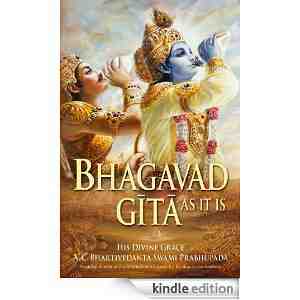
A Russian court has dismissed an appeal supporting the ban of an edition of the Hindu holy book Bhagavad Gita As It Is , in a case that triggered protests in India. The book is a used by the Hare Krishna movement.
In December, a court
in the Siberian city of Tomsk had rejected a plea by prosecutors to rule the edition to be "extremist" and therefore banned.
Prosecutors had filed an appeal in the higher court against the decision and so as to re-impose the ban.
The controversial commentary on the text was written by A C Bhaktivedanta Swami Prabhupada, the founder of the Hare Krishna movement. Followers in Russia saw the case as part of efforts by the Russian Orthodox Church to restrict their activities.
The Bhagvad Gita, one of the most popular texts for Hindus, takes the form of a conversation between the god Krishna and prince Arjuna.
Prosecutors in Tomsk are seeking through the courts to have the Russian translation of the most important work for Hare Krishna devotees, the Bhagavad-Gita As it Is , declared "extremist" and placed on the Federal List of Extremist
Materials.
An 'expert' analysis completed in October 2010 by three academics at Tomsk State University, Sergei Avanesov, Valeri Svistunov and Valeri Naumov, found that the book contains signs of incitement of religious hatred and humiliation of
an individual based on gender, race, ethnicity, language, origin or attitude to religion .
The analysis claimed the book humiliated those who did not believe in or even know about Krishna or follow Krishna's teachings. It claimed that the
author propagated the exclusivity and superiority of his faith and was hostile, insulting and humiliating about other faiths [Just like any other supposedly holy book then] . It also claimed that the author called for
hostile or violent acts against women and non-Hare Krishna devotees.
This case is more than important for us - it is vital, Hare Krishna lawyer Mikhail Frolov told Forum 18: This is the most important development in the whole history of
our movement in Russia. They are trying not just to declare our book extremist, but our religious teaching also. If they succeed, our community throughout Russia could be declared extremist.
Meanwhile, an appeal court in Dagestan, while
upholding a three-year suspended prison term on Ziyavdin Dapayev, has ruled that works by the late Muslim theologian Said Nursi should be handed to the Dagestan Muslim Board for a decision on the question of the destruction of the banned books and
pamphlets.