Liz Longhurst, the woman who fought for a ban on violent online pornography after her daughter's murder, has said she is disappointed it has not been more effective.
She said: I was glad that the law had been passed in 2009 but I did not feel
it was necessarily going to have a tremendously marvellous effect.
I was rather surprised that really very few cases have been brought. There have been lots of cases of [connected with] child pornography but not
many with adult pornography.
Longhurst said she was very sad to discover the man who murdered landscape architect Jo Yeates had viewed violent pornography on the internet.
[I wonder if Liz Longhurst ever sheds a tear for
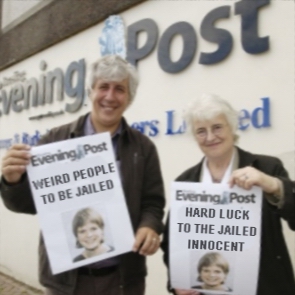
the innocent people persecuted by the law over a jokey bad taste video clip, or else for those people who would never dream of harming anyone, but who's tastes in porn would have been better left private?]
A Church of England bishop has urged people with shares in internet firms to confront them over their records on pornography.
The Rt Rev Mike Hill said that he was appalled to hear of Miss Yeates's killer Vincent Tabak's obsession with vile images
of women being sexually tortured, and called for the Church of England and other investors to force ISPs to block such material. He added:
This kind of pornography seems so degrading, obscene and deeply unhelpful to
the building of healthy communities. It beats me why any internet service provider would be happy to have that kind of stuff go out at all. You would have thought the risk to their reputations meant that any financial gain was not worth it.
The bishop, who sits on the Church's assets committee, added:
Of course not everybody who looks at internet pornography becomes a violent and sadistic killer. But the fact is a few do, and it may
"turn on" something that was not there before.
The Melon Farmers added:
Of course not every cleric who looks at religion becomes a paedophile child abuser. But the fact is a few do, and it
may "turn on" something that was not there before.
Lawyer argues that porn use should always be revealed in court
It sounds
like Nick Freeman is arguing to use the fear of porn use being revealed to courts (and the fear of wrongful conviction due to prejudicial evidence) as a general morality deterrent to viewing porn.
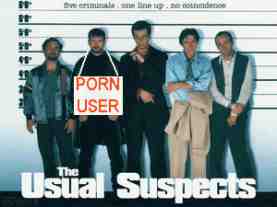
Ever been tempted to look at porn on the internet? After all, pornography is viewed by 35.9 % of UK internet users.
It's unlikely many of these are more than casual sauce-surfers, idling away a
few moments of spare time over their lunchtime pot noodle. Certainly - or rather, hopefully - very few, fuelled by a cyber-fix, would develop a thirst for violence or even murder. Unfortunately, it did in the case of Vincent Tabak. And yet his
predilection for hard-core and violent pornography - including images of women being held by the neck saying choke me - was kept from the jury in the Jo Yeates murder case.
An outrage since in my mind this was a
scorching piece of evidence which directly played to the mindset of the accused. Without it, the Crown just about limped home with a conviction after the jury deliberated for two days before returning a 10 - 2 majority. A very close call for the Crown.
...
It's time to smash this disgraceful contradiction by carving the legal position in statute.
In my view, anyone watching internet porn should
know that if they subsequently become a defendant or witness in criminal proceedings, their cyber spectating could be open to questioning in court, if relevant to the charge. Every day minds are polluted by the toxic trash being pedalled on the web. Yet
the law seems to protect a violent killer tanked up on gruesome internet footage whilst exposing an innocent witness for his lamentable sexual interest.
At the moment a judge has a discretion to make this call. It's
not enough. If he errs on the side of caution, suppresses evidence arbitrarily and gets it wrong, a vicious murderer could walk free. The scales of justice between the probative and the prejudicial need to be rebalanced. The law needs to stand as a
serious deterrent.
There are 755 million porn-heavy pages on the web, generating £ 60billion a year in filth-soaked revenue. And nearly 36% of the population are looking at it. One
of them could be you. Would you take a peek if you knew your secret wasn't safe?
The conviction of Vincent Tabak for the murder of Jo Yeates has thrown the issue of online criminally obscene adult content, sometimes known as extreme porn, into the limelight. The vast majority of the IWF's work concerns the removal of images of child
sexual abuse from the internet, for which we have an international remit, but we also deal with criminally obscene adult material hosted in the UK.
In 2007 the Home Office asked the IWF to allow our public internet reporting
mechanism to be used for the reporting of UK-hosted criminally obscene adult content. Following consultation with our industry members, our Board informed the government of our agreement to fulfil this role, from 26 January 2009, as part of our original
remit.
We are able to act on any public reports of online obscene adult content when it is hosted in the UK and contravenes UK Law, we cannot act if the content is hosted abroad and do not action legal adult content. The online
industry fully supports us issuing takedown notices for this part of our remit. However, we receive very few reports of this type of content which satisfies these criteria and enable us to issue a takedown notice:
In 2010 we issued eight notices for criminally obscene adult content.
In 2009 we issued two notices.
In 2008 the number was 39.
The reason there are so few is a reflection that the UK online industry provides one of the harshest environments for hosting criminal material. On those rare occasions when material believed to be unlawful is depicted on a website
hosted in the UK, we work in partnership with the online industry and the police to provide information to assist investigations into the distributers of the content. The material is removed in hours.
The IWF is not an
organisation which makes moral judgements on what is hosted on the internet. We are solely concerned with the prompt removal of criminal content within our remit and we have achieved great successes in this.
Offsite:
Interview with Susie Hargreaves, IWF Chief Executive
In recent years, the IWF has widened its net slightly. To its original concern with child abuse images, and imagery that
breaches the Obscene Publications Act, it has added extreme porn (2008) and cartoon images of child abuse (2009).
Which brings us full circle to the question of whether the IWF is in danger of turning into a net
police ? Hargreaves thinks not: There is no one on the IWF board from the police. Members come from a range of backgrounds, including human rights and some have strong anti-censorship views: the role of the IWF is to implement a takedown and
filtering of material in line with what the industry wants.
And there, she suggests, is the heart of the matter. It is not unusual to hear the IWF praised by government -- or even ministers suggesting, sotto voce, that the IWF
could be used as a solution to this or other problems, namely online bullying, terrorist sites and even piracy.
But so far, all such pressures have been resisted. MPs, she tells us, recognise that the IWF does what it does best
by sticking to a very specific focus .
An internet user will not face prosecution over a tweet exposing Vincent Tabak's interest in violent pornography during the trial.
Attorney General Dominic Grieve QC was considering bringing contempt of court proceedings against the unnamed
tweeter for breaching a court order by exposing Vincent Tabak's past that was judged to be best left out of the trial.
Because he co-operated and the message was swiftly removed, Grieve has decided not to pursue the case. The tweeter is understood
not to have been a journalist.


 Liz Longhurst, the woman who fought for a ban on violent online pornography after her daughter's murder, has said she is disappointed it has not been more effective.
  A Church of England bishop has urged people with shares in internet firms to confront them over their records on pornography.
  Ever been tempted to look at porn on the internet? After all, pornography is viewed by 35.9 % of UK internet users.
  The conviction of Vincent Tabak for the murder of Jo Yeates has thrown the issue of online criminally obscene adult content, sometimes known as extreme porn, into the limelight. The vast majority of the IWF's work concerns the removal of images of child
sexual abuse from the internet, for which we have an international remit, but we also deal with criminally obscene adult material hosted in the UK.
The conviction of Vincent Tabak for the murder of Jo Yeates has thrown the issue of online criminally obscene adult content, sometimes known as extreme porn, into the limelight. The vast majority of the IWF's work concerns the removal of images of child
sexual abuse from the internet, for which we have an international remit, but we also deal with criminally obscene adult material hosted in the UK.  An internet user will not face prosecution over a tweet exposing Vincent Tabak's interest in violent pornography during the trial.