A company responsible for advertising on the Egged bus company has refused to place a political advertisement on Jerusalem city buses showing female candidates for the city council, so as not to offend the haredi public. The poster disqualified by...
The advertisement rejected last week by the Canaan advertising company, which is charged with advertising with the Egged bus cooperative, includes the portrait of two women and a man running for city council on a joint religious-secular
list called Wake up Jerusalem-Yerushalmim. The municipal elections will take place on November 11.
A spokesman for the company stood by the rejection of the ad. All advertisements are subject to the approval of the Egged censor, Canaan
company spokesman Ohad Gibli said: In order not to offend the sensitivities of a certain public, certain criteria have been defined regarding the content of advertisements. Pictures of women cannot appear on buses that go through haredi
neighborhoods, Gibli said.
Egged spokesman Ron Ratner said the bus company was never asked about advertisements with the portraits of women running for the city council, and would never have nixed them: Egged never received a query on this
issue and would never have rejected such an advertisement of a public figure so long as it was positive, modest and respectable, and did not hurt public sensitivities. The Egged spokesman said he thought the whole issue was a PR ploy since the
would-be city councilors never contacted Egged on the issue.
It is very sad that in Israel of 2008 women suffer such brazen discrimination, which is absolutely unacceptable, said Wake up Jerusalem-Yerushalmim spokeswoman Meirav Cohen,
whose portrait was one of those appearing on the banned advertisement.
In the meantime, the ads in question have gone up on bus stations, which are the responsibility of another advertising company.
Lipa Schmeltzer looks and sounds every inch the popular ultra-orthodox Jewish singer that he is. He sings in Yiddish. He dresses in the clothes of a Haredi Jew and all of his song lyrics come from the scriptures.
Yet some say Schmeltzer's music,
and that of others like him, is indecent and unfit for public consumption.
They are leading the public astray and are causing a great negative influence on the young generation, says Rabbi Efraim Luft, head of an ultra-orthodox
organisation in Israel called the Committee for Jewish Music.
Supported by leading Haredi rabbis, Rabbi Luft has drawn up a black-list of musicians and bands - music that he says that is not kosher and cannot be played at ultra-orthodox weddings
or public events because of its decadent nature.
What Rabbi Luft objects to so vehemently is not just contemporary, western music - rock, rap or pop - but the use of modern instruments and beats in the tunes of orthodox singers like Lipa
Schmeltzer: The main part of the music should be the melody. Percussion should be secondary. They should not bend notes electronically and should not use instruments like electric guitars, bass guitars or saxophones in Jewish music .
Menahem Toker, an award-winning disc jockey, who was dismissed from a radio show under pressure from Haredi activists, warns the policy could backfire:
In Jewish Orthodox culture there's no cinema, no theatre, no television. The only thing we have is music. We are the same, orthodox, people but if they don't find an alternative they'll lose the young people - they'll go to non-kosher shows and
they'll have lost the next generation.
Tzipi Livni is poised to become Israel's next prime minister - but ultra-orthodox newspapers in the Jewish state are refusing to publish her picture for reasons of religious modesty.
Only about 600,000 of Israel's 7 million population are haredi,
or ultra-orthodox, but they pack a strong political punch and include key officials including cabinet ministers and the mayor of Jerusalem.
No haredi paper will publish Livni's picture, said Avraham Kroizer, a public relations adviser to
the incoming premier: Graphic artists will blur the faces of women that do make their way into pictures that the papers want to use. They will also blur pictures of television sets or other items deemed improper to be seen by the wider haredi public.
One ultra-orthodox paper also said it would not be using Livni's name Tzipi - short for ‘Tziporah' which means ‘bird.'
We might write "Mrs. T. Livni" or just "Mrs. Livni," but the name. Tzipi is too familiar. It
is not acceptable to address a woman using her first name, especially when she goes by a nickname, said a senior editor at Hamodia, the oldest ultra-orthodox daily.

 A company responsible for advertising on the Egged bus company has refused to place a political advertisement on Jerusalem city buses showing female candidates for the city council, so as not to offend the haredi public.
  Lipa Schmeltzer looks and sounds every inch the popular ultra-orthodox Jewish singer that he is. He sings in Yiddish. He dresses in the clothes of a Haredi Jew and all of his song lyrics come from the scriptures.
 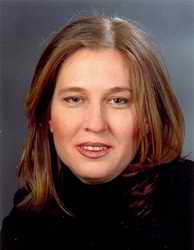 Tzipi Livni is poised to become Israel's next prime minister - but ultra-orthodox newspapers in the Jewish state are refusing to publish her picture for reasons of religious modesty.