|
|
Pre employment job vetting of minor offences now illegal
|
|
|

|
25th January 2016
|
|
|
See article from theregister.co.uk
|
Mandatory pre-employment criminal record checks have been ruled unlawful in the UK, following a ruling in the High Court. Lord Justice McCombe and Mrs Justice Carr declared the government's disclosure scheme is incompatible with Article 8 of the
European Convention on Human Rights. The High Court heard the complaints of two people who had suffered professional setbacks after being forced to disclose minor criminal convictions to potential employers. Lord Justice McCombe ruled that
the criminal record disclosure scheme in the UK was arbitrary and unlawful. The challenge related only to minor offences, and no challenge was made to the rules requiring disclosure for those who have been convicted of violent or sexual
crimes. The Home Office has declared that it will consider whether to appeal the decision.
|
|
|
|
|
|
|
|
1st February 2013
|
|
|
This ruling may limit the disclosure of historic information, but what about its retention? See
article from independent.co.uk
|
|
|
|
|
|
|
|
26th January 2013
|
|
|
The overzealous criminal record vetting system has allowed old, minor and unreliable information to wreck the lives of too many hardworking people in the UK. See
article from bbc.co.uk
|
|
|
|
|
|
|
|
4th November 2012
|
|
|
Growing numbers of people are being turned down for jobs and university places because they accepted police cautions for minor offences. Cautions showed up on 153,000 Criminal Records Bureau checks last year. See
article from dailymail.co.uk
|
|
|
Home Office to expunge consensual gay sex from criminal records currently used to unjustifiably ban gays from working with children
|
|
|
|
|
11th September 2012
|
|
|
See article from homeoffice.gov.uk
|
The Home Office will, from 1 October, begin the process of correcting an anomaly in the criminal records system which has for decades seen gay men unfairly stigmatised. Anyone with a historic conviction, caution, warning or reprimand for
consensual gay sex, that meets the conditions laid down in the new Protection of Freedoms Act, will be encouraged to come forward and apply to have these records deleted or disregarded. Until now, people wishing to volunteer or work in roles that
require criminal records checks have been discouraged from doing so, for fear of having to disclose offences which have long since been decriminalised. These changes mean that, after a successful application, this information no longer needs to be
disclosed on a criminal records certificate and those individuals who may have been inhibited from volunteering or seeking new work will now find that inhibition removed. The change was made under the Protection of Freedoms Act, which received
royal assent on 1 May 2012. The Home Office is working closely with the Courts and Tribunals Service, and the Association of Chief Police Officers and the Ministry of Defence to run the application process. A dedicated team of caseworkers will consider
each case and make recommendations to the Home Secretary who will have the final decision. Successful applicants will have their records updated so the offence will no longer appear on a criminal records certificate or be referred to in any future
court proceedings. Update: Now in force 2nd October 2012. See article from
homeoffice.gov.uk From 1st October anyone with a historic conviction for certain decriminalised consensual sex offences can apply to have these records deleted. Until now, people wishing to work in roles that require background checks have been discouraged from doing so for fear of having to disclose offences which have long since been decriminalised.
The change was made in the Protection of Freedoms Act, which received royal assent on 1 May 2012. The process You can apply on the Home Website by filling out the following online form. The Home Office will
then work with the Courts, Tribunals Service and Association of Chief Police Officers. A dedicated team of caseworkers will consider each case and make recommendations to the Home Secretary who will have the final decision. Successful applicants
will have their records updated so the offence will no longer appear on a criminal records certificate or be referred to in any future court proceedings.
|
6th February
2011
|
|
|
|
Government to scale down the vetting scheme for people who work with children
|
See article from bbc.co.uk
See also
article from theregister.co.uk
|
A scheme for vetting people who work with children is to be scaled down. The Daily Telegraph reports that following a review of the Vetting and Barring scheme, criminal record checks will only be carried out on those who have intensive contact
with the young. As a result, ministers agreed to vet adults only if they saw the same group of children or vulnerable people once a week or more, rather than once a month as originally proposed. It is estimated that this will halve the
number of people who will be vetted from the 9 to 11 million people previously caught up by the scheme. At the same time, the government will announce that criminal record checks are to be sent to individuals first - before they go to potential
employers - to allow them to challenge any mistakes. Also minor offences will be removed from the checking process. A Home Office spokesperson said an official announcement would be made shortly.
|
12th December
2010
|
|
|
|
|
Growing numbers of volunteers are refusing to put up with humiliating and unnecessary vetting checks See article from
spectator.co.uk
|
27th October
2010
|
|
|
|
Government announces review of vetting for people working with children
|
See press release from homeoffice.gov.uk
See also
UK gov vets the vetting process from
theregister.co.uk by Jane Fae Ozimek
|
The Home Office have issued a press release about their plans to scale back the vetting scheme being applied to workers who may come in contact with children: In order to meet the Coalition's commitment to scale
back the vetting and barring regime to common sense levels, the review will: consider the fundamental principles and objectives behind the vetting and barring regime, including:
- evaluating the scope of the scheme's coverage
- the most appropriate function, role and structures of any relevant safeguarding bodies and appropriate governance arrangements
-
recommending what, if any, scheme is needed now; taking into account how to raise awareness and understanding of risk and responsibility for safeguarding in society more generally
Announcing the review, Featherstone said: While it is vital that we protect the vulnerable, this scheme as it stands is not a proportionate response. There should be a presumption that people wishing to work or volunteer with children
and vulnerable adults are safe to do so unless it can be shown otherwise. The review will also take on board the criminal records regime, which Featherstone describes as having developed piecemeal and due for an overhaul to ensure
that we strike a balance between protecting civil liberties and protecting the public.
|
29th September
2010
|
|
|
|
A disproportionate interference that doesn't make children safer
|
From civitas.org.uk
|
With the imminent results of the Coalition Government's major review of the Vetting and Barring Scheme (VBS), which regulates contact between adults and any child not their own, independent think tank Civitas releases a new edition of Licensed to
Hug , which insists the Government must get rid of the VBS once and for all. The dramatic escalation of child protection measures, such as the VBS, has created an atmosphere of suspicion that actually increases the risks to children and
damages relations between the generations. In October 2009, Britain's newly-established Supreme Court ruled that the vetting system poses a threat to individuals' rights and represents a disproportionate interference in people's lives. Also
in 2009, the outgoing Information Commissioner, Richard Thomas, warned that the use of so-called soft intelligence had the capacity to damage an innocent person in his or her career financially and socially . However, well-founded civil
liberties concerns had to contend with a powerful cultural acceptance that those with nothing to hide have nothing to fear : Concerns about civil liberties tended to be outweighed by the idea that you cannot argue with a scheme that
intends to protect children. Many individuals simply complied with the rules, and hoped the problems caused by false allegations or incorrect information would not affect them. For some, this gamble didn't pay off: Headlines such as Vetting blunders label 12,000 innocent people as paedophiles, violent thugs and thieves
... indicate that the consequences of the inevitable errors that will be made by this vast technical system should not be regarded lightly. Home Secretary Theresa May announced the major review of the VBS in June 2010, in recognition that the
existing system has got out of hand. She insisted that a new proportionate and commonsensical scheme would take a measured approach and scale back the regulations. If the Government fails to halt the VBS, the scheme will continue to poison
the relationship between the generations, intersecting a broader culture of fear, which creates a formal barrier between adults and children. Licensed to Hug calls on the Government to adopt a radically new approach which recognises that the healthy
interaction between generations enriches children's lives: What's required is not just a new system, but an enlightened approach towards the promotion of intergenerational contact. Perhaps the worst thing about the current vetting procedure
is that it doesn't guarantee that children will be safe with a particular adult. All it tells us is that the adult has not been convicted of an offence in the past. Employers might even feel that they had fulfilled their obligations by paying for a CRB
check and lower their guard: Rather than creating an atmosphere of fear and suspicion based on the assumption that the majority of adults have predatory attitudes towards children, we should encourage greater openness and more frequent contact
between the generations.
|
9th July
2010
|
|
|
|
Unvetted parents banned from their children's school sports day
|
Based on article from
dailymail.co.uk
|
A school turned a father away from his son's first sports day after banning parents who have not been checked by police from mixing with pupils. The taxi driver had gone to watch his son, a year seven pupil, compete in sprints and egg-and-spoon
races. But teachers refused to let him spectate because they did not believe he had undergone checks by the Criminal Records Bureau. De Lisle Catholic Science school in Loughborough has a policy which says that any parent who has not passed
the checks is banned from attending events in which pupils take part. The father told a Talksport radio programme: I couldn't believe it when they told me I wasn't allowed in because I didn't have the relevant CRB checks. I'd called the school
that morning to ask if it would be OK if I came along and they said it would be no problem. But when I got to the school the assistant head teacher said that as I hadn't had a CRB check then I couldn't watch. I'm a taxi driver and I have to
have regular CRB checks as part of my licence. I've never had any trouble. What is the world coming to when parents can't watch their own kids take part in what is a big day in their young lives? I'm all for protecting kids, but surely
there has to be a place for common sense. The school said in a statement: We fully appreciate that one parent was upset by our policy regarding the attendance of parents at sports days. A spokesman for Leicestershire County
Council told Talksport: Parents should have access to school activities. We certainly do not issue any guidance to say parents should have a CRB check to attend school sports days. The day-to-day running of the school is a matter for the school and
its governors, but we are contacting the school to discuss their policy with them.
|
27th June
2010
|
|
|
|
A Manifesto Club report about child protection vetting
|
Based on article from telegraph.co.uk
|
As many as 4million volunteers have been forced to undergo Criminal Records Bureau checks over the past decade, according to a new report, but many are giving up on their roles because of the red tape involved and the feeling that they are under
suspicion. People who devoted their spare time to helping out in their communities say they found the vetting process thorough insulting while the bureaucracy it entails creates a burden and a bore . Even people who sell
tickets to a botanic garden or offer to write a local newsletter have been told that they must have their backgrounds checked in case they pose a risk to children. Some children are being prevented from joining Cub packs and Scout troops until
their parents have been vetted, while schools are forcing visitors to wear badges displaying their CRB numbers and making teachers accompany them to the lavatory. The flower guild at Gloucester Cathedral, who make arrangements before services,
were told they had to be vetted to prevent paedophiles infiltrating their group, and in case they used the same lavatories as choirboys. Five members have already resigned while a further 20 are threatening to do so. Since 2002 the CRB, an agency
of the Home Office, has carried out 20m detailed background checks on those who work regularly with children or vulnerable adults. Its Enhanced Checks look for convictions or cautions as well as unproven allegations held on file by police. Although volunteers themselves do not pay to be vetted, their organisations must pay a £20 administration fee while the rest of the cost is borne by CRB checks paid for by companies and public sector bodies.
The new report, Volunteering Made Difficult , discloses that 3.87m volunteers have been vetted over the past eight years – a fifth of the total. A further 2m are likely to have to sign up when the Government's new vetting and barring
scheme, now on hold pending a review, comes into force. Josie Appleton of The Manifesto Club, the civil liberties group that compiled the new report, said: The regulation pressed on volunteers is completely out of proportion with the everyday
nature of their activities - after all, they are just listening to children read or doing the crosswords with elderly people.
|
15th April
2010
|
|
|
|
2,522 cases where employment vetting has wrongly labelled people as criminals
|
Based on article from theregister.co.uk
|
The Criminal Records Bureau has paid out compensation of £290,124 to people wrongly labelled criminals during background checks by the agency. The CRB issued 3,855,881 certificates in 2008/2009. In the same year there were 2,522 disputes
handled, and upheld. These claims were brought by the registered body or by the applicant because they believed the information either related to someone else or was in some other way incorrect. Hat tip to The Sun for making the Freedom of
Information request, which also found there have been 15,000 other bungles in the last six years. Most of the mistakes involved either mixing up records checks or incorrect information from the police.
|
8th December
2009
|
|
|
|
The pernicious rise of the CRB Stasi
|
Based on article from bigbrotherwatch.org.uk
|
The Daily Mail are reporting that Manor Community College in Cambridge is to ban any visitor who has not been checked by the Criminal Records Bureau. The Head of the Secondary School claims the decision is necessary to prevent strangers
walking around the premises. But also admits that volunteers, visitors and contractors will be hit with the ban. So, unless Manor Community College is unique in that there are a slew of strangers wanting to check out Year 5's latest art
project, what this measure will actually achieve is reducing the number of volunteers able to donate their time and energy to help out stressed teachers at sports days or similar events. Not content with poisoning the way children view adults, the
government is effectively making the fear of being left alone with young children the first step into adulthood for 16 year-olds. The CRB is the rotten core at the heart of the national obsession with paedophilia. It seriously hinders
volunteerism, has frightened many adults into not spending time with the young children of friends and family and is on the verge of making scouts and sports clubs a thing of the past. The CRB is fast becoming a symbol of the so-called broken
society and needs urgent reform.
|
7th November
2009
|
|
|
|
|
Her Majesty's Pleasure: How England 'Safeguards' Sexuality See article from carnalnation.com
|
1st November
2009
|
|
|
|
Supreme Court finds that child protection vetting disclosures go too far
|
Based on article from
dailymail.co.uk
|
Criminal record checks have gone too far and must be tilted back towards those wanting to work with children, the new Supreme Court has ruled. In a victory for campaigners fighting the rise of the Big Brother state, the Justices ordered an
overhaul of enhanced criminal records bureau checks against anybody seeking a job with a vulnerable adult or child. In particular, the presumption in favour of disclosing soft intelligence against an applicant came under attack. Each year,
around 20,000 people have details of this type of information disclosed to potential employers, in many cases scuppering their hopes of gaining a job. But Lord Neuberger said soft intelligence may constitute nothing more than allegations of
matters which are disputed by the applicant, or even mere suspicion or hints of matters which are disputed by the applicant . In future, where there are doubts about the information, Chief Constables should allow the individual affected to make
representations before the information is released to employers, the court ruled. Police must also show much greater consideration for the private lives of job applicants. Lord Neuberger said: The widespread concern about the compulsory
registration rules for all those having regular contact with children demonstrates that there is a real risk that, unless child protection procedures are proportionate and contain adequate safeguards, they will not merely fall foul of the Convention, but
they will redound to the disadvantage of the very group they are designed to shield, and will undermine public confidence in the laudable exercise of protecting the vulnerable. Lord Hope said that, in many cases, disclosing details about an
applicants private life goes further than is reasonably necessary for the legitimate object of protecting children and adults . The same information will be released to a succession of employers, in what Lord Hope described as a rigid,
mechanistic system that pays too little attention to the effects of disclosure on the applicant. Lord Hope said past rulings had tilted the balance of the system against the applicant's right to privacy. He added: It should no longer
be assumed that the presumption is for disclosure unless there is a good reason for not doing so .
|
5th August
2009
|
|
|
|
CRB who vet people working with children got it wrong in 1570 cases
|
Maybe also a bit of advance propaganda paving the way for compulsory ID cards Based on article from telegraph.co.uk
|
More than 1,500 people have been wrongly branded as criminals or mistakenly given a clean record by the government agency set up to vet those working with children.
The number of errors by the Criminal Records Bureau (CRB) has more than doubled
in the past 12 months, despite intense pressure for it to improve its performance.
Many of the victims of mistakes would have been intending to take up jobs as teachers, nurses and childminders, or become youth volunteers.
Hundreds of
innocent people have been accused of wrongdoing by the CRB. They are likely to have faced career problems or stigma from their communities as a result. They will also have had to go through an appeals process to clear their names.
The worsening
figures are an embarrassment for the Home Office, which faced criticism after the number of errors by the bureau was first highlighted by The Daily Telegraph last year.
The latest figures show that 1,570 people being checked by the CRB were
wrongly given criminal records, mistakenly given a clean record or accused of more serious offences than they had actually committed in the year to March 31.
This compares with 680 people in the previous 12 months. The disclosure is likely to
deter innocent people from applying for positions that require scrutiny, for fear of being labelled a criminal.
A copy of the CRB's annual report, which will be formally published next month, shows that 3.9 million certificates were processed by
the agency: an increase of 500,000 on 2007-08 and the highest figure since the agency's creation.
|
5th February
2009
|
|
|
|
Children's chat room moderators will required vetting
|
Based on article from theregister.co.uk
|
Organisations with interactive websites likely to be used mainly by children must ensure that staff moderating the sites are not barred from working with children from October.
It will be a criminal offence for an organisation to knowingly employ
a barred person for a regulated role, such as moderating children's sites.
The Government is changing the way that it controls who has access to children and vulnerable adults and new laws take effect on 12th October. Those make the moderation of
online services such as bulletin boards a regulated activity.
The Safeguarding Vulnerable Groups Act was introduced in 2006 and has been modified by a commencement order which expands it to include some online services as regulated activities,
meaning that they cannot be performed by anyone on the list of banned people. The new law includes as a regulated activity "moderating a public interactive communication service which is likely to be used wholly or mainly by children".
The law will be phased in and from 12th October this year will only apply to people filling new jobs in regulated areas. It will extend to all 11 million roles connected with children and vulnerable adults over the following five years on a phased basis, but the Government has not yet published the phasing-in programme.
|
15th November
2008
|
|
|
|
Criminal Records Bureau understates inaccurate vetting reports
|
Thanks to MichaelG
Based on article from
dailymail.co.uk
|
More than 12,200 innocent people have been branded criminals by bungling police and Government officials, it has been revealed.
The incorrect records showing them to be paedophiles, violent thugs or other convicts were disclosed to schools,
hospitals, nurseries and voluntary groups by the Criminal Records Bureau. The extent of the misreporting is four times worse than officials had suggested.
Those wrongly accused by the CRB face having their careers blighted. They also have to go
through an appeals process to clear their names. By the time that has finished, they may have been stigmatised and their chance of obtaining a job or training post dashed - disclosures are sent to the potential employee and the applicant on the same day.
The CRB's annual report indicates that only 680 inaccurate disclosures were made last year. But figures seen by the Daily Mail reveal there were 2,785 last year. Since 2003-2004, more than 12,200 have been wrongly stigmatised as criminals. They
contested their cases, and were proved to be right.
Figures obtained by Tory MP Mike Penning show that, in some years, virtually every contested disclosure was found to be inaccurate. In 2005-2006, 2,669 disputes were upheld, out of 2,675 that
were contested.
The CRB had been effectively covering up the scale of the problem by only making public those mistakes for which its staff were personally responsible. It had not been releasing details of disclosures containing inaccuracies
supplied to the CRB by other public bodies - most notably the police - then subsequently disclosed in the agency's name. Mistakes have included people having convictions wrongly attributed to their name because of a mistake by staff entering information
into the Police National Computer.
Shadow Home Secretary Dominic Grieve said: The increase in the number of incorrect disclosures is disturbing. These are mistakes that risk ruining people's lives.
Phil Booth, of the NO2ID privacy
campaign, said: One mistake in the system and your whole life can go down the pan. You are officially tagged a criminal when you have done nothing wrong.
|
12th September
2008
|
|
|
|
Councils create additional vetting databases of adults working with children
|
Based on article from telegraph.co.uk
|
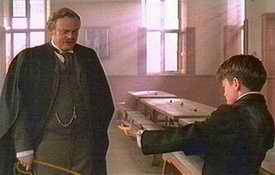
|
|
This'll hurt me more than
it hurts you Jenkins
|
|
That's right Mr Chips!
...Especially when I tell
'em you're a paedo!
|
All adults who work or volunteer with children must have abuse allegations made against them investigated by council officers and kept on file until they retire, even if they are totally groundless.
Local authorities around the country are
setting up databases to hold records of accusations made about anyone from teachers and doctors to Scout leaders and private tutors.
They are employing staff just to look into the claims - which can be made anonymously - who are required to
contact police, social services or the adult's employer and then keep track of the case.
Details of the allegation will be kept on the accused's personnel file until they retire so they can be seen by potential employers, and in a reversal of the
basic tenet of English law they will only be deemed innocent if they can prove it.
It comes on top of the new vetting system being implemented for everyone who works with under-16s, the Independent Safeguarding Authority, which will lead to 11.3
million adults having their backgrounds checked.
Professor Frank Furedi, a sociologist at the University of Kent, said: Those who are accused may become the lifetime victims of these allegations. It then creates an incentive to make those
sorts of accusations by people who know it can affect someone's career. This will play into the hands of those who believe there is no smoke without fire.
Following the Bichard inquiry into the murders - which called for the creation of the
new nationwide vetting body - the Government published guidance which told local authorities to do more to investigate allegations of harm of children. Since then they have been recruiting Local Authority Designated Officers whose job it is to record and
monitor allegations of abuse.
They must investigate any claim that an adult who works with children - whether self-employed, business staff, volunteers or public sector employees - may have harmed a child or committed a crime against them.
The LADOs have to tell the employee's manager about the allegation, as well as the complainant's parents, and decide if police or social services should get involved.
They track the claim to ensure it is resolved, and record whether it has
led to disciplinary action, dismissal or a criminal prosecution.
Councils are told to keep a "comprehensive" summary of the allegations, which should be given to the accused as well as kept in a person's confidential personnel
file... at least until the person reaches normal retirement age.
Definitions make it difficult for an employee to remove all suspicion. The guidance states that unsubstantiated does not imply guilt or innocence , just a lack of
evidence, while for a claim to be classified unfounded or malicious the council must have evidence to disprove the allegation.
|
11th September
2008
|
|
|
|
Adults without children discouraged from public parks
|
Surely discouraging adults from parks will end up reducing the natural policing. It could end up with them feeling lonely, threatening and inhabited by gangs/groups of youths. Based on
article from shropshirestar.com
|
Council staff have been ordered to stop and quiz any adults found walking in Telford Town Park without a child.
Anyone who wants to go to the park but is not accompanied by at least one youngster will have to explain why they are there.
Telford campaigners battling to retain full public access to the park today branded the policy
draconian and authoritarian madness but the council defended the policy, claiming it had a responsibility to protect the vulnerable.
The policy came to light after two environmental campaigners dressed as penguins were thrown
out of the park last month when caught handing out leaflets on climate change.
Telford & Wrekin Council said Rachel Whittaker and Neil Donaldson of the Wrekin Stop War pressure group were ejected because they had not undergone Criminal Records
Bureau checks or risk assessments before entering the park.
David Ottley, Telford & Wrekin's sports and oppression manager, said in a letter seen by the Shropshire Star: Our Town Park staff approach adults that are not associated with any
children in the Town Park and request the reason for them being there. In particular, this applies to those areas where children or more vulnerable groups gather, such as play facilities and the entrances to play areas. This is a child safety
precautionary measure which members of staff will continue to undertake as and when necessary.
Former childcare social worker John Evans said: It is authoritarian madness which can only be based on ignorance. It appears that the council
wants to use child protection as a cover for anything they don't like taking place in the park, like the campaign against global warming by those two people who were handing out leaflets. It is absurd, it is insulting and what's more it is dangerous as
it panics people about the dangers their children face. Councillor Denis Allen, cabinet member for community services, said: Our staff are asked to approach adults without children in areas where children gather such as play areas, using their
own judgement and discretion. Comment: Telford Bulldozer through their Park Policy 11th September 2008, thanks to David According to someone who lives in the area:
This is a little deeper than you know. The Telford Town Park was recently almost built over under first a labour administration and under the first few months of this Conservative administration. A gentlemen went out
into the park to leaflet people to let them know what was going on. He led a campaign that was politically embarrassing to the council and its authorities and they confiscated the leaflets and stopped him handing them out.
He demanded an apology
and an explanation.
When the council were pressed for a reason why they took this action, after many, many attempts to get a reply, the officers came up with this "policy" as the reason. It's junk made up after the fact to justify what
was in effect an attempt to silence somebody who didn't agree with their development plans.
Now the same guy raised and won a parish referendum. It made enough fuss and garnered enough support, with others, to cause the council to rethink the
policy. Though the Park is not certain to be saved in its entirety the position is now much more secure.
When the two environmental protesters came into the Park dressed as Penguins, the council were stuck with their recently made up policy and
enforced it. So earning themselves a rebuke from the Home Office as well.
|
20th August
2008
|
|
|
|
|
Malicious gossip could cost you your job See article from theregister.co.uk
|
26th July
2008
|
|
|
|
|
Criminal record checks could hit over 14 million people See article from theregister.co.uk
|
15th July
2008
|
|
|
|
Mother stopped from travelling with son in taxi to school
|
One has to wonder if the inevitable distrust and loathing of authorities caused will do more harm than good for society. Based on
article from the Daily Mail
|
A mother has been barred from travelling in the taxi provided by the council to take her own son, Alex, the five miles to school. Her offence? Not to have had a Criminal Records Bureau check.
Mrs Jones has fallen foul of the council's
policy which considers anyone travelling with the teenager to be working on its behalf and, therefore, obliged to have CRB clearance.
Now Alex, who has cerebral palsy, must travel alone until his mother passes the police check.
The
Merthyr Tydfil Council Pedantry Officer said: The CRB checking is a requirement of our transport provisions in relation to adults travelling on home-to-school transport in the capacity of an escort.
This is a standard requirement and has been
for several years. Any adult acting as an escort will, in the public gaze, be viewed as acting with the full acquiescence of the council and hence with its implied authority.
For the protection of the council and all vulnerable persons in its
care it's essential all those endowed with an authority, implicit or explicit, should meet the security requirements within the transport contract provisions.
A recent study has warned that the rapid spread of child protection checks and
health and safety rules has 'poisoned' relations between adults and children and left youngsters at greater risk. It said CRB checks and the rise in other regulation have fuelled an atmosphere of suspicion and left adults afraid to intervene or take
responsibility.
|
7th July
2008
|
|
|
|
700 innocent peopled wrongly deemed unsafe to work with kids
|
Based on article from the Telegraph
|
Hundreds of innocent people have been wrongly branded as criminals by the Government agency set up to vet people working with children, The Daily Telegraph can disclose. Thousands of people are being forced to have multiple CRB checks for
different jobs because the checks are currently not transferable
People applying to take up jobs as teachers, nurses, childminders and even those volunteering to work with youth groups are likely to have been among those falsely accused of
wrongdoing by the Criminal Records Bureau (CRB).
Those wrongly accused by the CRB face having their careers blighted or being stigmatised by their communities. They also face having to endure an appeals process to clear their names.
Article
continues
The CRB, an agency of the Home Office, was set up to vet those working with children or vulnerable people. It carries out checks on criminal convictions, cautions and reprimands, while an enhanced check also examines any other
information held by local police forces.
However, figures seen by The Daily Telegraph disclose that in the year to February 2008, 680 people were issued with incorrect information on their background checks by the CRB.
The disclosure is
likely to deter many from applying for positions which require a check.
The Daily Telegraph has further learnt that the CRB agency is plagued by delays and mistakes which is jeopardising its efficiency. It is the latest Government agency to face
questions over its handling of sensitive personal data.
Last night, the Conservatives said that blocking innocent people from working with children was "completely unacceptable" and that the CRB needed an urgent overhaul. It has also
emerged that:
David Ruffley, a shadow Home Office minister, said: Nearly 700 mistakes that could ruin people's lives is 700 too many. There is an emerging crisis of public confidence in the handling of this public information.
The
Home Office admitted that mistakenly branding innocent people as criminals was "regrettable".
A Criminal Records Bureau spokesman said: The Criminal Records Bureau's first priority is to help protect children and vulnerable adults,
and we will always err on the side of caution to help ensure the safety of these groups.
|
28th June
2008
|
|
|
|
11 million potential child abusers to be vetted in Britain
|
Based on article from the Telegraph
|
A quarter of the adult population faces vetting in an escalation of child protection policies, according to a report.
The launch of a new Government agency will see 11.3million people vetted for any criminal past before they are approved to have
contact with children aged under 16.
But the increase in child protection measures is so great it is "poisoning" relationships between the generations, according to respected sociologist Professor Frank Furedi.
advertisement
In a report for think tank Civitas, he said the use of criminal records bureau checks to ensure the safety of children and vulnerable adults has created an atmosphere of suspicion.
As a result ordinary parents - many of whom are volunteers at
sports and social clubs - now find themselves regarded "potential child abusers".
Professor Furedi said most adults now think twice before telling off children who were misbehaving, or helping children in distress for fear of the
consequences.
He said that the need for the checks had transformed parents in the regulatory and public imagination into potential child abusers, barred from any contact with children until the database gives them the green light.
From next year the new Independent Safeguarding Authority will require any adult who come into contact with children or vulnerable adults either through their work or in voluntary groups to be vetted.
But Prof Furedi's report, Licensed to Hug, highlighted examples of when adult-child relationships were distorted by the need for CRB checks already being required by schools and other organisations.
In one example, a woman could not kiss
her daughter goodbye on a school trip because she had not been vetted. In another, a mother was surprised to be told by another parent that she and her husband were "CRB checked" when their children played together. In a third example, a father
was given "filthy looks" by a group of mothers when he took his child swimming on his own.
Prof Furedi details how one woman was made to feel like a "second class mother" because she was barred from a school disco because she
did not have a CRB check.
Prof Furedi, a sociology professor from Kent University, said that adults are no longer trusted or expected to engage with children on their own initiative. When parents feel in need of official reassurance that other
parents have passed the paedophile test before they even start on the pleasantries, something has gone badly wrong in our communities.
We should question whether there is anything healthy in a response where communities look at children's
own fathers with suspicion, but would balk at helping a lost child find their way home.
Figures show that volunteering is on the decline with 13 per cent of men saying they would not volunteer because they were worried people would think they
were child abusers, according to a survey last year. The report comes after Children's Commissioner, Sir Al Aynsley Green, said 50,000 girls were waiting to join the Guides because of a shortage of adult volunteers, partly caused by the red tape of the
CRB process.
|
7th May
2008
|
|
|
|
Teaching becomes a particularly risky career choice
|
See full article from the
Daily Mail
|
A headmaster caught fishing with an out-of-date rod licence is waiting to hear if he will lose his job for having a criminal record.
Bob Yeomans described his predicament as 'child protection gone mad' after his conviction for forgetting to renew
the £25 permit was referred to a council panel.
Yeomans, the head of St John's Church of England Primary in Walsall for 26 years, was caught by a water bailiff last summer while on a fishing trip on the Dove in Derbyshire. Horrified at his
oversight, he immediately pleaded guilty. He later paid a £50 fine and £70 costs and considered it the end of the matter.
But almost a year later the offence was flagged up by the Criminal Records Bureau following a routine background check.
The chair of governors was notified there could be an issue with a CRB check and rang to tell me, Yeomans said. I said, 'Is it a member of staff?' and he said, 'No, it's you'.
I was shocked. In effect, he was being asked if I was
fit to work with children for forgetting to renew my rod licence.
As required by procedure, the chairman referred the matter to a council panel that decides whether staff can continue teaching.
It's a bit of a joke in the school
now, he said. But you'd have thought someone would have had some common sense at an earlier stage. It was just child protection gone mad. It was clear the offence was irrelevant.
Mick Brookes, of the National Association of Head
Teachers, said: He forgot to renew his fishing licence... that is the level of trivia that is bedevilling us all - it's petty.
A spokesman for Education Walsall, part of the Serco group which runs education with the council, said the panel
dealing with such cases looked at factors including the seriousness of the offence or allegation, the history of offences and time since the event in question. In the vast majority of cases, a positive trace will not mean that a person cannot be
employed or continue to be employed.
|
|
|