|
|
James Ferman's unpublished policy to ban chainsaws
|
|
|

|
7th August 2001
|
|
|
From the sadly defunct Ban the Board of Film Censors
|
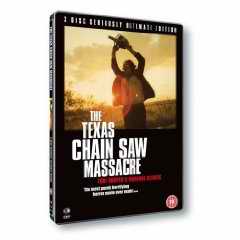 Censorship is revealed to be an unworkable concept when censors change their minds about what is permissible. If material is deemed dangerous, corrupting, imitable, etc., then surely it must remain so, regardless of whether it's 1901 or 2001?
But if, as seems to be the case, material can be reassessed and judged harmless, then it stands to reason that it was harmless in the first place, and the argument for censorship collapses. Let's look at the farrago caused by the Texas Chainsaw films,
which has managed to prolong itself for nearly thirty years.
Censorship is revealed to be an unworkable concept when censors change their minds about what is permissible. If material is deemed dangerous, corrupting, imitable, etc., then surely it must remain so, regardless of whether it's 1901 or 2001?
But if, as seems to be the case, material can be reassessed and judged harmless, then it stands to reason that it was harmless in the first place, and the argument for censorship collapses. Let's look at the farrago caused by the Texas Chainsaw films,
which has managed to prolong itself for nearly thirty years. The original Texas Chainsaw Massacre created quite a stir before it arrived in the UK in 1975. This was not because it was the goriest film ever made. It wasn't by a long chalk;
someone cuts his hand during the first twenty minutes and the rest of the blood-letting happens off screen. No, the talk was that the film was reputed to be one of the most frightening ever made; many viewers and most critics found it so, although some
people thought it hilarious. James Ferman, newly appointed secretary of the BBFC, was very influenced by this advance publicity. He convinced himself that there was no way that the sustained terrorisation of a young woman could have a beneficial
effect on the British public. Well, correction here. He was worried about the effect on the British working class. After the film had been shown, uncensored, to members of the British Film Institute at the London Film Festival, Ferman got up on stage
and, thinking he was among friends, said, "It's all right for you middle-class cineastes to see this film, but what would happen if a factory worker in Manchester happened to see it?" When they heard this gaffe, the
audience became hostile, and Ferman was visibly shocked. He never again referred to the true nature of his job as a censor - to stop working class people being stimulated by controversial films. Instead, for the rest of his interminable office, he
fortified his unassailable position as guardian against the abuse of women. This attitude did not always extend to his treatment of female employees, many of whom found his attentions objectionable. But away from Soho Square, during his many public
engagements, Ferman became scrupulously politically correct. He was still wittering on about feminism when he retired in 1999. The Texas Chainsaw Massacre , the film that had so shocked the inexperienced censor, became Ferman's bete noire. He, and
only he, banned it and saw to it that it stayed banned. A legend grew up around his supposed condemnation of chainsaws. Reputedly the instrument could not be featured or even referred to in any film.
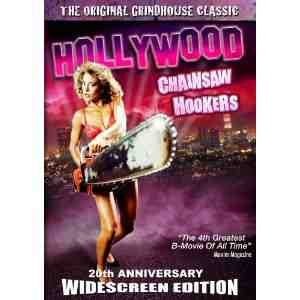 But was this a myth? Ferman certainly forbade other weapons - most famously chain-sticks - but never issued a written instruction about chainsaws. Nevertheless, folklore had it that Ferman was trying to obliterate the lumberjack's tool from
British cinema history. In 1983 a chainsaw murder was cut from Scarface . In 1986 The Texas Chainsaw Massacre 2 was banned. In 1988 the organisers of a horror film festival seemed to believe that some kind of retribution would befall them
if they publicised the screening of a film which featured the forbidden word in its title. Hollywood Chainsaw Hookers was shown as Hollywood ******** Hookers . Madness appeared to be prevailing. It goes without saying that in 1990 even the
heavily cut version of Leatherface: Texas Chainsaw Massacre III was also banned.
But was this a myth? Ferman certainly forbade other weapons - most famously chain-sticks - but never issued a written instruction about chainsaws. Nevertheless, folklore had it that Ferman was trying to obliterate the lumberjack's tool from
British cinema history. In 1983 a chainsaw murder was cut from Scarface . In 1986 The Texas Chainsaw Massacre 2 was banned. In 1988 the organisers of a horror film festival seemed to believe that some kind of retribution would befall them
if they publicised the screening of a film which featured the forbidden word in its title. Hollywood Chainsaw Hookers was shown as Hollywood ******** Hookers . Madness appeared to be prevailing. It goes without saying that in 1990 even the
heavily cut version of Leatherface: Texas Chainsaw Massacre III was also banned. This unaccountable hysteria now seems to belong to the distant past. Chainsaws are part of the era that brought us Driller Killer s and Cannibal
Holocaust s, stupid films we weren't supposed to see, but which everybody saw because pirated videos were on sale at every other car boot sale. These films turned out to be very disappointing indeed. They were supposed to be dangerous and harmful but
quite patently most of them were just bad. The censor has an unpopular job. One of the ways in which he can sustain himself in power is to pretend to be sympathetic to public opinion. Robin Duval would have done himself no favours had he appeared
to be as batty as his predecessor and maintained his now ludicrous conviction that the mere sight of a chainsaw inspires us to carve up our neighbours. Consequently, as soon as he got his feet under Ferman's desk, Duval made sure he distanced himself
from such fanaticism by passing uncut not only The Texas Chainsaw Massacre 2, which opened in cinemas October 5 to generally dismissive reviews, but also the fourth episode of the series, Return of the Texas Chainsaw Massacre , now on video.
Yes, it's official. These films aren't harmful at all. It was just that a crazy old censor, now completely discredited, was squeamish about them. But surely, therefore, isn't there a chance that the present censor is equally bonkers and that all his
senseless decisions will one day be overruled...?
" Censorship is belief that one's obscenities must be the obscenity of all "
- Jay E. Daily, The Anatomy of Censorship, 1973.
|
|
|
James Ferman, retired BBFC director, looks back on 25 years at the cutting edge of entertainment
|
|
|
|
|
20th December 1999
|
|
|
From the Independent
|
 When I took the job of "film censor" in 1975 - my tenure came to an end last month - I was warned to forget about following public taste: any decision I took would be too lenient for some, too strict for others. Nearly a quarter of a century
later, the situation is much the same - as this weekend's Channel 4 special on censorship has shown. However, though society is still polarised, at least the grey areas in between have shifted. Nudity is no longer an issue, and sex is far more
acceptable, in the right context. Even bad language is less contentious - people still find it offensive, but the words objected to are arguably far stronger than 20 years ago. Some call it freedom.
When I took the job of "film censor" in 1975 - my tenure came to an end last month - I was warned to forget about following public taste: any decision I took would be too lenient for some, too strict for others. Nearly a quarter of a century
later, the situation is much the same - as this weekend's Channel 4 special on censorship has shown. However, though society is still polarised, at least the grey areas in between have shifted. Nudity is no longer an issue, and sex is far more
acceptable, in the right context. Even bad language is less contentious - people still find it offensive, but the words objected to are arguably far stronger than 20 years ago. Some call it freedom. In recent years I have come under strong
personal attack from various newspapers, especially those that specialise in frivolity and family values. But my early years as director of the British Board of Film Censors - its name was changed to the British Board of Film Classification in 1985 -
were not accompanied by press carping. In those days we were seen as a modern, campaigning body. In the late 1970s we helped to reform obscenity law; in the 1980s we were largely responsible for sweeping away "video nasties"; and we laughed off
Monty Python's Life of Brian by passing it uncut for teenagers. But the religious right struck in 1988 over Martin Scorsese's Last Temptation of Christ, whipping up a tabloid storm over allegations of blasphemy, even before the film arrived in
Britain. When I suggested mildly to a journalist that prominent churchmen might do better to see the film before commenting, it drew the front-page headline: CENSOR SAVAGES BISHOPS. I responded by inviting 28 church leaders in to see the film, including
five Anglican bishops. They all agreed it was not blasphemous at law, so the furore receded. But not for long. In the 1990s, a new wave of screen violence coincided with a rise in juvenile crime. Videos became the scapegoat, and video regulators
the villains - too liberal for the tabloids and too strict for the arts crowd. The Jamie Bulger killing traumatised the nation, and the press was quick to allege corruption of the two child murderers by video violence. As tension grew, two more brutal
crimes were attributed to videos, and it took some months for the Home Office to research the evidence and report in Parliament that "the police reports did not support the theory that those crimes had been influenced by exposure either to any
particular video, or to videos in general". Unfortunately, truth is no bulwark against insidious rumours, and the allegations were stubbornly and mischievously recycled over the next few years. The BBFC had become a good story, the stuff of
Parliamentary debate, rent-a-quote MPs and tabloid hysteria, fuelled every year by one or two contentious titles. A climax was reached in 1997 when examiners were doorstepped by Daily Mail photographers as they left home to take their children to school.
A gallery of mugshots was printed along with scurrilous condemnations of each for having put the social fabric at risk by passing Crash - in retrospect a non-event, since few bothered to see it. I was the chief culprit. "Does nothing appal
this man?" asked the Daily Mail. Well, yes, I murmured, rape as entertainment appals me, mutilation and torture appal me, as I've made clear year after year. I've always carried the can for Board decisions, even though most of them were reached by
consensus. Crash was a unanimous decision, as was the decision to release The Idiots (with its nude orgy) uncut. But I was hired on the understanding that the buck stopped with me. What this meant became clear within weeks of my joining when both my
predecessor, Stephen Murphy, and the Board's long-serving president, Lord Harlech, stood in the dock at Bow Street accused of aiding and abetting an indecent exhibition. What they had done, after lengthy deliberation, was to pass a sex education
film called Language of Love. They were swiftly acquitted, but the film was referred to the Old Bailey, and I spent much of the next year preparing its defence. Again we won, and the following year, 1976, I led the campaign on behalf of the local
authorities and the film industry to bring films within the Obscene Publications Act, which meant that at last, in 1978, the courts would have to consider films as a whole, just like books and plays. It also meant that artistic merit could be argued in
defence and that the test of criminality would no longer be offensiveness, but harm to the morality of a significant proportion of the likely audience. The "deprave and corrupt" test could have been conceived to hold the line against the
exploitation of sexual violence and torture, the biggest problems of the 1970s. It might also have been framed to provide the ideal weapon against the video nasties of the 1980s, where it proved its effectiveness repeatedly. I set out to establish
within the BBFC a framework of full and frank debate. We recruited examiners who could argue their case vigorously and professionally, and we encouraged diversity to ensure a broad range of opinion, with every reasonable point of view likely to be put by
the public canvassed first within the Board. We know that taboo themes, like those of Crash and Lolita, will engender controversy, but in a free society there should be no such thing as a taboo theme, only taboo treatments. In the 1970s, exploitation
film makers were often irresponsible in their treatment of rape and sadism. Today, under a stricter censorship of sexual violence, such problems are far less frequent. Last year the Human Rights Act wrote into British law the Freedom of Expression
provisions of the European Convention on Human Rights. This, for the first time, puts the burden of proof on the censors, not the film makers. But unlike the American Bill of Rights, the Act recognises that freedom may need curtailing "to prevent
crime or disorder" or "to protect health or morals". This echoes the 1994 amendments to the Video Recordings Act, which require the Board to consider "harm to potential viewers or, through their behaviour, to society". It is a
good test, and one we have applied responsibly. Having suffered my own share of heavy-handed censorship as a television director in the 1960s and 1970s, I took pride in transforming the BBFC from a board of censors to a board of classification.
Few cinema films are cut these days, with the numbers declining from 40 per cent in 1974 to under 4 per cent in 1998. On video, cuts are averaging about 8 per cent of the total, reflecting the stricter standards for viewing in the home where there is far
less control of audience age. But if I began by refusing to cut works of art, I learned very quickly that art had little to do with violence or sexual violence or crass commercial exploitation. Violence is still the thorniest problem: to what
extent should the goal of free speech vindicate scenes of brutality and blood-letting? Even in America, judges have begun to wonder if the test of "clear and present danger" remains adequate to stem the drip-drip effect of "designer
violence" on inner-city teenagers with access to guns. I'll be glad to say goodbye to the violence of contemporary films and videos. Sex is a different matter. In the last quarter century, both the Board and the British public have begun to
accept increasingly frank depictions of sex on the screen. No sexual image has been cut from any cinema film in the last 10 years, and explicit sex education tapes now cause little comment on the shelves of W H Smith. But pornographic videos that offer
non-violent sex between consenting adults as an aphrodisiac are still treated as criminally obscene by the police and Customs and Excise. The Board believes such material should be classified for adults-only sex shops, and last summer the Video Appeals
Committee supported this view by granting a sex shop certificate to just such a video. The extent to which this can be treated as a precedent is the subject of much high-level debate. If this approach is disallowed, then sex entertainment will be
relegated once again to the black market jungle, where pornography is mixed with violence and degradation in a manner which is scarcely conducive to a healthy society. I have no wish to encounter pornography ever again once I leave the Board, but
24 years have not convinced me that the meagre pleasures offered by voyeuristic sex are harmful to those who seek them out, provided the sex is legal, consenting and non-violent. Society has far more important things to worry about, and we should stop
wasting public money pursuing non-violent pornography through the courts.
|
|
|
One of James Ferman's final lectures before retirement was addressed to the British Film Academy
|
|
|
|
|
10th December 1999
|
|
|
From the Evening Standard
|
We began the night with the shark from Jaws eating Robert Shaw. James Ferman first saw it a few weeks before he became film censor. How could I pass this as a PG? he asked himself. It would give children nightmares. So, as censors do, he
rushed off to a child psychiatrist, who said, What's so bad about nightmares? It's just kids working through their problems. So Ferman passed it PG, and Jaws is now family folklore . Mind you, he did cut out the shot of Shaw spewing
up blood: it gave him nightmares. So began the learning curve, steep and swift, of the man who recently retired from the BBFC. He was giving his valedictory address last week at the British Film Academy. It lasted over three hours, and by the time
I went home we hadn't even got to Crash . Very instructive it was, too, in ways that perhaps censors cease to appreciate. For what the evening's strange mix of experience and innocence confirmed again and again was the British genius for hypocrisy
- for sanitising some of the lewdest, most degenerate and horrific material submitted for a censorship certificate so that the film companies selling it could take their profit without undue offence to public decency. I saw Ferman not in a new
light, but in a clearer one: not so much a film censor, more a trading standards officer for the film industry. Only reasonable, of course, since it's still the trade that appoints British film censors to be judges in their own cause. "Rape," said Ferman next.
There was a lot of it about in the Seventies . We then saw a lot of it: Emmanuelle raped in an Indonesian bordello, Emmanuelle raped in a Tokyo cabincar. And an Emmanuelle-type raped, whipped and branded on her bottom in the French classic The
Story of 0 , which Ferman advised on in the so called "rough cut". We saw how much rape there had been: Ferman attributed it to the backlash by male film-makers against the Women's Libbers . Anyhow, he wasn't having it, at
least not too much of it: especially not if the lady, after being gang-banged and buggered, simply adjusted her dress and went off as if it had been a thoroughly therapeutic experience. Rape without consequences was dangerous fantasy stuff: it was OUT.
Then he showed the piece de resistance of the genre, though that phrase is not very apt since the two women raped in Michael Winner's Death Wish 2 could put up next to no resistance at all to the gibbering multi-racial rapists
who gang-banged them fore and aft. I cut three minutes 42 seconds of that stuff , said Ferman, a record I think. Winner was furious. We then saw "that stuff" uncensored and really it did look the worst screen violence against
women I've ever seen. Winner, we were told, later became "Censorship Officer" for the Directors' Guild. "Nudity," Ferman went on, " doesn't seem to bother many people nowadays. " Usually the bare bottom is at
the bottom of the list; female tops are there, too. Violence, drugs, swearing - those are the great British worries. Ferman was told that one producer, a very big name in Hollywood, previewed his ultraviolent films to the worst elements in Los
Angeles and, when he noted their attention wandering, snipped away at the film until it was an uninterrupted series of violent acts: no compassion got a look-in. But what could Ferman do with such people? What he'd done was to "classify up",
not reject a movie, but censor it a bit for older age groups. It wasn't a perfect solution. But that's what he was paid to do, and now with the Convention on Human Rights a part of British law, it would mean his office couldn't take a high hand and
reject what it considered obscene out of hand: it had to be made decent. That's what freedom of expression meant. The certainty that this is what it meant became a little less certain when he showed a clip from the Stallone thriller Cliffhanger
, which had Craig Fairbrass using a man's head as a football. Fair-brass, one gathered, was a very popular character in London's East End, and it hurt Ferman to deprive him of his spectacular run-up to the prostrate victim, all the while doing a
jaunty little soccer-style commentary, before kicking the man into goal. Ferman took out most of his kicks, but preserved the entire sequence for his private collection and has shown it with great effect to MPs and others. I show them the cut version
first, which looks bad enough. Then I show them the uncut version. That clinches it: the MPs all cheer the censor's team. We were wondering at this point when penises were going to enter the discussion. Now they did. He told us how he'd been
courageous, yes courageous enough to give a certificate to the Japanese film Ai No Corrida (In the Realm of the Senses) , a story of perverse love, in which a man and woman go the limit - the limit being reached when she strangles him
"with his permission", said Ferman, which made it all right, and castrates him. He showed us the scene where she fellates him, erect. The lawyers had said it would not tend to corrupt and deprave a significant number of people. It looked so
ugly, I could believe it. But problems arose when the same lady began pulling a naked child's pubescent penis, hurting him. Couldn't pass that: the Protection of Children Act, and all. So Ferman had what he called "an optical" made, that
enlarged the area around the child's private parts, but left the latter out of sight below the level of the cinema screen. A triumph of trompe-l'oeil art. So with this reconciliation of art and commerce, the evening ended with great
applause and a vote of thanks from the film people whose wares Ferman had perused, purified and passed over for 23 years. Perhaps only Michael Winner would have sat on his hands.
|
|
|
And getting the de-criminalisation ball rolling
|
|
|
|
|
1st December 1999
|
|
|
|
|
Watching all the currents within feminism is very interesting. We can't ignore what's happening; and I would say that in the seventies, we actually led it , says James Ferman. The GLC often showed films that we had refused certificates to.
But in the eighties Valerie Wise convinced Ken Livingstone (then leader of the GLC) that he'd been wrong and they withdrew all the certificates they'd ever given. That was two years before the GLC was abolished! We noticed the number of
films, particularly in porn, in which women were forcibly stripped at gunpoint or knifepoint and raped. They were eventually, as they say, screwed into submission, threw their arms around their attacker and thanked him for this glorious liberating
experience. Plainly, the message in these films was that when a woman says no she really means yes. The BBFC decided that the material was depraving and corrupting. It was not a message about rape that ought to be propagated. these films
were all for men - so we laid down a policy that we would not accept that message in porn. Serious films make their own rules. I don't think you can have rules about serious films, but you can have rules about a genre like pornography . Ferman
pioneered the cinematic release of Ai No Corrida a few years ago and stresses the distinction between quality films and those which are apprehended rather than comprehended. Pornography is a generalising medium, it doesn't exactly promote
intellectual messages. Anyone who has taken a media studies course during the eighties will probably know about the male gaze. For feminist film theorists, it was fundamental to the way Hollywood misrepresented women. Whilst male characters
were shot head-and-torso entire frame, the camera would linger on parts of women's bodies for no obvious narrative reason. Pornography was seen as the most extreme example of the way cinema privileged the male gaze at the expense of women. For
feminist theorists like Professor Linda Williams, demonising male voyeuristic pleasure in this way created its own problems. Its moral distinction between 'normal' and 'perverse' subjectivities, she says, is what led some feminists to line up with the
anti pornography crusades of the moral right. She is one of a growing number of 'pro-porn feminists' who claim that the way to challenge the anti women messages in porn is not to 'just say no' to everything sexual. Williams wants to create
alternative material which shows women as active sexual agents, given the licence to define 'a desire of one's own'. This not only brings her into confrontation with the vociferous pro-censorship lobby in the US, but also challenges the conventional
distinction between soft and hard core pornography. Linda Williams, in her book Hard Core, contends that pornography is a genre which has changed since the seventies. It often contains a perverse dynamic that undermines notions of phallic
supremacy . She concludes that it is in the profusion rather than the censorship of pornographies that resistance can be found to the dominance of the heterosexual, masculine, pornographic imagination .' Ferman has shared many a
pro/anti-censorship debating platform with Williams. A last- minute phone call from him once rescued material from the hands of British customs. He remains unconvinced by her arguments. Linda comes out of an American perspective , he counters,
where no matter what you feel, you have to be anti-censorship because censorship has been used by the likes of Senator McCarthy in such intolerable ways. The last thing any American can be is pro censorship...but I'm afraid that men who are potential
rapists are turned on by films that reinforce that propensity . Has he seen any of the change which Williams describes? We see an awful lot of porn, we don't see many films with complex characterisation . In the United States, 40% of
mail-order video porn is said to be bought by women and it has a growing popularity amongst middle-class couples. Candida Royalle is an ex-porn star who set up her own film company, Femme Productions, to make pornography which addresses this new market,
including the work of 'post-porn, post-feminist performance artist', Annie Sprinkle. For these Ferman has unqualified enthusiasm. The people she's assembled around her are all talented. It looks nice, it's about people, they look at each other, their
eyes talk to each other. In most porn you don't get that - in fact you hardly get any faces. The reason Femme videos, which have won awards from the American Association of Sex Therapists, were not released here turns out to be a uniquely
British combination of prudishness and politics. Explicit sex cannot be passed in the '18' category for sale in ordinary video shops. The 'R18' category, which means restricted supply through licensed sex shops was proposed in 1984 by Tory MP Graham
Bright. We argued very hard for it as a liberal safety valve, but in the end, the Home Office sided with those who were against it , recalls Ferman. In the Standing Committee, the motion won by a landslide but the Home Office persuaded Bright to
accept minor changes in the wording. Instead of simply saying, 'To be supplied only through sex shops', they wanted the legend to read, 'To be supplied only in licensed sex shops', which meant no mail order sales. There were only about 80 licensed
sex shops in England, one in Wales and none in Scotland or Northern Ireland. Although more liberal local authorities do not require sex shops to be licensed, this means they are unable to sell 'R18' material. 'So effectively, what we ended up with was a
category which was open only to the chain of shops which had enough clout financially to corner the market and get the few licences that were going. It turned out not to be politically advantageous for councils to grant too many licences because there
were no votes in pornography. Most of the pressure on local politicians is part of the NIMBY syndrome. Pride Video has succeeded in breaking out of this legal triangle and has four explicit safer sex videos on sale in WH Smith. These are
health education videos. We have to distinguish between them because the law does so...if something is in the interests of art, science, literature or learning, it has an advantage over something which is just entertainment. Yet Ferman would not be
drawn into advocating change. It's not a question of being happy with it, we have to live within the law and that's what the law is. He claims that almost all videos submitted by gay and lesbian production companies like Pride, Pout, and
Dangerous to Know are passed uncut, adding, I think it's a great pity that we haven't got a viable sex shop category. I wish that some gay companies would open some gay sex shops and I wish some women would get together and open a chain of women's
sex shops because there is room or sex entertainment for women and gays of a kind which I believe would be legal in a licensed sex shop if we classified them as such, but at the moment they are just not commercially viable. But is the
marketplace to blame for all the anomalies within British censorship? What about the fact that erections cannot be shown, for instance? Not true, claims Ferman. It's police custom and practice that's led us to believe that there's a law against it.
The police have a checklist approach where, if there's an erection, they assume it's getting towards being obscene and if there's a penetration shot, it's obscene. If you ask them why penetration is obscene, they have no answer, it's just that in their
book, it always has been . Sado-masochistic porn, according to Williams, rarely shows genital sex but tends to be more concerned with rituals of sexual power. While she draws on psychoanalytic theory to argue for the progressive importance of
the feminist lesbian sadomasochist, for Ferman, SM brings to mind a spate of mid-eighties concentration camp videos, SS Experiment Camp, The Gestapo's Last Orgy and Nazi Love Camp 27 from Italy and Germany. When you see as much of that as we do, you
have hard and fast rules that don't allow eroticised sadistic treatment of women. Certainly the worst sadistic stuff is coming from Germany. I don't understand why, but clearly there must be women who do this for a living . Their bodies must be
so distended after they've done a couple of years of it. They get hauled up on chains, weights are hung from their labia and nipples and they are pulled down so far that they must surely lose all elasticity... ' He recalls one video like this called
Extreme Torture, which he banned, only to discover it in a very middle-class, very respectable, pedestrian precinct in the centre of the Hague . His German counterpart told him that They may be made in Germany, but they can't be sold here
because of our constitution . This states that any media product which glorifies violence is illegal. If it makes violence seem sexy, that qualifies, concludes Ferman, so they make it and export it . As for films portraying
dominant women, Ferman says, If it were an exploitation film, we would still be very careful about it. We have quite a lot of sub/dom films. The first one we got was called Thigh and Squatting Power, simply about a big strapping woman who sat on
little men and squeezed their heads between her massive thighs. It's easier to pass when the woman is on the dominant end because it doesn't reinforce the power relationships in society, but we don't like the idea of young women being seduced into
allowing themselves to be tied up or put in a position where they can no longer withdraw their consent. We've always said that if someone could teach us a way to be liberal on masochism without being liberal on sadism, we would do it . While
there is clearly a huge gulf between the sensibilities of people who buy the atrocities that Ferman describes and those who opt for the 'bisexual pornutopias' described by Williams, concepts like 'soft-core' versus 'hard-core' do little to clarify it.
They shed even less light on the issue of power relations in sexual imagery. If images of inequality are so powerful once made sexually explicit, then isn't this precisely the area that women should seek to subvert? And if governments wish to intervene
in favour of fairer power relations, why only in representations of sexual activity and not, say, in economics? Asked if he thinks Britain is a repressive society, Ferman replied, I think it's trying not to be, and I think the public are
prepared to go further than the regime within which we have to work and I think that the police are way behind public taste. But I have to say that when people occasionally try to break out of the straitjacket like the satellite channel, Red Hot Dutch,
you suddenly discover that there is a residual conservatism which comes out.
|
|
|
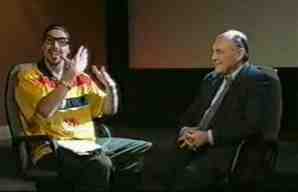
Ali G interviews film censor James Ferman
|
|
|
|
|
1st January 1998
|
|
|
See video from YouTube
|
From Channel 4's 11 O'clock show from 1998 or 1999
|
|
|